
¡Dios Mio Ricardo! It is a great pyramid!
Etowah Mounds National Historical Landmark is located on the Etowah River in Cartersville, Georgia (NW Metro Atlanta).
In 2004, when Pilar and I were visiting Etowah, only about 5% of the town’s area had been studied by archaeologists. The state’s official brochure for Etowah Mounds presented false chronological information. Its museum contained several displays, which directly contradicted what was discovered by those archaeologists.
Pilar stated that the principal earthen pyramid at Etowah Mounds was larger than any earthen pyramid in South America, except perhaps one or two in the Pacific Coastal Plain of Peru.
Few people are aware that there are several earthen pyramids in the Southeastern United States and Middle Mississippi River Valley, which are larger than most of the stone-veneered and earthen pyramids in Mesoamerica and South America,
The Great Pyramid of the Sun at Chichen Itza, Yucatan is 24 meters (79 feet) tall and was built around 1200-1300 AD. The Great Pyramid at Poverty Point, Louisiana was built around 1300 BC and was approximately the same height! No structure in Mesoamerica equaled the size of the mound at Poverty Point until around 500 BC.
In 2018, I would discover measured drawings of the Great Earthen Pyramid at Etowah Mounds that were made by a scientist from Yale University, Elias Cornelius, in 1818.
In 1818, the largest Etowah Pyramid was shaped similar to the Pyramid of the Sun, but 33 feet (10 m) taller and twice as large at the base. The other mounds at Etowah were quite different in shape than they appear today. What you see today are simulated mounds, created by Georgia State Parks Dept. laborers, with no input from the original archaeologists,
Between 1832 and 1886, the shape and size of Etowah Mound A was radically altered by (1) Cultivation of corn at the top of the mound, (2) Amateur art collectors, who paid to be allowed to dig in the structure, (3) The First Ohio Volunteer Infantry Regiment in 1864, who constructed artillery fortifications on top of the mound, during the four months that it was stationed within the archaeological zone, and (4) massive flooding, caused by a hurricane in the autumn of 1886 . . . which washed away the north and south ramps of the pyramid, plus deposited 15 feet (4.57 m) of silt over the base of the pyramid.
The Peopling of Eastern North America Series
by Richard L. Thornton, Architect and City Planner
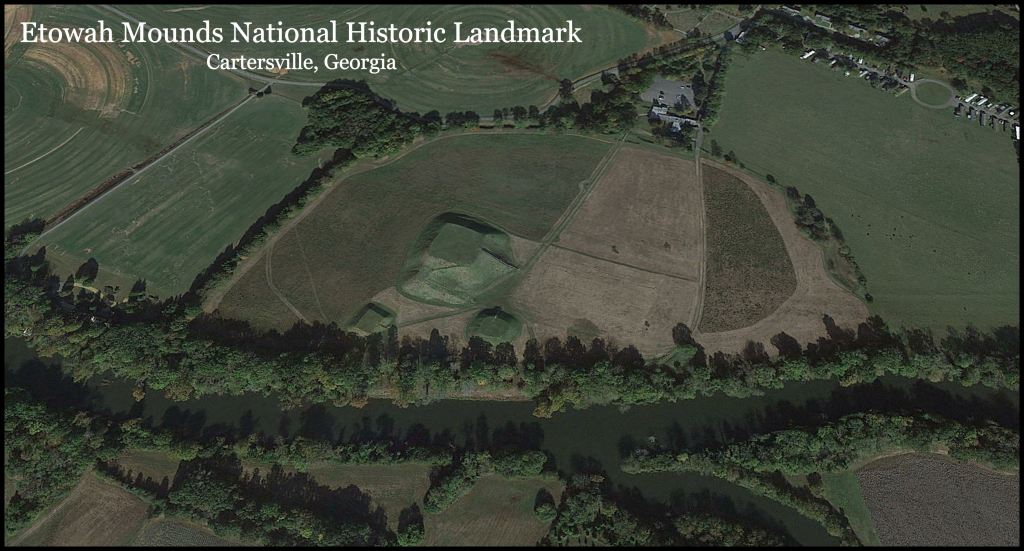
Etowah Mounds on Google Earth – There were at least 18 mounds at the town site originally . . . on both sides of the current location of the river. The lower mounds were diminished by cultivation of crops and by a 15 feet coating of river silt – See below.
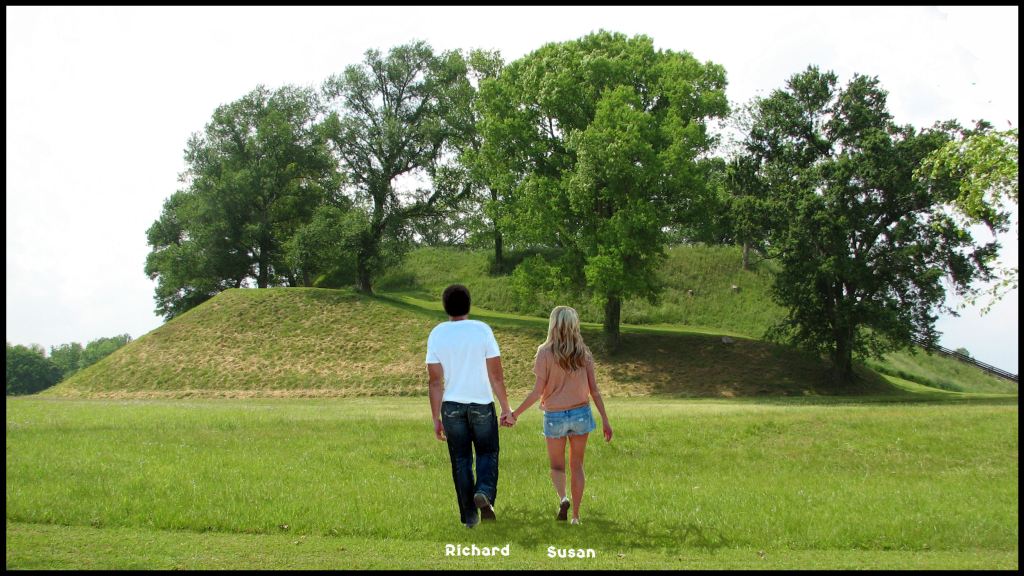
The South side of Mound A in 1998, when Susan Karlson and I were visiting the site. I lived near Etowah Mounds from June 1995 until December 1998. This is actually a staged photo. LOL Just before then, after knowing me for seven years, for the first time, Susan held my hand in public. I asked a tourist to take our photo at the same location, holding hands and walking together.

Mound A at Etowah Mounds in 2004 – A few years later, the giant trees were removed.

Ramp of Mound A in 1998. The actual base of the ramp and mound are 15 feet (4.57 m) below the surface. Massive flooding caused by a hurricane in the autumn of 1886 deposited a deep layer of silt over the Etowah Mounds Archaeological Zone.
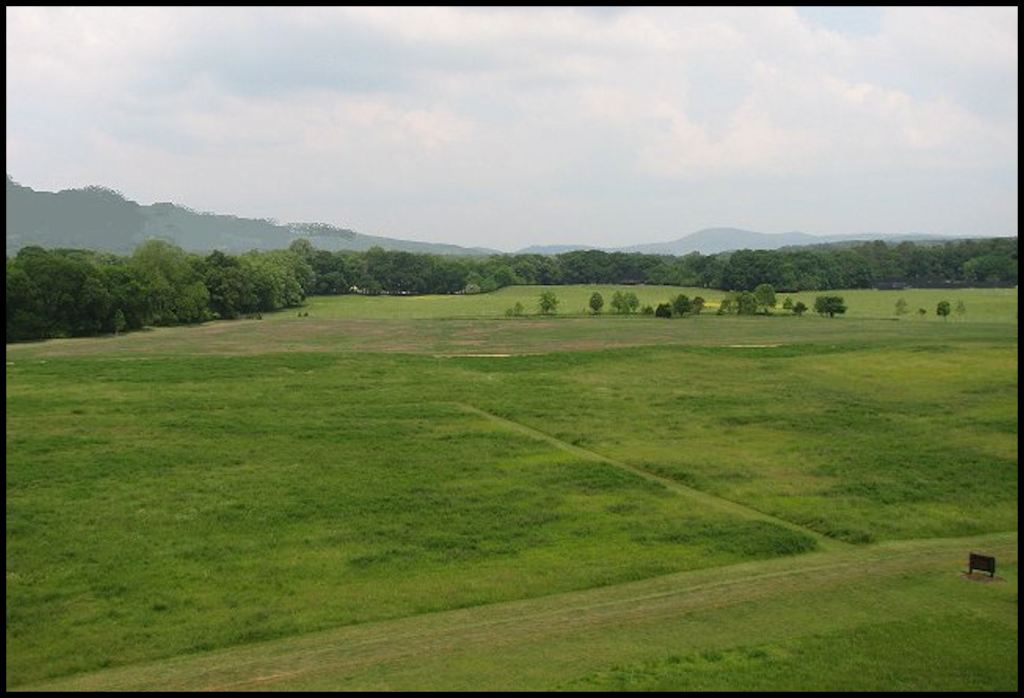
Panoramic view from the top of Etowah Mound A in 1998, when I was living in Cartersville and visiting the site with Susan Karlson. A few years later, a mega-millionaire’s mansion was built on top of a low burial mound near the river bank, just beyond the boundaries of the state-owned property. Several FEMA, National Park Service and City of Cartersville, GA employees, who refused to issue a building permit for this mansion in the primary Flood Hazzard Zone on top of Native American burials, were fired.

This is the appearance of the Etowah Mounds Museum in 2004. The wing that states, “Etowah Archaeological Museum” was added in the mid-1990s to the original structure designed by Georgia Tech architecture professor Julian Hoke Harris in the early 1960s. It was in classes, taught by Professor Harris that I learned how to hand-make Mesoamerican and Creek style pottery and statuary, It was also from Professor Harris that I learned the sacred symbols of the Creek People. I liked to put them on the buildings that he designed around the Atlanta Area.
Overwhelmed by the sheer size of the thing
All that I knew about Etowah Mounds in 2004 was what Drs. Kelly and Lawson had taught me from 1969 to 1972 or what was contained in their archaeological report. Therefore, I rummaged through my library until I found the 1957 archaeological report, so that Pilar would have something factual to go on when visiting the Etowah Mounds Museum.
Pilar’s university education provided very little factual information on the indigenous peoples of the Southeastern United States. She had no idea that their provinces included large towns, majestic pyramidal mounds or vast expanses of cultivated fields.
After paying for our tickets, Pilar insisted that we initially bypass the museum exhibits and walk straight to the largest earthen pyramid. She then insisted that we walk around the entire periphery of Mound A then climb the stairs to the top. Very few visitors walk along Mound A at its base. Only from that perspective can you really appreciate the scale and steep slopes of this Native American monument.

Visitors to Etowah Mounds today are told that this document never existed!
After visiting Mounds B and C, Pilar and I returned to the museum to view the exhibits with Drs. Kelly and Larson’s report in hand. Pilar was flabbergasted that the State of Georgia would invest so much money into creating new exhibits and tourist literature in the mid-1990s that contradicted the discoveries of archaeologists that were hired by the State of Georgia.
In an earlier article, I told you that Pilar had a secret, playful side. Without warning, she walked up to the counter of the museum store then announced to the lady at the cash register that she was Senior Professor of Mesoamerican Archaeology at the National University of Colombia. She would like to see the archaeological report on Etowah Mounds and possibly buy a copy.
The lady looked blank-faced then called for one of the rangers in the exhibit area. When told what Pilar was asking for, he looked quite worried then went into the office to bring out the Site Manager. He informed Pilar that for unknow reasons, Dr. Kelly and Dr. Larson never produced a report on their archaeological work. Therefore, the faculty of the University of Georgia’s Department of Anthropology helped State Parks administrators construct exhibits about ten years ago, which accurately described Etowah Mounds, when the museum was renovated.
At this point, I pulled out my copy of the archaeological report. I announced, “Sorry folks, but I was standing on this exact spot in November 1971, when Dr. Kelly himself gave me a copy of this archaeological report. It was distributed free to all members of our Georgia Tech architecture class, but was also being sold by the museum.”
“The new paintings in the museum are grossly inaccurate. Kelly and Larson found stone temples and retaining walls. There was a huge rectangular building next to Mound A, which could hold at least 500 people. Your $125,000 diorama about where and how the marble statues were found is pure fiction.“
I opened the archaeological report and showed them the photos of what I just described. The Site Manager became wide-eyed. He asked to borrow the report. I told him, “No way! I would never see it again and then state officials would then claim that they never saw it.”
As we went out the door, Pilar commented, “Ricardo, there is something very strange about archaeology in the Estados Unidos.” I said, “Yep!”
All of the Etowah Mounds drawings and paintings that you see in Wikipedia and when you Google “Etowah Mounds” are inaccurate . . . except for two, which are my work. In our next article, I will explain what visitors to Etowah Mounds are told and then what professional archaeologists have actually found there. Until then . . .
 The Americas Revealed
I have witnessed several “historical sites” in the US of A that look false and glossed up for tourists. In the Western US, I have also seen how mountain villages have been sleeked up for tourists and ski resorts. When I lived in Telluride, CO, I lived through the process of the sell-out of former mining shacks for real estate developers, zoning chamges to create a “Mountain Village”, which is entirely simulated. Not surprising that America’s history–even recent history–is becoming a pretense. The TVA authority mega-monoliths dominate downtown Knoxville, TN.
LikeLiked by 1 person
It’s actually the opposite situation at Etowah Mounds. This very complex and sophisticated town site was “dumbed down” and its occupation shortened shortened by UGA professors in the mid-1990s. Soldiers at Etowah wore leather armor and helmets with copper crests. They were extremely tall. However, paintings at the museum, make them look like Apaches! There were a wide variety of buildings, not just little huts. There were multiple paved plazas with stone retaining walls – even some stone temples.
LikeLiked by 1 person
We don’t seem to be saying anything different. Modernization has glossed over historical truths, and romamticized facts. It’s happening all over the country and all over the world.
LikeLiked by 1 person
Is there any likelyhood of reproducing a certified copy of the original report?
Is there any other copy available other than your own? Did you keep in touch with others in your class who might have a copy and can verify its contents?
You need to call History Channel again to see if they want to do a revised history of the United States and base the episodes on findings like this and old names on the maps you found years ago.
LikeLiked by 1 person
Abebooks was selling used copies of the booklet. I have also seen used copies on Amazon.com from time to time. It is a copyrighted government document that cannot be copied without permission of the State of Georgia.
LikeLiked by 2 people