
Efforts between 1970 and 2008 to re-brand Etowah Mounds National Historical Landmark in NW Georgia into the Capital of the Great Cherokee Empire and a 21st century center of the occult
It was a vicious, behind-the-scenes political battle that ruined the lives of several honest government employees, but went under the radar of the national news media.
The Muscogee-Creek Nation in Oklahoma eventually stopped this travesty, but even they might have failed, had not the 9/11 terrorist attacks instantly switched the Bush Whitehouse’s attention.
The Peopling of Eastern North America Series
by Richard L. Thornton, Architect & City Planner
Was Etowah Mounds Creek or Cherokee?
During the past 20 years, I have given much thought to understanding why the Native American cultural history, taught to students in the Southeastern United States has so many omissions and downright false statements in it. The most obvious cause is that almost all of the early archeologists working in the region and all of the original anthropology professors were from other parts of the United States. Most of the original professors obtained their PhD’s in anthropology from Harvard University, the University of Pennsylvania or Midwestern universities.
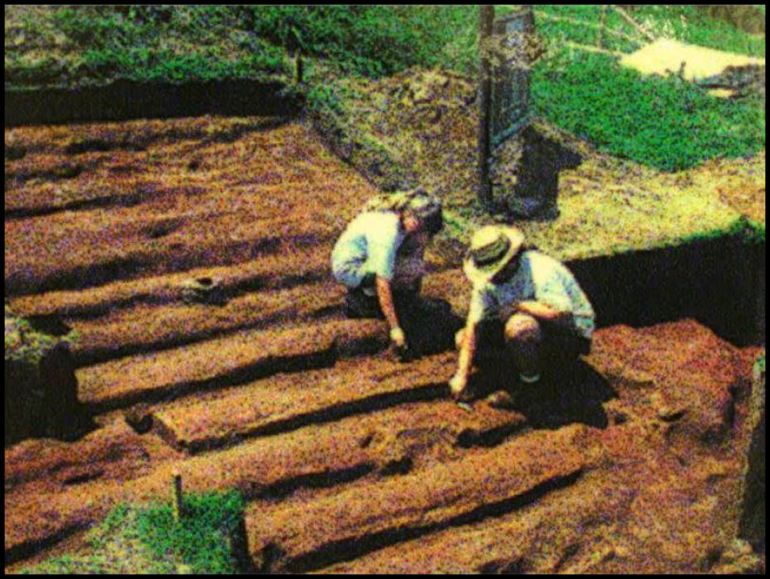
Tedious work at Etowah Mounds – 1955-1957
An ongoing argument at Etowah Mounds
Dr. Arthur Kelly stated in the report, published by the Georgia Historical Commission, that tribal identify of Etowah Mounds was the subject of many arguments, while the excavation was underway. He recognized that the artifacts at Etowah were quite similar to those at the Lamar Village Site in Ocmulgee National Monument in Macon, GA . . . which he thought had always been “Creek”.
Joseph Caldwell had been taught at the University of Chicago that the Cherokees were the most advanced tribe in the Southeast and indigenous to the region.
Actually, they did not arrive in the South until the late 1600s. Yale University professor, Elias Cornelias, learned in 1818, that the Cherokees never lived at Etowah Mounds and did not occupy farms on the Etowah River until 1795. However, the problem is that unlike historic preservation architects, late 20th century archaeologists just did not do the comprehensive archival research, which architects consider to be the norm.
Graduate student Roy Dickens was adamant in his extreme support for the Cherokee team and never waivered throughout his career. That they built all the mounds was revealed to him in a dream!
Lewis Larson, who received his PhD in Anthropology from the University of Michigan, was undecided. In order to stop the constant bickering among staff members at Etowah, he proposed that they hold off their decision until Caldwell excavated the mounds at Tugaloo Island in extreme northeast Georgia, adjacent to South Carolina.
In Georgia’s “orthodox history,” the area around Tugaloo Island was assumed to be always “Cherokee.” If the artifacts on Tugaloo Island were like Ocmulgee National Monument and Etowah Mounds, then Etowah Mounds was “Creek”
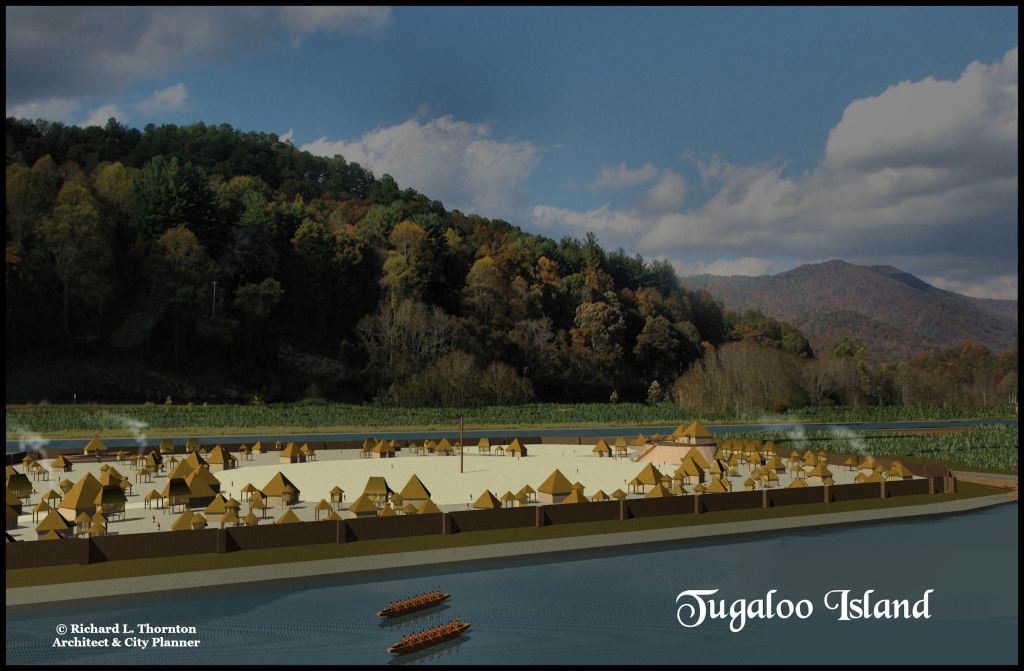
The Tugaloo River is a tributary of the Savannah River
Tugaloo Island
Caldwell and his team worked at Tugaloo Island in 1957 and 1958. In 1885, Cyrus Thomas of the Smithsonian Institute excavated mounds near the Georgia bank of the river, next to Tugaloo Island. His team unearthed Deptford, Swift Creek, Woodstock and Etowah Complicated Stamp and Lamar pottery, which are all proto-Creek or Creek ceramic styles. Apparently, Kelly, Larson and Caldwell were not aware of these excavations. Otherwise, they would have known in advance that the town on Tugaloo Island was at least, Proto-Creek.
There were eight visible mounds on Tugaloo Island. Construction of the first one would have begun around 800 AD. The period of most extensive mound construction was between around 1250 AD and 1450 AD. All of the artifact,s unearthed at Tugaloo Island, were very similar to those created at Ocmulgee National Monument in Macon, the Nacoochee Mound (21 miles away) and Etowah Mounds.
Using the new technology of radiocarbon dating, Caldwell determined that the entire town on Tugaloo Island was burned “no earlier than 1700 AD.” A few years later, a small village, composed of small round huts, was constructed in one section of the main plaza. This was confirmed by Georgia’s Colonial Indian Agent, Rev. Charles Wesley, in 1737. He stated that he found no Cherokees living in the Province of Georgia, but there was “a small, wretched Uchee village of perhaps 100 inhabitants, located on Tugaloo Island” . . . plus numerous Uchee hamlets and farmsteads from there northward to the North Carolina Line.
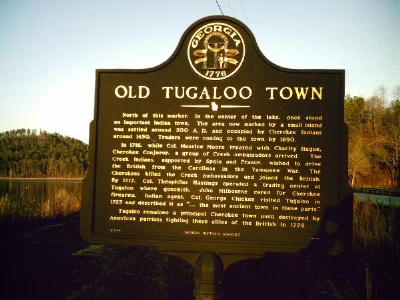
Official response by State of Georgia
During the 1970s and 1980s, the Georgia Historical Commission (same folks, who sponsored Etowah Mounds Dig) erected historical markers around Lake Hartwell. The signs describe Tugaloo Island as “the first Cherokee town in Georgia.” They state that the first mounds were erected by the Cherokees in 1450 AD and that they continued to live on Tugaloo Island until 1776 AD. This fictional history has now spread to the official Georgia History Text and to tourist literature throughout NE Georgia. How could that be?
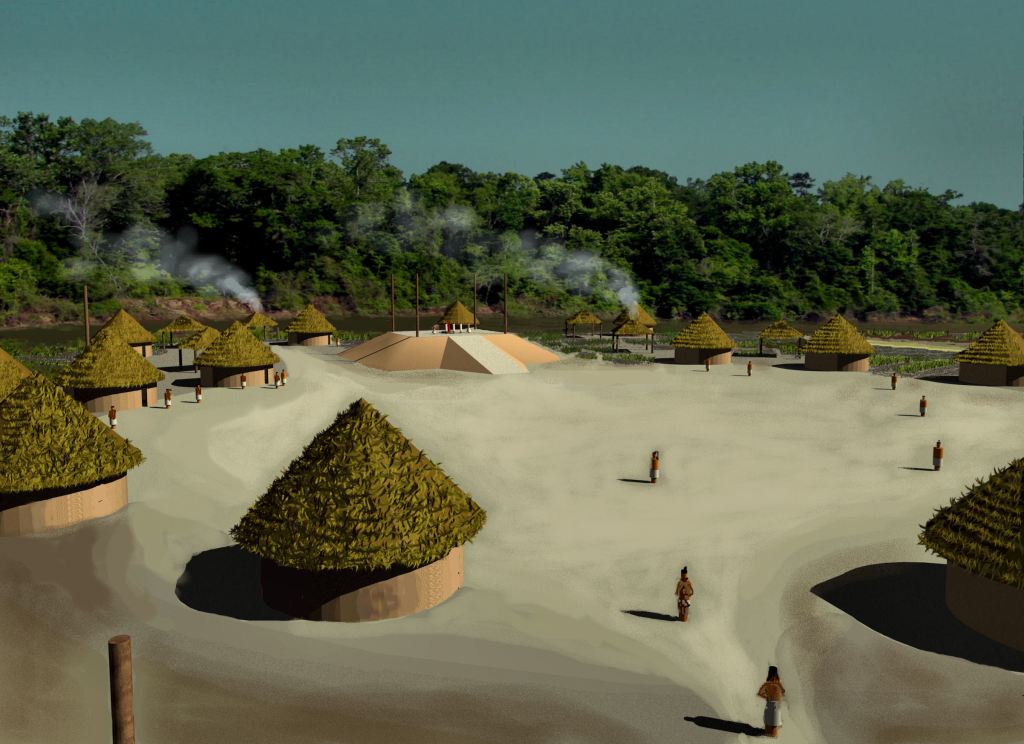
VR Image of Site 9FU14 by the author – created in 2008
The occult’s love affair with all things Cherokee
During the years, 1967-1969, Dr. Arthur Kelly directs archaeological digs on the property of the Great Southwest Corporation on the Chattahoochee River near Six Flags Over Georgia. The work was done by Georgia State University faculty and students, even though Kelly was based at the University of Georgia. Most of the sites were to be developed into an industrial park.
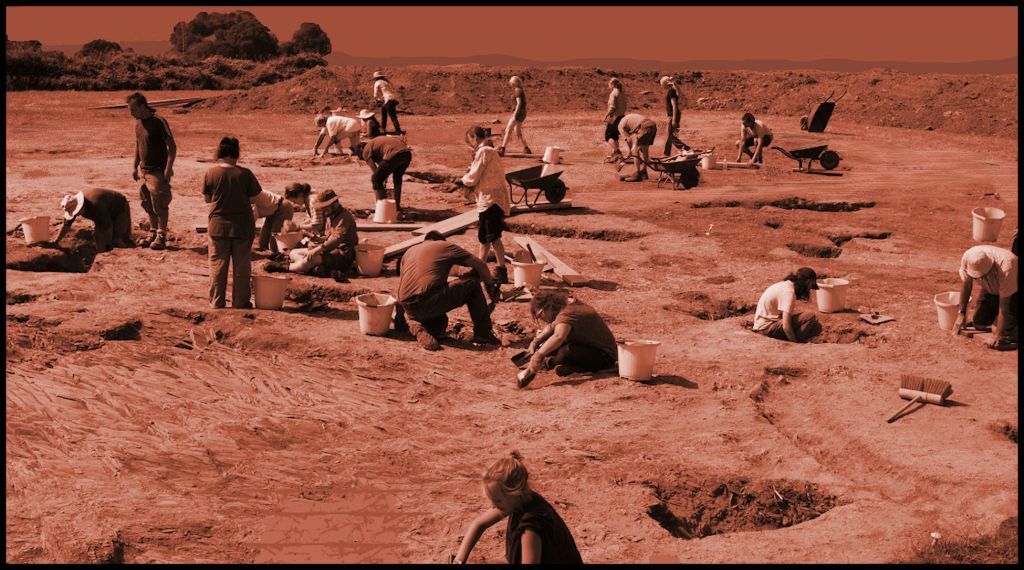
Archaeological site 9FU14 on the Chattahoochee River
In late 1968, Kelly was notified by the Fulton County, GA Building Inspections Department that he was to provide them a scaled site plan in compliance with the county’s Land Development Ordinance of the 9FU14 village site, which at that time was the oldest known permanent Native American village site in the United States (450 BC).
Kelly fist submitted site sketches with various colors of ball point pens on grid paper. They were not to scale and not decipherable, except maybe to other archaeologists. They were rejected. He next submitted a student artist’s three-dimensional sketch. It was rejected.
Early winter quarter 1969, Kelly posted a note on the bulletin board of Georgia Tech’s Architecture School, seeking a student volunteer to prepare a scaled ink on mylar plastic site plan. I answered the note because there were 128 female students at Georgia Tech, while there were over 6,000 at Georgia State. I had no clue that I was about to start a process, which would change my life.
After interviewing with Kelly and two GSU professors, I got the assignment, plus they offered to pay me $25 . . . which equal to about $220 in December 2024 . . . not too shabby. Kelly asked me to meet him on site the following Saturday. He was also meeting Atlanta Journal-Constitution Features writer, John S. Pennington for a wrap-up article on 9FU14.
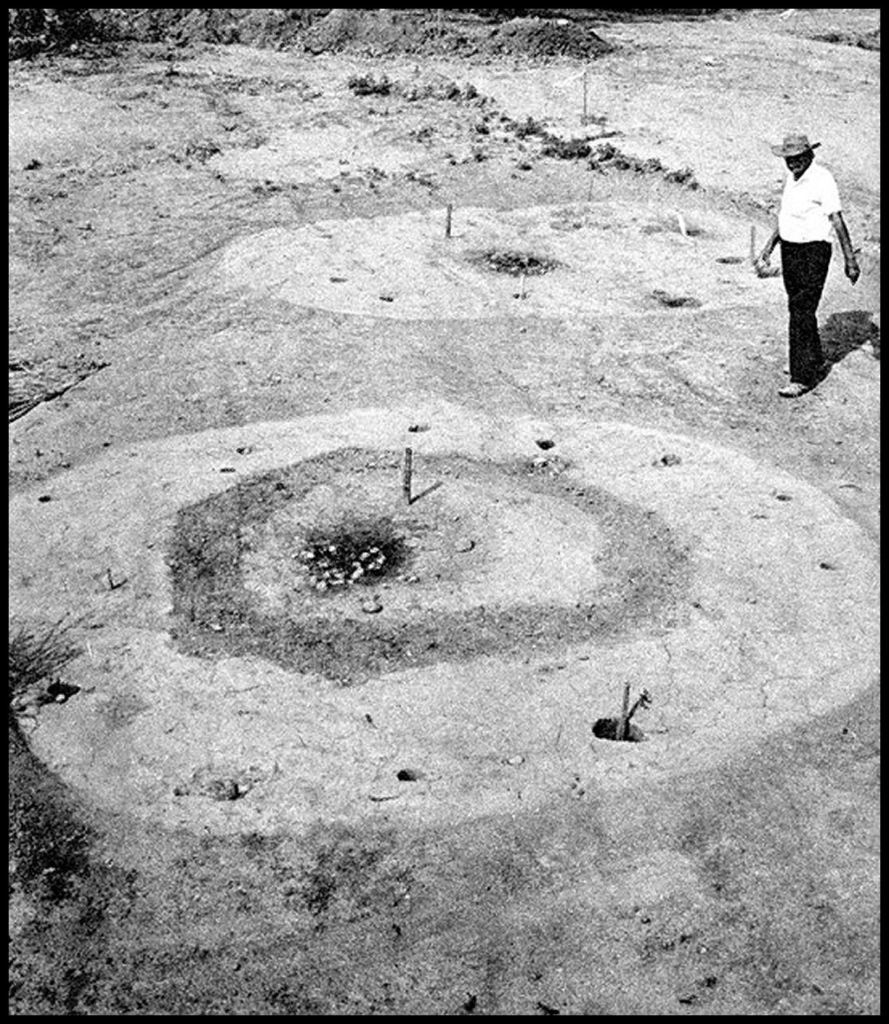
Dr. Arthur Kelley at Site 9FU 14 – Photo by John Pennington
Pennington, a Creek Indian, was a native of Andersonville in southwest Georgia . . . location of the infamous Civil War POW camp. Then State Senator Jimmy Carter was from the same county. Pennington had been instrumental in Jimmy’s initial election to the State Senate.

Since both of us were of Creek descent, John Pennington and I immediately connected spiritually. In fact, I still have some aged clippings of articles he had written for the AJC Sunday magazine, before we ever met. They are on archaeology and architecture. John also wrote an article in the AJC about me being awarded the first Barrett Fellowship (to Mexico) in 1970, then a big article about my slide presentation to the Atlanta Archaeological Society at Georgia State University in 1971.
The last time that I saw John in person was at a dance in the basement of the Governor’s Mansion in August 1971. He was there alone. I was with Emory University medical student, Anita Guffin. We felt sorry for him, so Anita danced with him some. Then Miss Rosalynn introduced him to some single women more his age.
This was the first time that John had ever talked about his personal life. He was essentially in the same situation that I would be in 1990, while living in the Shenandoah Valley. He was married, faithful, lonely, celibate and miserable. Just like me, he had to attend parties alone. At first, he told me was that his wife had moved in with a Cherokee woman in North Carolina. That sounded weird, so I did not ask any questions.
John did elaborate a bit, later on in the evening. His estranged wife was from Hendersonville, NC. She imagined her home county to be the land of the Cherokee, even though that part of the North Carolina Mountains was always Muskogee-Creek until ceded to the whites. He said that she started wearing Indian clothing and claimed that although now white, she was in an earlier life, a Cherokee Princess. She began driving up to the Cherokee Reservation on weekends “to learn Cherokee culture” then suddenly announced that she was moving in with a woman there.
That’s all I knew until a happenstance crossing with Marilyn’s life path in the mid-1980s. My second cousin, Jack Bone, Jr. asked my mother to tell me that he had several interesting books on Native Americans to give me.
My former wife and I drove down to Metro Atlanta from our North Carolina farm to visit with Jack and his family. What I did not know until 2024, was that Jack and his uncle, Sam Bone, were enrolled in the federally-recognized Seminole Nation. That means that I am eligible.
Jack was a very successful home builder and developer. His basement was filed with a wide range of Native American artifacts and crafts that he had obtained from an estate in Northeast Metro Atlanta, which he had purchased to build McMansion houses, which now resale for $2-3 million each.
The decease owner’s legal name was Mrs. John Ruskin, but she had rebranded herself as “Princess Chewanee . . . a reincarnated Cherokee Princess.” Apparently, her heirs were not interested in her Native American collection.
Also, in Cousin Jack’s basement was a filing cabinet full of correspondence and records of the Cherokee Princess Cult. Princess Chewanee and John Pennington’s now ex-wife were good friends. The records included extensive biographical material on Marilyn Pennington.
After the time in Cherokee, Marilyn Pennington went back to college to become an archaeologist. The Cherokee Princess Cult decided that their mission was to bring honor to their Cherokee ancestors . . . who they believed had built ALL of the mounds, indigenous towns and stone-walled terrace complexes in the Southeast. Whenever Marilyn Pennington excavated a Native American site in northern Georgia, she labeled it “Cherokee.”
The Cherokee Princess Cult created the Great Cherokee Empire Map . . . you know the one that is featured on every Cherokee TV documentary, which shows the Cherokees formerly occupying most of seven states in the South? They accomplished this by adding the vast lands of the Chickasaw, Uchee (Yuchi) and Upper Creeks to the rather compact area of western North Carolina and eastern edge of Tennessee, where the Cherokees actually lived during the 1700s.
Apparently, Marilyn Pennington or one of her sisters inserted a mythical map of Georgia in the new Georgia History textbook, which my mother was using in her classrooms. It showed the Cherokees always occupying the region from Savannah, Macon and Columbus northward. My mother had a hissy fit on that one, when she was appointed to the state’s history curricula committee. Her first statement was that “The Cherokees had nothing to do with the building of Ocmulgee Mounds!”
The cult was also very active in creating career opportunities for young members of the cult. There was a scholarship program, plus Marilyn used her powerful position in state government to place sisters in other agencies. We can see the results.
In 1991, three state agencies funded separate archaeological digs near the new Brasstown Resort near Track Rock Gap. These sites had already been surveyed by Arthur Kelly and Lewis Larson. They were labeled satellite villages of the Etown Mounds Culture.
However, a young female archaeologist in the Georgia Department of Community Affairs sent out a national press release, whose headline read, “Archaeologists prove that Cherokees have been living in Georgia for 1000 years.” Her justification was that the site was three miles south of North Carolina, so it had to be Cherokee.
In 1993, a female reporter for the Atlanta Journal-Constitution used that same map that had been inserted in the new Georgia History Text in a large article on Ocmulgee Mounds. The article described Ocmulgee being built by the Cherokees “and other tribes.”
In 1994, the Georgia Parks and Recreation Division obtained hundreds of Native American artifacts, going back to the Ice Age, from throughout Georgia that were being stored at the University of Georgia. They were placed in a $125,000 permanent exhibit inside the new Brasstown Valley Resort Lodge and labeled “10,000 years of Cherokee History in Georgia.”
In 1995, articles began appearing in both the Atlanta Journal-Constitution and local Cartersville, GA newspapers that several Cherokee tribes were planning to build gambling casinos in the general vicinity of Etowah Mounds. Several prominent Georgia archaeologists had been hired to write reports, which supported the development of said casinos.
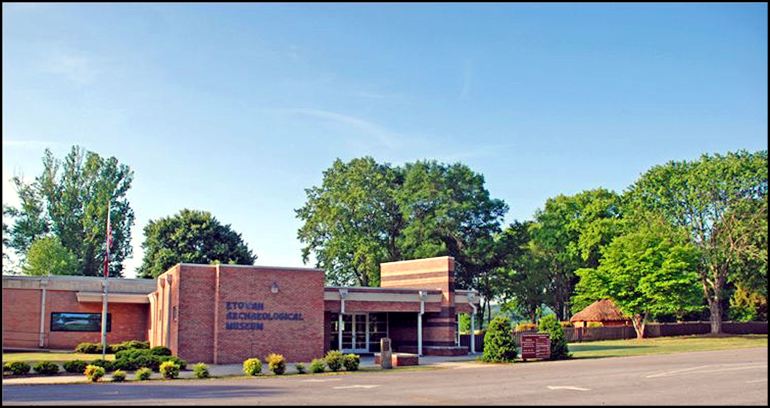
Etowah Mounds Archaeology Museum
In 1998, rumors began swirling that the State of Georgia planned to sell Etowah Mounds State Historical Site to developer, who planned to build a Cherokee casino there. While Susan Karlson and I were touring Etowah Mounds together, I asked the Creek site manager if the rumors were true. She waved us away from the main body of tourists and responded.
A multi-millionaire developer was wanting to lease the archaeological zone for $1 a year. He planned to tear down the existing museum then build a new “Cherokee History” museum in its place, which would be named after him. Around the archaeological zone, he planned to develop at gated community of mansions for members of the occult, so they “draw off the energy emanating from the mounds.” Around that would be developed a golf course and a Cherokee gambling casino.
The site manager warned me not to discuss this project on the phone. Cops were monitoring the phones of government employees in Cartersville. If any of them discussed the propose project on the telephone, they were summarily fired.
In 2000, George W. Bush defeated Al Gore in the electoral votes, but Gore slightly won the popular vote. I was not too concerned one way or another, until I learned from folks in Cartersville that the mystery developer at Etowah Mounds was the largest single contributor to the Bush Campaign.
Around Cartersville, the word was passed around that the project was a done deal. Any local, state or federal employee, who got in the way of developing the project in the Etowah River Flood Hazard Zone would be fired. Any institution, civic club, church or individual, which got in the way would have bad things happen to them.
By the spring of 2001, it did seem like a done deal. The Bush Whitehouse had ordered the National Park Service to decertify Etowah Mounds as a National Historical Landmark. When three close friends of mine in the NPS from my days in Virginia, refused to sign the decertification papers, because the decertification was illegal, they were fired by the Whitehouse. That was also illegal, but the Whitehouse staff got away with it.
Then the terrorist attacks occurred on September 11, 2001. The Bush Whitehouse reassigned staff that had been pushing the privatization of Etowah Mounds as a Republican experiment in “government efficiency.” That bought us some time.
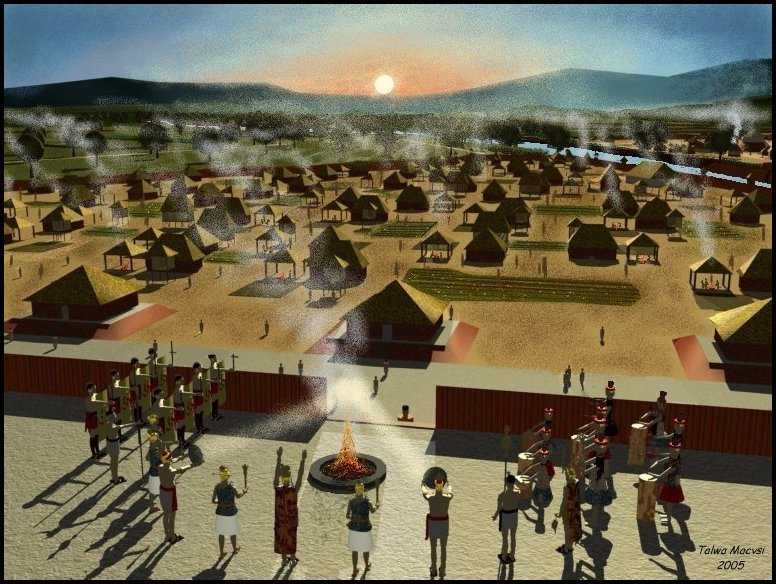
Out of nowhere the Muscogee-Creek Nation appeared on the scene like a mighty champion to fight the privatization of Etowah Mounds. Its Judicial Department sent Creek covert agents, posing as tall Mexican laborers, to Cartersville. They pretended not to understand English well, so locals talked freely among them.
The battle lasted almost a decade . . . but now those days have been erased from most peoples’ memories. The Cherokee Princesses kept on fighting to change the ethnic identity of Etowah Mounds to being a “Sacred Cherokee Heritage Site.”
In 2005, the Georgia Department of Transportation was planning to fund an archaeological dig on the south side of a bridge over the Etowah River near Ball Ground, GA. The north side of this Native American town had been studied by Robert Wauchope in 1939, Arthur Kelly in the late 1949s and Lewis Larson in the late 1950s and early 1960s. They had all interpreted Site 9-CK-1 as being a satellite of Etowah Mounds.
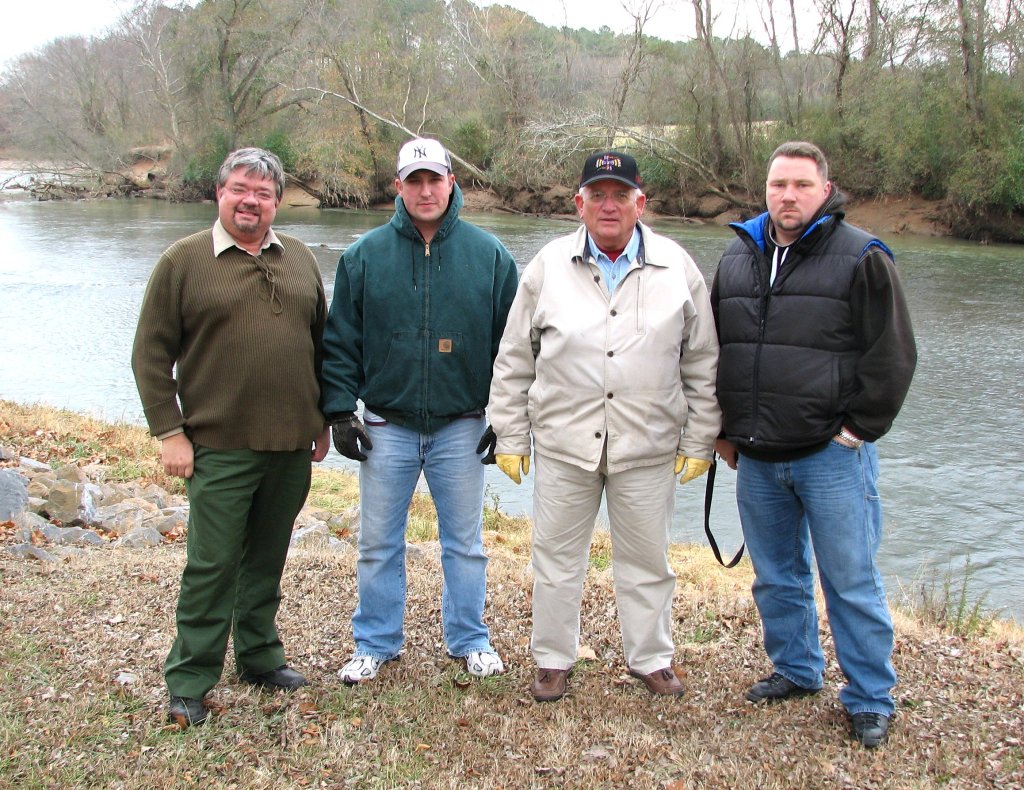
The Muskogee Creek delegation at Etowah Mounds . . . note the scowl on the face of the Assistant Director of the Creek Lighthorse Police on the right, because he was told by the GBI that I was a sexual pervert. LOL I thought that it was ironic that my family obviously had far more Native American heritage than any of these federally-recognized Creeks in Oklahoma.
In December 2005, a delegation from the Muskogee-Creek Nation traveled from Oklahoma to Jasper, GA to pick up the model of Ochesee (Lamar Village at Ocmulgee National Park) and join me on a tour of Creek heritage sites in Northern Georgia. They were also bringing the contract for the large model of Etowah Mounds.
The Georgia Bureau of Investigation had called several of the people, including Judge Patrick Moore and the Asst. Director of the Creek Lighthorse Police to warn them that I was a gay librul with AIDS and a long criminal record. Judge Moore checked the statements with some contacts in the U. S. Department of Justice, who described me as being just the opposite. Just as precaution, though, Judge Moore, purchased a Muskogee-Creek kitchen apron to give me as a house-warming gift.
Coinciding with their visit was the beginning of an over two week stay at my home by Susan Karlson. She had earlier sent me a surprisingly mushy email, stating that she had realized that we had always been in love since we met in June 1991. She intentionally came earlier than originally planned so she could meet my Creek friends.
Susan freaked out, when she saw Creek delegation step out of their car. She screamed “Oh My God!” and raced to the bedroom then locked the door. She begged me not to let them known that she was there. I kept her presence a secret for three days.
Susan later confessed that when she learned that the largest donor to the Bush campaign was also the man who planned to steal Etowah Mounds, she broke a bunch of federal law enforcement rules. She requested comp time to go on a brief vacation in Georgia with me, but instead traveled from Atlanta on to Ocmulgee, Oklahoma under a false identity as an Atlanta Area historic preservationist. She spent more time with Judge Moore than anyone else . . . so a sharp lawyer like Moore would certainly remember her.
I was a bit puzzled, when Judge Moore presented me the apron made to fit a slim woman’s figure. How did he know that Susan was hiding in my master bedroom? However, I figured out what was going on, when the Assistant Director of the Creek Light Horse refused to shake my hand and gave me “a you filthy pervert” look, I realized that the Georgia Cops had been at it again. However, I didn’t make a scene and went on with the show.
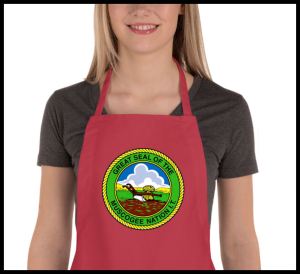
A few weeks ago, I called Judge Moore. He is no longer adjudicating, but is still practicing law. He is considered one of the top Native American attorneys in the nation. I emailed him a photo of the first Swedish girl to wear a Muskogee-Creek apron! That brought him a smile.
In December 2006, a young female archaeologist, employed by the Georgia DOT issued a national press release. entitled: “Archaeologists to prove that Cherokees have been in Georgia for 1000 years.” Yep, that is a similar title to the press release in 1991! However, if was a weird thing for a government agency to do, when the archaeologists had not even started digging.
Within a few days, the Museum of the Cherokee Indian in North Carolina re-issued the GDOT press release with two major changes. The headline stated, “Archaeologists to prove that Cherokees built Etowah Mounds!” The sub-heading read, “Known 1000-year-old Cherokee town is only 45 miles upstream.”
With two such national press releases, the Atlanta Journal-Constitution dispatched a Senior Reporter to write a feature article on the archaeological dig. The planned supervising archaeologist was still living in Illinois. She had never worked in the Southeast. However, she expressed her excitement in being able to reveal the long-concealed history of the Great Cherokee Nation.
A group of women in the Georgia Department of Community Affairs subsequently issued a $20,000 contract for the Illinois archaeologist to write a history of the Etowah Valley. That did not make the established archaeological firms in Georgia happy campers.
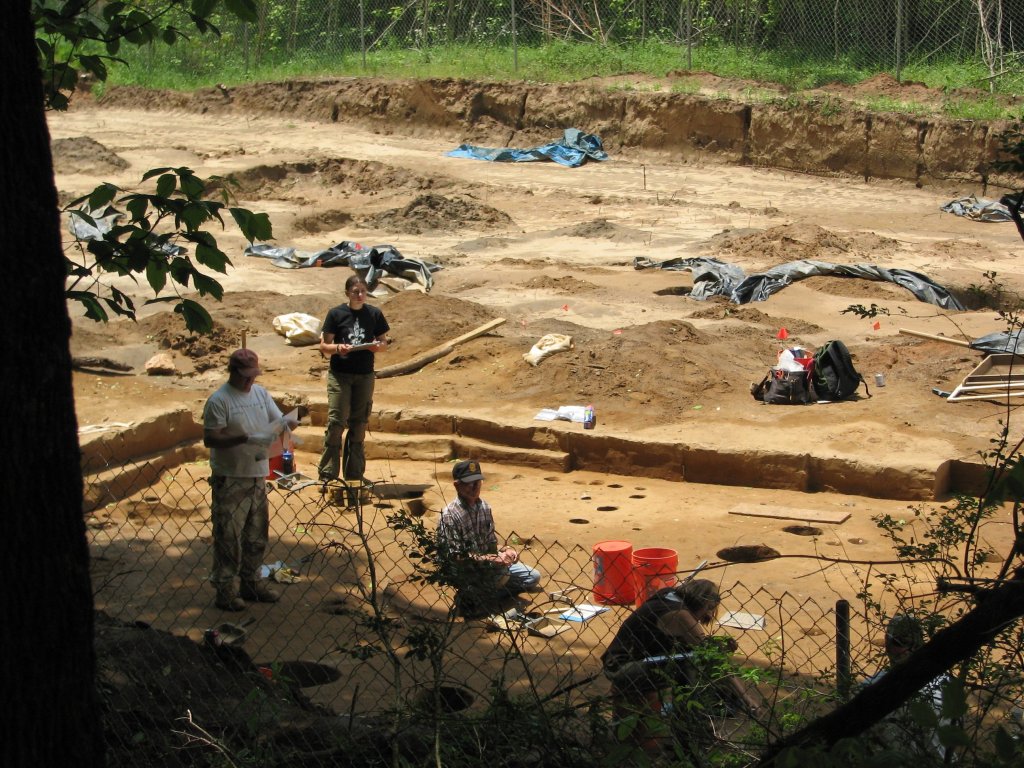
Photo of excavation at Site 9CK1 by the author
As soon as it was clear that Site 9CK1 had absolutely nothing to do with Cherokee history, the Georgia DOT stopped sending out press releases. There was no press release when the project was finished and certainly no retraction of the false information in the initial press release.
Also, of course, no one involved ever realized that Etowah is the Anglicization of an Itza Maya word . . . Etula.
And the beat goes on!
 The Americas Revealed
Kind of left speechless at the levels of corruption. Admittedly, as you spoke of the Cherokee Princess Cult, I kept getting amused flashes of Elizabeth Warren. Think her “membership” came to her in a dream too but I digress. I’m just happy there’s something left of Etowah and an honest record keeper called Good Man Thornton, keeping tabs for the true historical record. The truth is important.
LikeLiked by 1 person
When you live through experiences like that one does not appreciate the big picture until much later. I was just getting bits of bad news from time to time. I moved away from Cartersville in December 1998 to get away from all the drama. So, I was not personally involved thereafter with the very small percentage of citizens, who were actively fighting the project . . . and often paid a heavy cost for their courage.
LikeLiked by 1 person
Fascinating post Richard. Thanks for sharing your hard working research. Loved it.
LikeLiked by 1 person
Thank you/! Just be glad that throughout all those years, I have been keeping notes and they still survive. Keep in mind that I was essentially homeless from December 2009 to May 2018. During that period almost all my furniture and personal belongings were in rental storage bins.
LikeLike