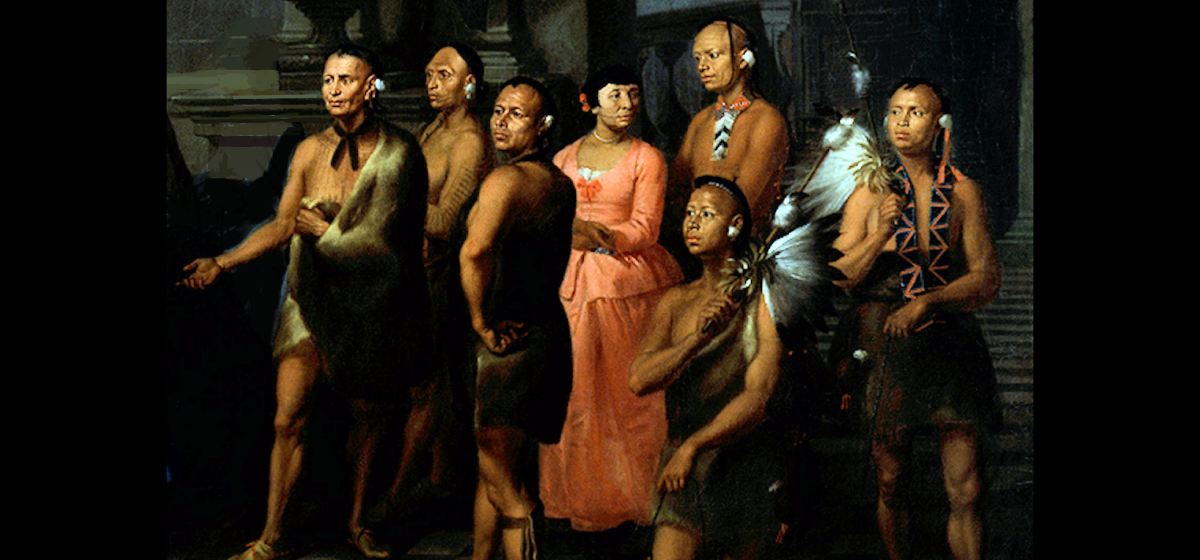
English explorer, Richard Brigstock stated that the elite of the Apalachete (Creeks), Itzate (Creeks), Cusate (Creeks), Chickasaw, Uchee, Kansa and Soque dressed very differently and lived in different style houses than the commoners. The Apalachete elite also lived in separate villages.
by Richard L. Thornton, Architect & City Planner
Image Above: It is a detail of a painting above by William Verelst (1704–1752), which is considered the most accurate and highest quality portrayal of Native Americans during the Colonial Period. The scene portrays General James Edward Oglethorpe presenting a delegation of Creeks from the Savannah Area to the Georgia Board of Trustees and several members of Parliament in July 1734.
The differing physical appearances of the guests reveal that the village of Yamacraw, at the edge of present day Downtown Savannah was composed of several branches of the Creek Confederacy. Some of the delegation look like Highland Mayas, some look like Tabasco Mayas and some look like Toltecs (very tall).
This painting hung on a wall of the Georgia Office in Westminster Palace until the end of the American Revolution. Anthony Ashley Cooper, 4th Earl of Shaftesbury, acquired the portrait, which stayed in the Cooper family until it was purchased by Henry Francis du Pont circa 1930. It is now on display at the Winterthur Museum near Wilmington, Delaware.
What gives Brigstock’s discussion of the Creeks, Chickasaws and Uchees in the 17th century great credibility is his detailed descriptions of the commoner’s architecture and town plans, Much of this information was unknown to archaeologists until the latter half of the 20th century . . . or even more recently. For example, he stated that the Apalachete lived in towns that stretched as far as three miles along fast moving rivers. Archaeologists are currently excavating a definite Apalachete town along the headwaters of the North Oconee River, which is indeed . . . three miles long.
Northern Georgia provides an ideal laboratory for me to study America’s past because it contained so many distinct ethnic groups, living close together in apparent harmony. This is especially true for the headwaters of the Chattahoochee and Savannah Rivers.
In 2024 and earlier this month I have shown you the appearances and buildings of the Indigenous American elites, plus the various categories of European and African settlers, who settled in the Georgia Mountains during the late 1500s and 1600s. Beginning next week, we will start looking at the lives of the “regular folks.” I think what is particularly fascinating is that the Chickasaw, Itzate, Cusate, Apalachete and Kansa lived in villages as close as a hundred yards apart for many centuries, yet their homes, public buildings and village plans remained distinctly different!
Until then . . .
 The Americas Revealed
Hi, Richard,
I hope you are well.
This painting was a revelation. My face is the same shape as some of their faces.
I knew my grandmother was descended from Creek, and I have seen other illustrations of Creeks, but I didn’t know that I shared a resemblance. I presume that the painter was accurate.
Re “Some of the delegation look like Highland Mayas, some look like Tabasco Mayas and some look like Toltecs (very tall),” Can you say which ones are which? I can see one really tall one there. My grandmother had two nephews who were 6′ 7″.
[image: Creek Painting Screenshot.png]
Below is a photo of me (many years ago), when I was 19, another of my grandmother, and a third of me in 2008 face painting with two little girls who were unknown Central American.
My skin coloring is light, except that I tanned. My mother said I wasn’t white, but “pink.” My hair was browner than the photo, when I had a red rinse on it, and it went platinum as I aged.
[image: Lou Anne Fauteck at 19.jpg] [image: Lillian Williams Morrison.jpg]
[image: 2008.png]
Thank you so much for posting this!
Luan
Lou-Anne F. Makes-Marks, Phd
LikeLiked by 1 person
Yes, the really tall ones are Toltecs – Upper Creeks. The man with the sloping forehead from head banding as a baby is Highland Maya. The ones who look more like Polynesians are Tabasco Mayas.
LikeLike
Thank you so much!
LikeLiked by 1 person