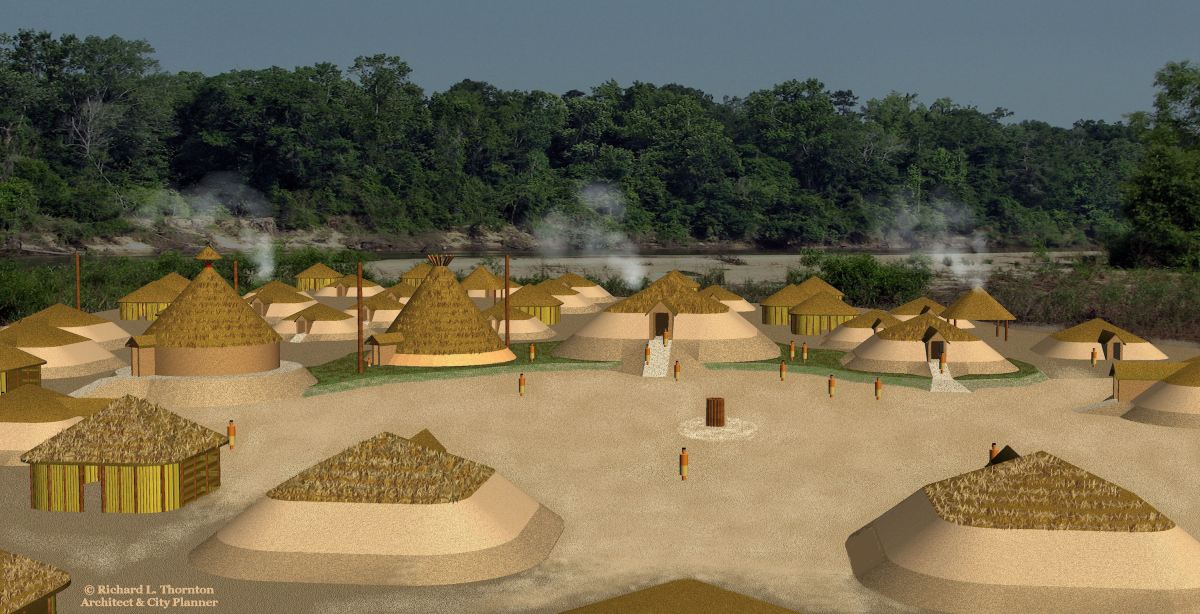
In the 1700s AD, they were recent arrivals to the Western Plains, whose original homeland was the South Atlantic Coastal Plain of South Carolina and Georgia.
The architectural rendering above is not of an early Mandan village in North Dakota, but a Pre-Columbian town site near Warner Robbins Air Force Base. The Creek name of this town is also the name today of one of the Western Plains Earth Lodge tribes . . . the federally-recognized Otoe People. This archaeological site is now a unit of the Ocmulgee National Historical Park.
An even older “Earth Lodge” town was excavated by archaeologist Robert Wauchope in the Nacoochee Valley of Northeast Georgia in 1939. However, currently the oldest known earth lodges were unearthed at Kolomoki Mounds in deep Southwest Georgia. Descendants of these people later founded the original village at Cahokia, Illinois!
by Richard L. Thornton, Architect & City Planner
Our winter series on the indigenous peoples, who settled Southeastern North America, continues with several articles on the Siouans. We will follow the paths of several Siouan tribes from the South Atlantic Coastal Plain up the rivers of the Southeast to the Mississippi, Arkansas and Missouri River Basins. Some of the Earth Lodge peoples even have migration legends that begin on the South Carolina Coast or at least on the rivers within the interior of Georgia, Alabama or eastern Tennessee, but they are ignored by contemporary anthropologists and Wikipedia.
I strongly suspect that at some time in the future, archaeologists will find a much older earth lodge village near the Atlantic Ocean. Maybe they already have, but the finding was ignored by their profession.
But then . . . maybe we have been misinterpreting the footprints of Woodland Period (1000 BC – 800 BC) in some village sites. Take a look again at the photograph below of Dr. Arthur Kelly by AJC writer, John S. Pennington in Spring of 1969. This is the famous 9FU14 site on the Chattahoochee River near Six Flags of Georgia.
Dr. Kelly told me to draw the houses with vertical walls in-filled with wattle & daub, plus conical thatch roofs. I was just a Sophomore at Georgia Tech and knew diddlysquat about what I was drawing. I did what I was told to do. However, my knowledge of the past in the Americas was to change radically in little over a year, when I was awarded the first Barrett Fellowship to study in Mexico.

Note that there is absolutely no evidence of a vertical clay wall between the post holes.
There was a reason that I wanted readers to first see the traditional cold-weather houses of the Northern Sami in Sweden. Three years and four months after this photo was made, I was all grown up and doing a man’s job . . . a body guard and companion for a female NATO biologist taking samples of fall-out from a Soviet nuclear test in Lapland.
We spent the night in a Sami earth lodge that was identical in size, shape and construction to the round earth lodges out on the Great Plains. The Kansa continued to build semi-rectangular earth lodges like those at Bullard Landing.
However, the footprint of the Sami lodge would have been identical to those houses that Dr. Kelly unearthed on the Chattahoochee River. The vertical posts were free-standing. The walls of the interior were formed by young tree trunks sloping outward from the posts about 45 degrees.
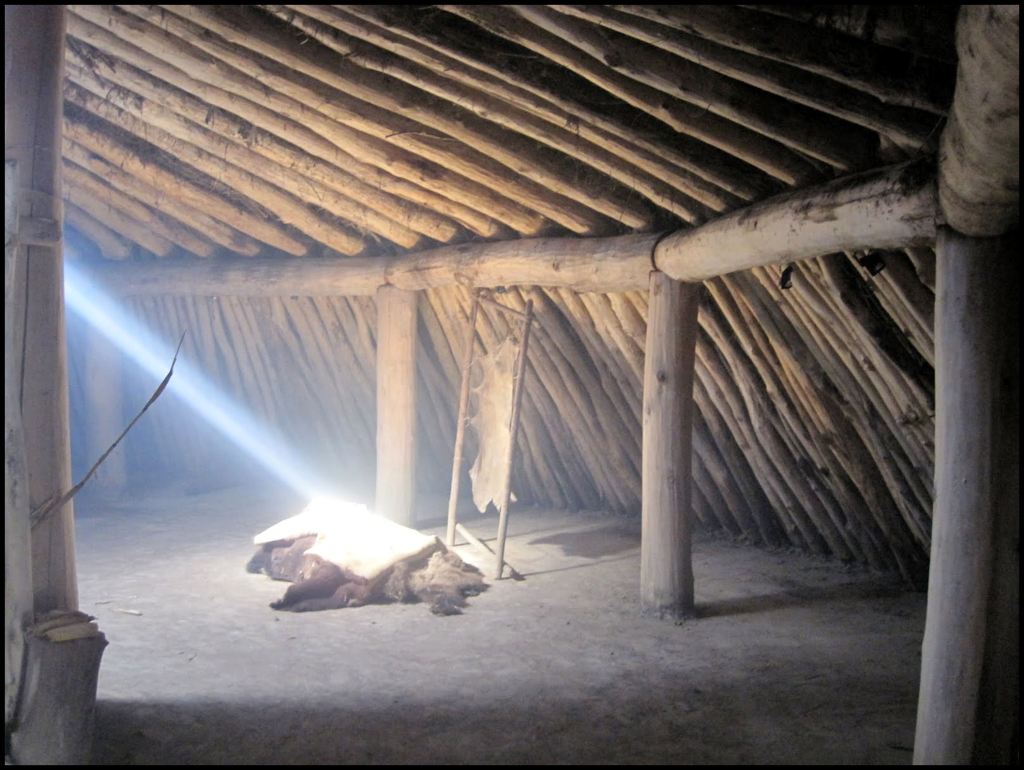
Interior of a restored round earth lodge in Kansas
This is what the interior of a Northern Sami earth lodge and a round Western Plains earth lodge look like. Have I and archaeologists been misinterpreting at least some of the Early Woodland Period house footprints in the Lower Southeast. I don’t know.
Until next time . . .


This earth lodge is reminiscent of the California roundhouses. They could be built at ground level or several feet down along the coast. At higher elevations, they could be deeply excavated. This is the Chaw’se roundhouse. Roundhouses are found around the world.
[image: ce3f6b16267beef9a78dc0f4b7e9f316.jpg]
LikeLiked by 1 person