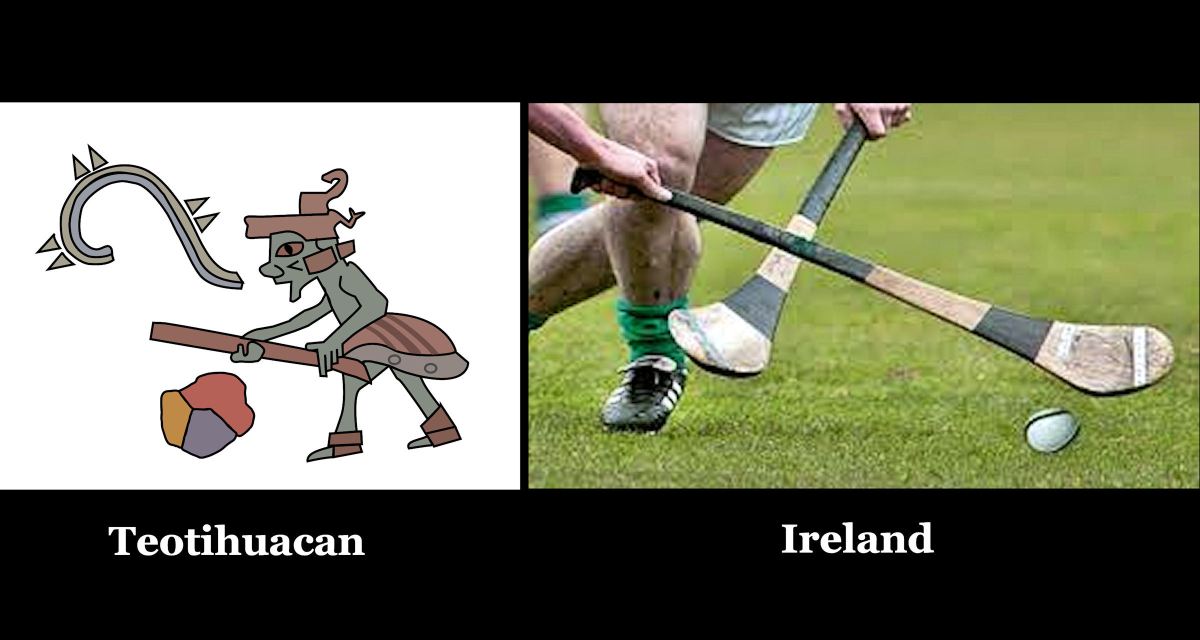
However, the oldest known stickball courts were found at Swift Creek Culture towns in the State of Georgia.
Did the Irish learn this sport while visiting the Americas or did the Irish introduce it to the Americas or did some other unknown people introduce the sport to both regions?
by Richard L. Thornton, Architect & City Planner
Long, long ago in a land far away known as Mexico, I was eating lunch with Dr. Román Piña Chán in his office at the Museo Nacional de Antropologia and showing him the color slides that I took in and around Teotihuacan during the week that I spent there. I asked him . . . “There are no ball courts anywhere. I thought all Mesoamerican cities had ball courts near their central plazas?”
Dr. Piña Chán responded that the INAH has never found any Mesoamerican style ball courts in the cities of Central Mexico, dating to the time period when Teotihuacan was occupied. This game involved rubber balls being hit through a goal by hands, elbows and knees. Mexican archaeologists have found many artistic descriptions of a stickball game like played in Ireland today. Apparently, Teotihuacano Stickball was played in large plazas or open fields . . . or maybe they are looking for stickball courts in all the wrong places.
Say what?

This is the stickball stadium, discovered in the Nacoochee Valley of NE Georgia by archaeologist Robert Wauchope in 1939. The field is about the same size as a soccer field. I suspect that the goal originally was a shed with one side open, like a hurling goal, but we really don’t know. The stadium still has two raised levels for spectators and is used by Youth League soccer matches. The participants have no clue that they are playing on an ancient archaeological site. I have found several more U-shaped stickball stadiums in the region with LIDAR.
Proto-Creek Stickball Fields
The earliest known stickball fields in Georgia are at Swift Creek Culture towns, dating from 100 AD to anywhere between 550 AD to 800 AD, depending on the location. They were bounded by U-shaped earth berms and a little smaller than the later ones, here in the Georgia Mountains.
Princes from Teotihuacan ruled the Itza Mayas and Soque (Zoque in Spanish) from 200 AD to 600 AD. The Itzas and Soque probably learned the game from their Teotihuacano overlords and so played that game rather than the rubber ball game throughout the Classic Period (200 AD – 900 AD).
Bands of Itzas and Soque brought the game with them, but it was already being played by indigenous peoples in Georgia on a somewhat smaller field. The Itzas settled in the Upper Chattahoochee River Valley, while their allies, the Soque, settled in the Soque River Valley. Both rivers have Mesoamerican names that are easily understood by Highland Maya immigrants, who have moved to North Georgia in recent decades..
The current form of stickball, played by Southeastern Indigenous Peoples seems to have arrived from northern tribes at a much later date. It is similar to the modern game of lacrosse, but has some features similar to the much older game, played with a curled wooden bat,

This is the Cold Springs Village Site in Central Georgia. The U-shaped stickball court was a standard feature of towns and villages in Georgia for many centuries. The original style of stickball probably involved knocking a leather ball into a three-sided shed that resembled a hurling goal . . . but I did not show it in this VR image, because we really don’t know.
 The Americas Revealed
I live in Chatsworth, Georgia, and I started out just study in Fort Mountain because I believed it was a serpent mound. But it’s way bigger than that and you have showed me that. Thank you so much, sir. For showing me all these places that are hidden from everybody it just really crazy that it’s right here where I live
LikeLiked by 1 person