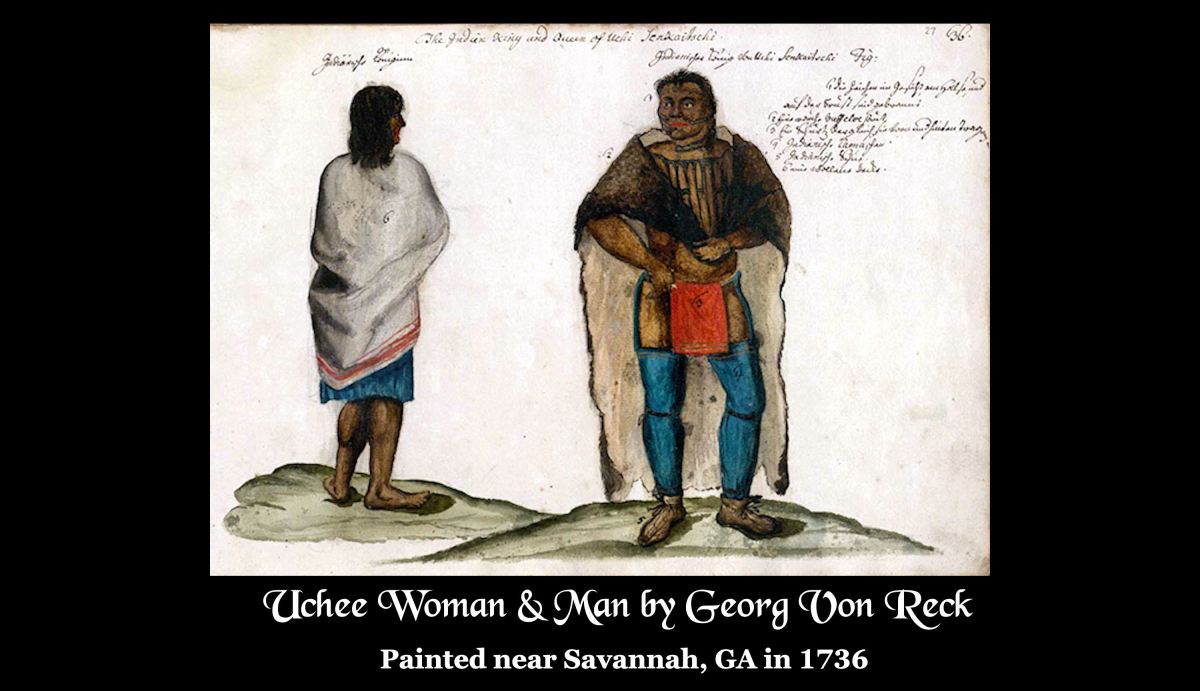
Samoans around Savannah, GA? Say what?
Breaking News
When tested by scientists, substantial Astronesian & Proto-Polynesian DNA markers are showing up in living descendants of Uchees, who lived in the Lower Savannah River Basin, plus Creeks from the eastern half of Georgia and the region immediately north of Auburn, Alabama.
Linguistic analysis has just identified both tribal and place names in eastern Georgia, and the southern tip of South Carolina, which are definitely Samoan or Austronesian words!
Uchee (aka Yuchi $ Euchee) appears to be the Anglicization of the Creek word, Ueshe, which means “Descendants from Water.” However, Yu-chi is also the name of a still-existing Austronesian tribe in the mountains of Taiwan.
The Creek word, Ueche seems to have been a generic label for all the allied tribes, who arrived on the South Atlantic Coast . . . via boats or canoes , , , long before Mesoamericans. Within the interior, these tribes typically had Gaelic, Itsate-Creek, West Germanic, Iberian or Basque names. Many Uchee tribes had a name that meant Ocean People/Tribe, Water People/Tribe or Descendants of the Ocean.
by Richard L. Thornton, Architect & City Planner

Austronesian trans-oceanic catamaran
Of course, use the search words “Polynesians in the Americas” and you will get a string of Gringo anthropologists telling you that no Polynesian DNA has been found in North America, but some Polynesians may have visited the coasts of Chile and Peru. What they will not tell you is that despite the hundreds of thousands of indigenous skeletons unearthed by archaeologists in the Southeastern United States, there are still no DNA test markers for the indigenous peoples there. Most will also not tell you that Mexican anthropologists have determined that the aboriginal people of Baja California were proto-Polynesians. Someone might also remind the audience that the oldest skeletons in California were Austronesians living on the Santa Catalina Islands.
Modern Polynesian DNA appeared about 1500 years ago as a mixture of Austronesian with varying amounts of Australoid, Melanesian and whatever. Before that time, proto-Polynesians are labeled Austronesians . . . the common ancestors of most Filipinos, Indonesians and Malaysians, plus some of the earliest colonists of Japan.
The current situation in Native American genetics can be illustrated by this metaphor: “We are highly educated scientists. We have examined all forests in Alaska, Oregon, North Dakota, New Mexico, Minnesota, Quebec and Maine, but found no persimmon trees. Therefore, it is a fact that the persimmon tree is not indigenous to North America.”
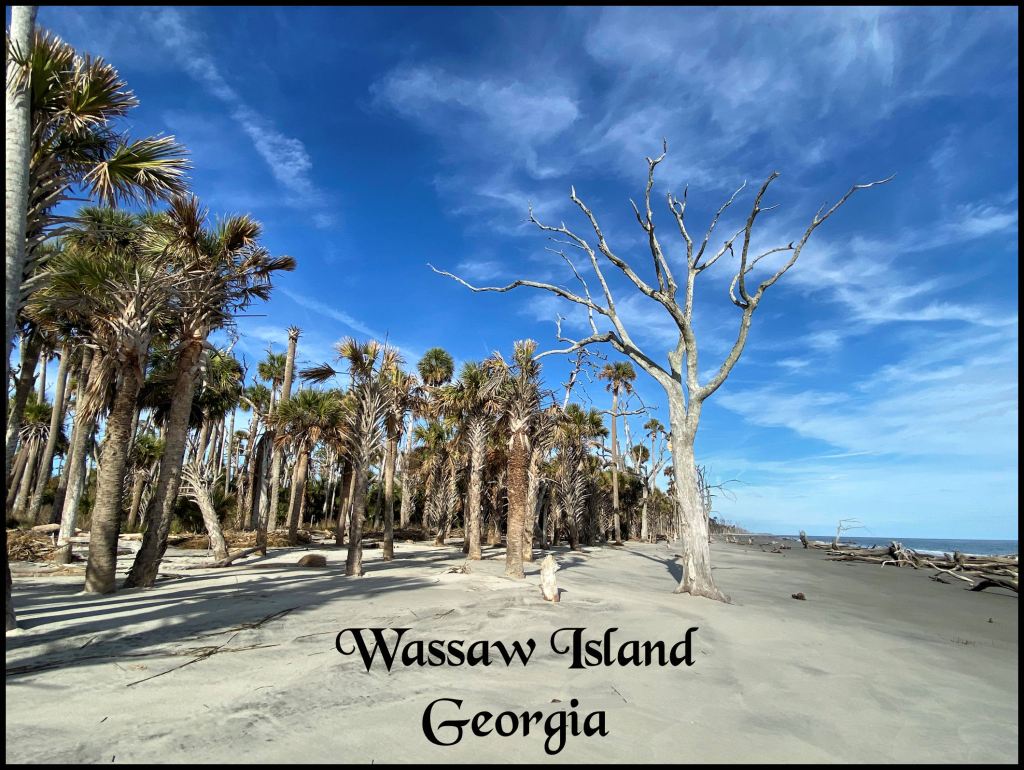
After becoming a National Wildlife Preserve, Wassaw has returned to its natural state.
Wassaw Island is separated from the mainland by tidal marshes and located southeast of Savannah, Georgia (see map below). Wassaw’s 10,050 acres includes surrounding tidal marshes, two smaller islands (collectively known as Little Wassaw Island), and several small hammocks. Together, they make up the Wassaw Island National Wildlife Refuge.
Human activity and impact on Wassaw has been minimal. Native Americans apparently used the island for hunting fish, fowl, reptiles, and shellfish. Indian artifacts dating to A.D. 550-600 have been found on the island. At the time that Savannah was founded in 1733, the island was utilized by Uchee families and bands for fishing camps and hunting.
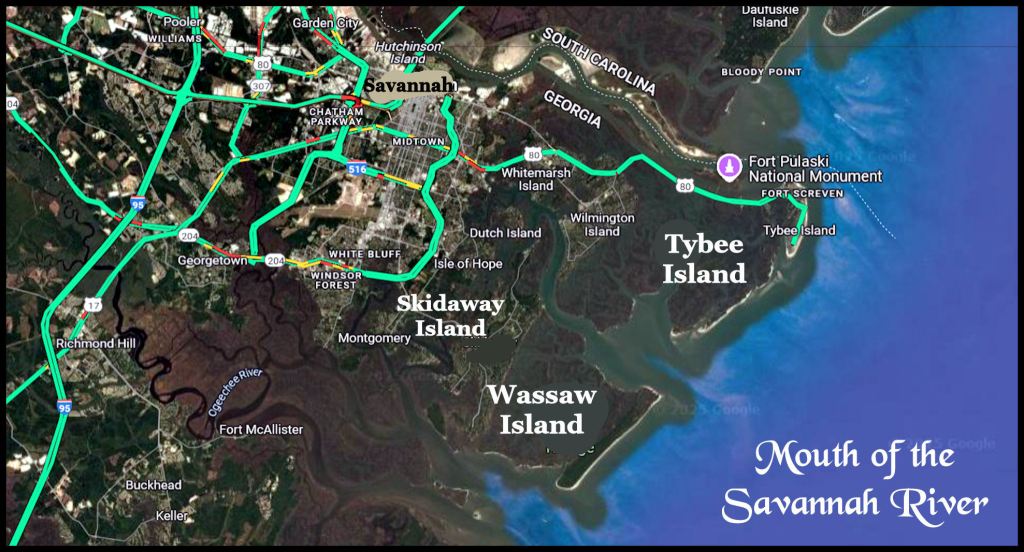
Wassaw Island is probably in a more natural state than any other island off the coast of the United States. Since arrival of British settlers, it has never been cultivated or logged.
The island is named after a Uchee tribe, named the Wassaw or Wassaule. Their Spanish name was Guaxule. One of their villages in the Blue Ridge Mountains was visited by the Hernando de Soto Expedition in the spring of 1540.
“Ss” is an 18th century means of denoting a “sh” sound in English. So, in modern English phonetics, the name would roughly be Wă : shăw. An Anglicized version of this word, Waxhaw, appears as stream and place names in both South Carolina and North Carolina.
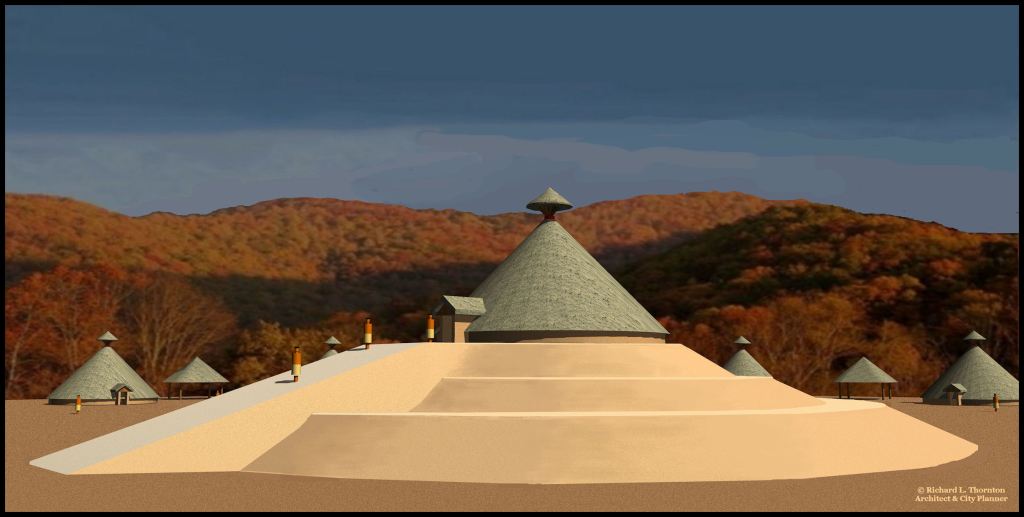
Capital of the Wassaw on the Middle Savannah River
The Wasaule apparently occupied a string of villages along the Savannah River up to the Blue Ridge Mountains, which facilitated regional trade. Their capital was located near Elberton, GA and was named Rembert Mounds by archaeologists. When Anglo-American settlers arrived there after the American Revolution, the town contained several massive rectangular, earthen platforms, containing extremely fertile terra preta soil. The soil was quickly hauled away by the settlers for fertilizing their gardens.
Etymology of Wassaw
After learning of the Austronesian – Proto-Polynesian DNA being found in descendants of Savannah Area Uchee, I looked up “wasa” and “vasa” in several Polynesian dictionaries. Wasa is the original Austronesian word for ocean! However, that word is now only used by peoples living n the earliest islands to be settled by Austronesians, such as Samoa and Figi. “Re” or “le” is the Gaelic and Uchee suffix for “people” in the sense of a tribe, kingdom or nation . . . so Wassawle means “Ocean People.” It was a perfect match.
The Uchee word for the Lower Savannah River was recorded by the British as being “Savano.” The largest island in Samoa is Savai’i. A group of villages, occupied by people from Savai’i is Savai’i Nuu. That’s very close to the sound of Savano . . . but not a definite match.
About this Samoan dance video
In this video of Samoan dancers, notice two things . . . the Samoan women are beautiful, but the powerfully built men look like the famous stone heads and statues of the so-called “Olmec” Civilization. Secondly, Samoan music is rapid and syncapated . . . just like General James Edward Oglethorpe described the Native American music around Savannah.
The truth is out there, somewhere!
 The Americas Revealed
My father liked his outboards, so we were familiar with the islands around Savannah. Wassaw Sound was a familiar landmark. I’ve never been on the island.
LikeLiked by 1 person