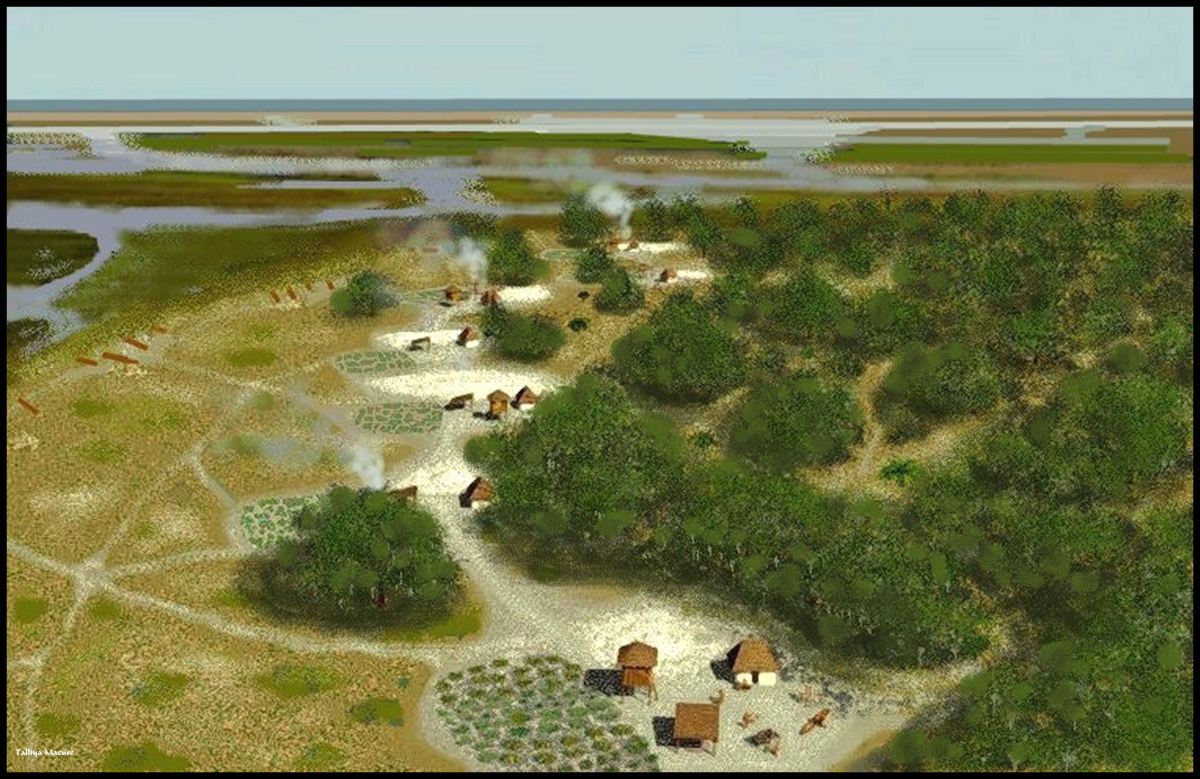
Excerpt from the forthcoming book . . .
The Forgotten Peoples of Georgia’s Coast
by Richard L. Thornton, Registered Architect & City Planner
Translations of Indigenous American words
In order to create accurate computer models of ancient architecture, one must first know who constructed those communities and buildings. Linguistic analysis of recorded tribal names, community names, political titles and incidental words spoken by the Indigenous Peoples of Georgia’s Coastal Region confirms the diverse ethnicities suggested by concurrent genetic testing of living descendants of Georgia’s Coastal Peoples by Dr. Donald N. Yates of DNA Testing Services, LLC in Colorado during 2022-2024. These ethnic identities are starkly different than those presumed by scholars in the past.
Eighteen years of archival and linguistic research has revealed a surprising mix of peoples living in Georgia’s Coastal Plain during the Early Colonial Period (C.E. 1500-1700). Several place names represent hybrid agglutination of two or more languages. Pronunciations of the Indigenous words will be included in the published book.
Key Tribal Suffixes
ti, te, tee, ty (Itza Maya, Itzate-Creek, Miccosukee) = tribe or ethnic group
re, ri, ry, le, lee, li, ly 1 (Archaic Gaelic, Archaic Scandinavian) = tribe with a chief or king
ge, ghe, gi, gee, ke, kee, ki, kee 2 (Gaelic, Norse, Iron/Viking Age Swedish, Algonquin, Iroquois, Lenape, Cherokee, Muskogee) = people or tribe
kora, cora, kola, cola, kura, kula 3 (Carib, Illyrian, Sea Peoples of Mediterranean) = extended family, tribe < Indo-European
koa, coa (Middle Arawak, Taino) tribe = kora
kua, cua, gua (Timacua, Southern Arawak) = tribe < kora
ko, go, co, (Chontal Maya,) = tribe or related people < Yamnaya Indo-European
tli, tle, tly (Chontal Maya of northern Veracruz Coast) = tribe or people
po, pa, pas (Itza & Chontal Maya) = living place of, “land of” , Indo-European
hika, hica (Southern Arawak, Florida “Apalache”) = living place of
bo (Panoan [Peru], Swedish, Danish, Anglisk 4) = living place of, village, “land of”
(1) Many tribes in the Lower Southeast rolled their R’s so hard that Europeans couldn’t decide to write an R or an L. This is still true for English speakers, when they hear Gaelic or Scandinavian languages.
(2) The same situation occurred when Southeastern Natives or the Norse pronounced a consonant which was half-way between a modern English G and a modern English K.
(3) The spelling of this word also varies to how the first listener perceived the heavily rolled R.
(4) The Angles first lived in southern Sweden then migrated to southern Denmark. Anglisk is the Scandinavian language that they spoke, prior to mixing with the Saxons in England. It would have been very similar to what was spoken by the ancestral Swedes.
Savannah, GA Area
Special note: The original word in the Colonial Archives and on the maps was Savanu. Virtually all references tell readers that “the Savannah River is named after the Creek word for the Shawnee, Savano.” However, the words for Shawnee used by the members of the Creek Confederacy were Shawanoki and Suwani.
The first official map to label the Savannah River by that name was by John and Richard Beresford in 1715. It shows a “Savana” village with 60 men on the South Carolina side of the river near present-day Augusta. On other Colonial Era maps, Shawnee villages are labeled Shaunee, while other villages in the Southeast are labeled, “Savanu” or “Savano.” Obviously, the Savanu and Shawnee were two distinct ethnic groups.
1. Savanu/Savano Tribe, Savannah River (EN)
Sava’i Nuu (Austronesian-Samoan) = Sava’i villages or territory.
Note: Sava’i was an Austronesian tribe in Samoa.
2. Wassaw Tribe, Island & Sound (EN) – Tribe living at the mouth of the Savannah River and in the Highlands.
Wasa (Austronesian-Samoan-Fijian) = Ocean
Note: The “Guaxule” encountered by De Soto in the southern edge of the Appalachian Mountains were Wasaw-re. They pronounced their tribal name, Washaw-le, in phonetic English.
3. Micco (EN) – Village chief or regional king among Creeks
Mikko (Creek) – “great,” chief, regional king < Mike – “great,” chief, regional king (Archaic Swedish) < Mik – “great,” chief (Yamnaya Indo-European)
4. Westebo (EN), Ouestebou (FR) – Name of Savannah River before 1715.
Uestebo = “Water People – Living Place of” – Hybrid word (Archaic Irish – Itza Maya – Panoan, Swedish or Anglisk)
5. Westo (EN) [Tribe living along the Savannah River in 1600s.]
Ueste (hybrid Archaic Irish-Itza Maya) = Water People
6. Uchee (EN) – Tribal/Ethnic name used by ALL British officials
Ueshe (Hybrid Archaic Irish-Muskogean OR the Irish Gaelic word for Water.
7. Wallie (EN), Guale (SP) – English and Spanish names for a tribe on south side of Savannah River, near the future city of Savannah. They were allies of the Yamasee in the Yamasee War, thus driven out of the region in 1717.
Wahare = Southerners (Hybrid Itsate Creek – Archaic Irish)
8. Yama (EN), Jama (SP-pronounced Yama)
Jama [pronounced Yama] (Chontal Maya) – Gulf Coastal Plain of Veracruz & Tabasco; a grassy coastal plain; a cultivated field, cleared by slash-and-burn; Name of province around the Jamapo River Basin in Veracruz State, Mexico;
9. Yamacraw Bluff (EN) – Adjacent to Downtown Savannah
Jamakora (hybrid Chontal Maya & Amazonian Carib) = Yama People or Tribe
10. Yamasee (EN), Yemansee (EN), Yamasé (FR), Jamiscaron (SP)
Yamasi (Chontal Maya & Itzate Creek) = Descendants of the Province of Yama. This may have applied to the original Mexican province or to the one in Georgia.
11. Pocotaligo (EN) – Principal town of the Upper Yamasee
Pocotaulicoa (hybrid Chontal Maya-Island Carib) = large town people
14. Tybee Island (originally Taubee) (EN)
Taube (Itza Maya) = salt
Note: Tybee Island had a long history of brine salt production.
15. Chicora (SP), Chiqola (FR), Palachicora/Palachicola (EN) – now Savannah
Aparashikora [Panoan (Peru] & Amazonian Carib = “From Amazon Basin-Descendants of-People”
Note: Pará is still today the name of the Brazilian State containing most of the Amazon Basin.
16. Duhare (SP), Duhale (FR & EN)
Du h’aire – Early Medieval Irish = “of Ireland” or “Irish”
Note: Within Peter Martyr d’Anghiera’s book, De Orbe Novo (1530 AD) is a description of the voyage of Francisco Gordillo and Pedro de Quejo to the South Atlantic coast in 1521. The two men mentioned a visit to a province called Duhare, somewhere near the Savannah River. Its occupants were of tan complexion with red to black hair. The men wore beards. They lived in houses similar to those of the Indians nearby. Their pottery was similar to that of the Natives. The Spaniards did not see any iron tools. The Duahare grew crops and livestock, indigenous to the Americas, plus some typical of northwestern Europe.
17. Datha [chief of Duhare Tribe] (Medieval Gaelic)
Datha (Medieval Gaelic) = “Painted”
Note: The Spanish account of the Province of Duhare mentioned that Datha’s body was completely covered in brightly colored tattoos.
Midway, GA to St. Catherines Island
1. Tacatacourou (FR) [Town near present day Midway, GA]”
Takatakora (Orinoco Carib) = “Toucan People” or “Spread Legs People”
2. Ossabaw Island & Sound (EN) Asepo Tribe (FR)
Asebo (Panoan from Peru) = Yaupon Holly – Place of.
Note: According to French Explorer, Jacques de Gourgues (1568), much of the island was occupied by Yaupon orchards. The Muskogee-Creek & Itsate-Creek word for Yaupon Holly is also asé.
3. Ogeechee River (EN)
Okeshi (Itsate Creek) = Water – “Descendants of”
4. Totolose (FR) – Town on mainland that raised chickens
Totolosi (Panoan from Peru) = Indigenous American chicken
5. Tupiqui (SP) – name of village on mainland near Sapelo River
Tupike (Tupi-Guarani) = Tupi People
6. Toali (FR & SP) – Town on the mainland, west of St. Cathrines Island
Toare (hybrid Ciboney & Archaic Irish) = Toa Province
Altamaha River, Altamaha Sound to St. Andrews Sound
1. Altamaha (EN) – Third largest river on the Atlantic Coast
Al Tama Haw (Itza Maya) = “Place of Trade River”
2. Olata (FR) Political title along lower Altamaha River and coast
Orata (Panoan from Peru) = Village chief, spokesman for village < “Orator” (Latin) < Ancient Indo-European
Note: The word was absorbed into the Creek languages as the title of the chief of a small village or foreman of a public works team.
3. Ouria (FR) – Political title along lower Altamaha River and coast
Uriwa (Panoan) = king < “Oriya” = One who leads ritual (Indo-European)
4. Tama (SP) – Province and capital town on Upper Altamaha River
Tama (Itsate Creek < Itza Maya < Totonac) = Trade
5. Thamacogen (FR) – Tribe on Middle Altamaha River . . . later, NE Georgia.
Þamacogen (Hybrid Itza Maya & Frisian) = Trade Connectors
Note: The Thamacogen originally lived in villages along the Middle Section of the Altamaha River. After the Spanish began colonizing the South Atlantic Coast, the Thamacogen moved to what is now Jackson County, GA in NE Metro Atlanta. The original name of Jackson’s county seat was Thamacogen. It is now named Commerce, GA.
“Kog” was originally the Scandinavian word for a tooth, but by the early Medieval Period meant the wooden tendons on a boat or house that held timbers together, simultaneously being a synonym for a “connector.”
6. Jarua (FR) – Name of priests among the Utina, who could defeat enemies from afar
Jarua (Southern Arawak) = Sorcerer, who can defeat enemies from afar.
7. Utina (FR) – Name of a powerful tribe on the middle Altamaha River.
Otina (Southern Arawak in Peru) = Principal – Assenting (onomatopoeca word – vocative assenting action)
Note: This tribe was NOT Timucuan, as claimed by Florida academicans, but related to the Florida Apalachee, who were Southern Arawaks from Peru.
8. Utinahica (FR) – Capital of the Utina Tribe on the Ohoopee River in SE Georgia
Otinahika (Southern Arawak of Peru) = Utina Tribe – Place of.
9. Ohoopee River (EN) – Major tributary of the Altamaha River in SE Georgia.
Ahope from Ahopeya (Itsate Creek/Seminole from Spanish obiya . . . priest sorcerer, who can defeat enemies from afar.
10. Alecmanni tribe (FR) – Wealthy tribe with towns and villages along the middle and lower Altamaha, plus NE Georgia.
Alekamanni (Anglisk in Scandinavia) = Medicinal Herb Healer – Noblemen
Note: The Commander of Fort Caroline, Captain René de Laudonnière, stated that the Alecmanni’s name meant “medicinal herb-people” and that one of their villages was on the May River, near Fort Caroline. Their capital was about 20 leagues (44 miles) upstream from the fort.
De Laudonnière’s statement was trustworthy. Alek was the Creek word for an “herbal healer.” It now means a medical doctor.
For over a decade I searched every possible Indigenous American Language for the words, Alek Manni” meaning “Medicinal Herb-People.” There were no Indigenous American words other than “alek” in Muskogee Creek that were even close. However, “manni” had no meaning in the Creek languages or any other in the Americas.
In Julius Caesar’s Commentarii de Bello Gallico, he listed several Germanic tribes in with “manni” as a suffix. “Manni” was the plural of “nobleman.” It could also mean “nobility” of both genders.
In English alphabetic letters, the Swedish word for medicinal herb is “leka.” The Swedish word for an herbal healer and now a medical doctor is lekare.
Anglisk (ancient English) created participles and verbs by adding an “a” to the front of the noun. Abide is a good example of such a verb that survives today.
In Anglisk, “aleka” meant “to heal with herbs” which was equivalent to “herbal healer.” Anglisk was the only language in the world in which Alekamanni could mean “Herbal Healer – People.”
11. Alec Town (now Doctortown) & Alec Mountain (EN) – Community in Wayne County, GA on Altamaha River and a prominent mountain in NW Habersham County, GA with several ancient stone ruins on it. Doctortown, GA is 42 miles upstream from the probable site of Fort Caroline in Georgia.
12. Talaxi (SP) – Tribe living near mouth of the Altamaha River in the 1500s and early 1600s.
Tulashi (Itsate Creek) = Descendants of people who lived in or near Etula (know today as Etowah Mounds).
13. Sapelo Island (SP > EN) – Island in the mouth of the Altamaha River.
Sapele (Panoan from eastern Peru) = Flat Island
14. Aseo (SP) – Original name of St. Simons Island, GA
Aseo (Southern Arawak from Peru) – Yaupon Holly – Principal Place
Brunswick, GA southward to Florida – Okefenokee Swamp
1. Guadalquini (SP) – Jekyll Island, GA
Wadalquini (Taino) = Ceremonial Center ~ regional dancing and ceremonial space
2. Mocama [tribe] – Tribe on Cumberland Island, GA and around St. Marys Sound, GA
(probably) Mokana – a Carib tribe living on the coast of Venezuela.
3. Tacatacuru (SP) – Major town on Cumberland Island.
Takatakoro (Carib) = “Toucan People” or “Spread Legs People”
Note: There was a town with the same name near present-day Midway, GA.
4. Satilla River (EN) – River system in southeastern Georgia.
Sati-re (Hybrid Panoan-Archaic Irish) = Colonist – People
Note: Many Southeastern tribes rolled an “R” sound so hard that it seemed to be an “L” sound to most Europeans.
5. Seloy (FR) – village in the Satile Province
Sero (Panoan) = damp and muddy ground
6. Satiuria (FR) – Capt. René de Laudonnière assumed that this was the name of the province immediately south of Fort Caroline. Florida academicians make the same assumption, but are puzzled why there was no such tribe between Jacksonville and St. Augustine. The simple answer is that Fort Caroline was not in Florida and the Satile were a Georgia tribe, which became part of the Creek Confederacy.
Sati Uriwa (Panoan) = Colonists – King (title of tribe’s ruler)
7. Satipo – This is the name of the capital town of the Satile Province in SE Georgia . . . the name of a province and its capital in eastern Peru and the name of a town near the confluence of Citigo Creek and the Little Tennessee River along the North Carolina-Tennessee Line.
Satipo (Panoan) = Colonists – Living Place of
8. Choya (FR) – Native American town on 16th and 17th century maps in present-day SE Georgia
Choya [Plural = Choyan] (Panoan from Peru) = Florida Carpenter Ant (Camponotus floridanus) Similar parasitic ants lived in the Andean Foot Hills and Rain forests of eastern Peru.
9. Serape (FR) & Sarape (SP) – Billy’s Island in the Okefenokee Lake (now swamp)
Serape (Panoan from Peru) = Crumbling or eroding bank of lake or stream
10. Okefenokee Swamp (EN) – Originally, a large shallow lake in SE Georgia, which is now a swamp.
Oka-fenoke (Itsate Creek) = Water Shaking
11. Tamacoa & Thimacoa (FR) ~ Timacoa & Timucua (SP) – French and Spanish names for several tribes in extreme present-day extreme southeast Georgia and northeast Florida. Apparently, these tribes pronounced the same word differently. These tribes were loosely aligned in a confederacy.
Tamakoa (Hybrid Totonac/Itza May with Middle Arawak) = Trade People
12. Napoyca (SP) – Name of Amelia Island, FL its elite family and its principal town
Napo hika (Northern Timucuan) = Anointing – Living Place of
Note: In Spanish, the letter “y” is pronounced like an English ĩ” “Hika” is a Southern Arawak suffix from Peru. This suggests that at least some of the Timucua originated in Peru
 The Americas Revealed
Thank you, Richard!
LikeLiked by 1 person
Always learning so much here with you Richard. I’d sign up for an online course or come sit in a classroom with you any day! As would others that I’ve shared your work with! Last night I caught podcaster Lex Fridman on YouTube interviewing archaelogist, Ed Barnhart and he sounded like a grifter off your playbook or something. Not to judge him too harshly as I only watched a portion and know little else of him, but I commented on Fridman’s page that you’d be a much better interview for sure!
LikeLiked by 1 person