
A return to my old stomping grounds, eleven months after Hurricane Helene . . . Welcome to a world, where the road system, outside of the interstates, has about the same capacity as a century ago and large real estate developments in the county aren’t required to control storm water . . . even next to streams, prone to flooding.
Since I moved away from the Asheville Area in 1987, its population has more than doubled . . . YET outside the interstate highway system, there has been virtually no construction of new roads or even widening of existing roads in either Asheville or surrounding Buncombe County. As a result, there is constant state of traffic congestion in both the city and the suburbs, The road system is grossly overloaded and the situation is getting worse as dense housing development continues in former rural areas.
The scale of the catastrophic flooding in the Asheville Area from Hurricane Helene, about a year ago, was due to construction of new buildings in flood hazard zones since 2005, when the Bush Whitehouse was persuaded to drastically reduce officially-designated flood hazard zones in the Asheville Area. However, stormwater damage is a disaster waiting to happen outside flood zones. The only storm drainage system is in central Asheville . . . and it is over a century old. Developers in the unincorporated county areas are being allowed to dump stormwater runoff directly onto major thoroughfares.
Asheville’s leaders have always bragged about their air quality, despite the fact that the city was located in a natural basin. That is no longer the case, according to recent air quality studies. A doubling of the population has resulted in a more than doubling of the number of cars and trucks on the roads. Meanwhile, the number of vehicles passing through the region on the interstate highways are increasing annually.
by Richard L. Thornton, Architect & City Planner

This is the typical state of traffic flow throughout the Asheville Area on week-days . . . not just near areas, damaged by Hurricane Helene. In the little town of Weaverville, about nine miles north of Downtown Asheville, I was forced to wait through two changes of the traffic lights to get through street intersections on a Friday afternoon!
A metaphor for all that is wrong
When I woke up on Friday morning, August 8, 2025, it was delightfully cool here in the Georgia Mountains . . . 68° F. with a high expected of 75°. Blue skies were peaking through light clouds. Did I really won’t to spend the day working on a computer model of Cumberland Island, GA? Nope! I hollered “Road Trip!” to my two herd dogs. They barked enthusiastically a big YES!
On the spare of the moment, we hopped into my Explorer and headed north toward Asheville. I was curious to see how repairs were coming and how my former farm withstood the ravages of Hurricane Helene.
The Georgia and North Carolina Mountains were gorgeous until we neared Asheville. Some bright bureaucrat had decided to construct major widenings of the interstate system around Asheville at the same time bridges were being rebuilt because of flooding damage. There was dust, diesel smoke, detours and 10-25 mph traffic all of the rest of the way into Asheville. Then I crested a hill and saw a layer of smog hanging over the city. OMG!
The City of Asheville has done a good job of cleaning up the flood detritus near downtown. What one sees now are vast spaces covered in grass, where commercial buildings used to sit. Away from Downtown one could still see piles of debris and devastated, empty buildings. Only 1/2 % of the commercial property owners along Asheville’s two rivers carried flood insurance.
None of the industries on the south side of Weaverville, which formerly employed over a thousand local residents were still operating. They were not damaged by Helene, but obviously had been for sale or lease before the storm. No major employers had taken their place. I didn’t even see any office parks. So, how do all these newcomers to the Asheville Area make a living . . . or do they?
My heart sank as the Ford Explorer entered the Reems Creek Valley . . . my old stomping grounds for a decade in the past. The historic old grist mill . . . the Weaverville Milling Company Restaurant . . . was abandoned and covered with kudzu. Hurricane Helene had crumbled the dam then emptied the mill pond.

Screen shot of Google Maps (8/10/2025) – Since I departed from the Reems Creek Valley, the NCDOT and Buncombe County ceased to maintain the rights-of-way of Reems Creek Road. Simultaneously, farmers stopped maintaining their fields in anticipation of getting rich by selling their land to developers. As a result, dense young forests are a few feet from the paving and Duke Energy has been forced to run the power lines OVER the paving of the road. As can be seen, limbs also overhang the road . . . which is a major thoroughfare. Limbs and trees frequently fall on vehicles.
What had been a pristine mountain valley, known for its broad expanses of pastures and historic rural architecture, was now a patchwork quilt of overgrown, abandoned farms and housing developments sprouting up everywhere. Why in the heck would anyone want to live in dense, three story apartment building complex, ten miles north of Downtown Asheville? (They rent from $2000 to $2700 a month!)
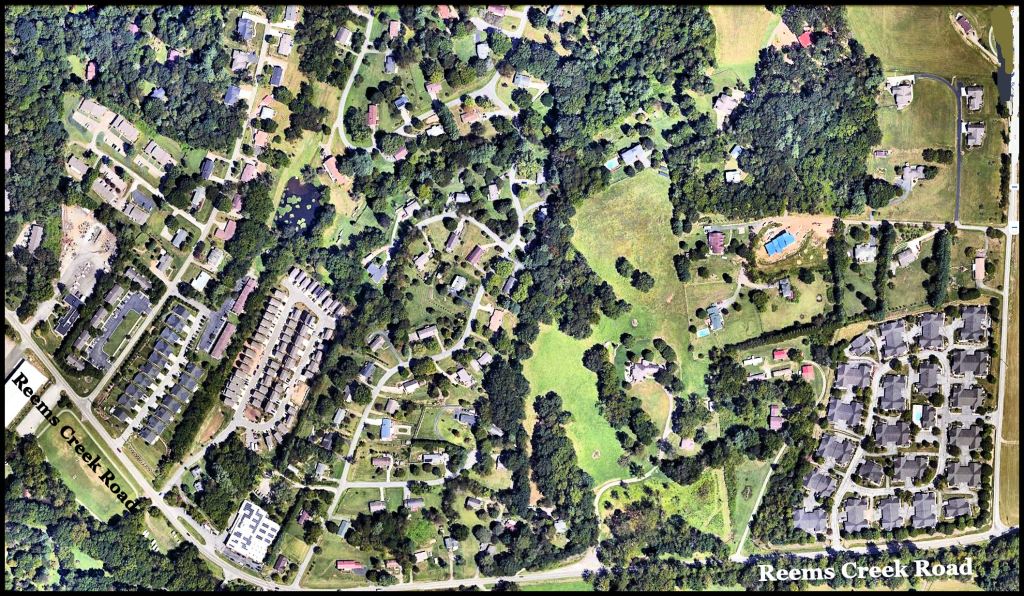
In 1987, this was a picturesque dairy farm. First came the “estate lot” houses then the tiny lot houses then town houses and now dense apartment developments. There are no stormwater retention ponds as required throughout the Georgia Mountains and Atlanta Metro Area. All the rain flows directly into Reems Creek Road and then into nearby Reems Creek.
About a quarter mile past the first cluster, I encountered stalled traffic. The line of cars and trucks stretched at least a mile beyond. What in the world? Must be an accident.
Nope! A minor rainstorm overnight had caused a mudslide from the construction site of three story apartment buildings. The mud had choked a large steel drain cover in the middle of Reems Creek Road. That’s right. The stormwater control for a dense apartment development consisted of allowing the water to flow down the entrance lane of the project and into a storm drain IN THE ROAD. From there a culvert pipe dumped the water (and mud) into nearby Reems Creek.
Had I entered a third world nation illegally without carrying a passport?

This is Blackberry Inn Road, near my former farm, on the morning of September 28, 2024. The road and bridge have been completely repaired. The only way that you would know that there had been a catastrophic flood. was that Reems Creek now flows throujgh a deep gorge composed entirely of rocks of various sizes . . . totally devoid of soil or plant life.
There was no way of predicting how houses would be affected by the raging torrents of Reems Creek. Some were completely destroyed and their occupants killed . . . some suffered severe damage that is being repaired and some showed practically no water damage. The homeowners with nicer houses and obviously more income were repairing their homes, despite having no flood insurance. Less affluent residents were patching up the best they could with scraps of wood from construction sites.
And then we come to the suffering that our nation has turned its back to as it eagerly awaits the construction of a $200 million ballroom addition to the Whitehouse. I saw with my own eyes couples and families illegally living in tents on the sites of their former homes along Reems Creek. I was told that many, many more homeless people are in the same situation in more remote areas of the North Carolina Mountains. North Carolina law enforcement officers are generally refusing to evict homeless families from their own property, just because they don’t have a bathroom, which meets Health Department standards.
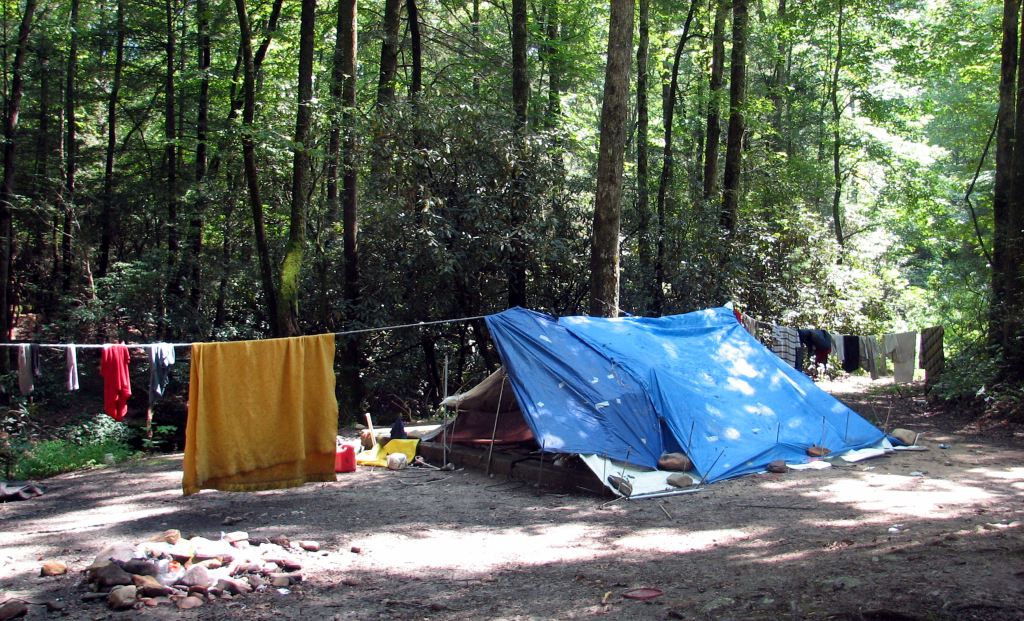
The homeless from Hurricane Helene lost everything . . . including their camping equipment. There are possibly thousands of people in the North Carolina and Tennessee Mountains, who are still homeless. No one is helping them. There is no hope of them rebuilding their homes without financial help from someone. Our national leaders have turned their backs on their plight and deemed them less than human.
Shortly after Donald Trump came into office, he cut off all FEMA funds to North Carolina and Georgia. No one is helping these people. They are being portrayed as parasites by the elite. Last week a talking head suggested that all homeless American citizens should have their citizenship taken away and they should then be deported by ICE . . . for being lazy.
As some readers might know, in late 2009, I was illegally foreclosed upon and then evicted with three days notice on Christmas Eve . . . when I was supposed close on a FannieMae Low Interest loan in mid-January. I think God wanted me to learn first hand how the powers-that-be, plus many law enforcement officers,treat the homeless.
My three dogs and I lived in a tent or empty chicken house at various locations in the Appalachian forests for two years and four months. I had adequate money to buy food, pay my car note and pay car insurance, though, due to a research project for former NPS Director Roger Kennedy. I also had serious military training and experience in surviving in the wilderness. Most of these flood victims have none-of-the above.
There is no excuse for these flood victims not receiving generous help from both their state and our national government. Our forefathers never intended our nation to be for the rich, of the rich and by the rich. The engine for the F-35 fighter jet, the Pratt & Whitney F135, costs roughly $15 million. That would buy 75 very nice homes for the homeless in western North Carolina and Tennessee.


FEMA spent all of the money on illegal immigration before Trump become president and that was proven in Congress. But all the flip-flopping that Trump has done on the Epstein files it makes me think that he is guilty somehow.
LikeLiked by 1 person