
It was in an era when there were very few Mexican restaurants or Latin Americans living east of Texas or north of Miami. There were no Native Americans or Latin Americans on the anthropology faculties of Southeastern universities, other than the University of Miami.
In 1970, there were very few female archaeologists in the United States. Those who did manage to get their PhD always played “second fiddle” to the male archaeologists. In contrast, in Latin America there were many, highly respected female anthropologists and archaeologists, such as Dr. Piña Chan‘s wife, Beatriz. I would subsequently have romantic relationships with three of them.
by Richard L. Thornton, Architect & City Planner

Site 9FU14 on the Chattahoochee River near Six Flags Over Georgia . . . where I first met with Dr. Arthur Kelly to discuss preparing a site plan of what they had unearthed.
It is 2025 and people today have no clue that much of what they read in official references about the orthodox history of Southeastern Indigenous Peoples was created by academicians, who grew up and were educated in other parts of the United States. They were experts on pottery styles with English names, but had absolutely no knowledge of the indigenous languages, cultural traditions or migration legends of the people, who created the pottery.
The only exception was the Cherokee. Academicians agreed with the Cherokee tourist brochures, which said that they migrated southward from the Great Lakes Region in the late 1600s and did not build any mounds.
Showing the world my color slides
I was the first recipient of Georgia Tech’s Barrett Fellowship, which was the equivalent to over a $8,000 grant today. The faculty committee, who selected me, insisted that the funds be spent on package tours to the major tourist attractions only . . . because they wanted my activities to be accountable to Tech’s administrators.
My Mexican fellowship coordinator, Dr. Román Piña Chan, tossed that syllabus into the trash can and instead sent me by public buses to both the major sites and into the boonies. I saw things that very few Gringos, if any, had ever seen. Fortunately, he also, unbeknownst to me, sent very flattering letters to the School of Architecture and Georgia Tech’s president at the end of the fellowship, which explained his departure from the syllabus and evaluated my learning process.
My two faculty advisors, Ike Saporta (President of the Atlanta Archaeological Society) and Julian Harris (Architect of the Etowah Mounds Museum) were floored by the 2500+ color slides that I took in Mexico. In particular, they were awed by the views of Teotihuacan from atop 10,000 feet tall Cerro Gordo Mountain. They immediately embarked me on a series of slide lectures at the anthropology departments of universities in Georgia.
The presentations culminated with a program at Georgia State University, sponsored by the Atlanta Archaeological Society. It was requested that I focus on Teotihuacan, Tzintzuntzan and the Maya cities, since those slides were my most spectacular ones. The lecture was publicized in the Atlanta Journal-Constitution, but I expected maybe 30-40 attendants . . . instead, 284 signed the register. About 30 more, mostly students, came in after the program had started.
In order to break the ice and connect with the much larger crowd than expected, I started asking ad-libbed questions. The responses came as a big, big surprise. By the way . . . in the period 1970-1971, the term “Native American” had just been coined, but was considered a contrivance of political extremists, so was not used in academic presentations.
The crowd was a mixture of archaeology professors . . . who dressed eccentrically to let you know who they were . . . plus some regular professors. Atlanta’s intelligentsia were there in designer fashions. Some young people were dressed as hippies. Other students dressed as students.
The Questions
(1) How many people here consider yourself to be American Indian or Latin American?
- I was the only person, who raised their hand.
(2) How many of you have visited Mexico?
- About a third of the crowd raised their hands.
(3) How many of you have been in a romantic relationship with an American Indian or Latin American?
- No one raised their hand, but me.
(4) How many of you have kissed an American Indian or Latin American?
- No one raised their hand, but me.
(5) How many of you have even dated an American Indian or Latin American?
- No one raised their hand, but me.
(6) How many of you have had an American Indian or Latin American friend?
- No one raised their hand, but me.
(7) How many of you have invited an American Indian or Latin American into your home?
- No one raised their hand, but me.
(8) How many of you have dined with an American Indian or Latin American?
- There were no hands at first, then some of the archaeologists stated that Maya women had cooked their meals, when they were at summer digs in Mexico or Central America.
(9) How many of you have even had a conversation with an American Indian?
- A smiling elderly man raised his hand then said “Richard, I have had many conversations with you, most of them on the phone, though. In fact, you probably wouldn’t be here tonight, if it wasn’t for my endorsement of your fellowship.”
Dr. Arthur Kelly had aged so much since the late winter of 1969, I initially didn’t recognize him. Yes, his endorsement did clinch the fellowship grant. That was the last time that I ever saw him.
(10) For the last question, I asked how many people had visited a Creek town site in Georgia.
- Everyone raised their hand. At least the ice-breaking exercise ended on a positive note.
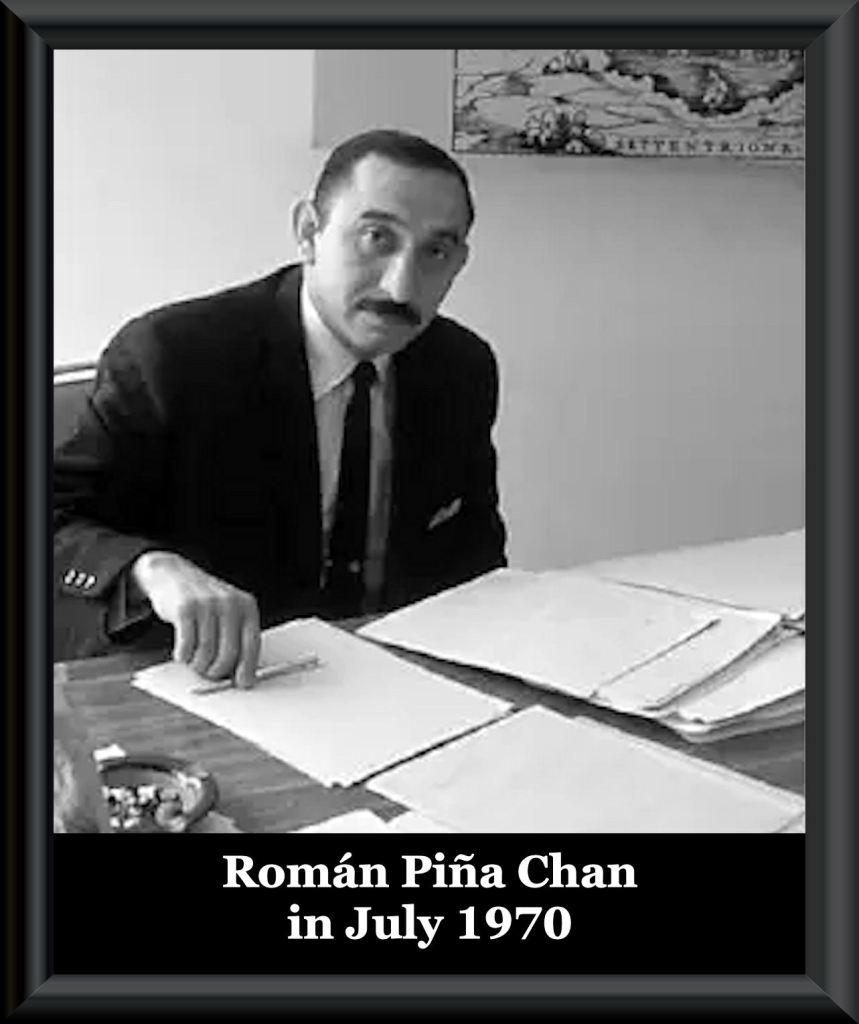
Dr. Piña Chan’s mother was Maya. To have a man, who was essentially Maya, rise to the top in the Instituto Nacional de Antropologia E Historia itself was a radical change in Mexico.. Prior to then, the profession had been dominated by sons of the lily-white Mexican aristocracy.
The Aftermath
The primary professional motivation for both Román Piña Chan and Arthur Kelly was the joy of gaining new knowledge. In addition, Román and Beatriz loved working with young people, while teaching them how to teach themselves. In fact, that was the most important gift I gained from the fellowship in Mexico. Never think that you know everything there is to know. Never stop learning.
Dr. Kelly was railroaded off the University of Georgia faculty in December 1969 . . . ostensibly because he showed artifacts, excavated along the Chattahoochee River, to an AJC writer, that he thought were either made in Mexico or copies of Mesoamerican artifacts. He also showed the artifacts to me. Kelly was ostracized by his fellow archaeologists in Georgia for the last 10 years of his life . . . but was always highly admired by my generation of architects.
You see . . . both Román Piña Chan and Arthur Kelly were quite aware that the only reason that they had jobs was the economic impact of heritage tourism. Preservation and public visitation at their archaeological sites was a high priority. They considered their nation’s historic and prehistoric sites as patrimony that should be protected for all time.
The next generation of archaeologists in Georgia were more ego-driven. They delusionally viewed themselves as omniscient wizards, holding sublime knowledge that mere mortals and other professions could not possibly understand. Their particular speculations on the past became the sacred beliefs of a religion that could not be challenged. They viewed Native American town sites as their private domain, which should be off limits from mere mortals and unknown to the public.
In 1995, the archaeologists in several Southeastern states pushed through policies that forbade even government-employed historic preservation planners from possessing the list of archaeological sites in their region. As a result Alabama, Georgia, North Carolina and Tennessee have experienced a catastrophic number of Native American earthworks destroyed. Local officials don’t know of their existence until it is too late to stop them being bulldozed by investors receiving tax credits for growing corn to produce ethanol.
As a result of the indifference of “archaeologist wizards” to the citizenry, Congress and state legislatures have steadily reduced funding for archeological investigations. That, in turn, has dramatically reduced the jobs for archaeologists and thus, the number of students studying to be archaeologists. Many major Southeastern universities now have too few archaeology students to carry out any archaeological investigations of their own.
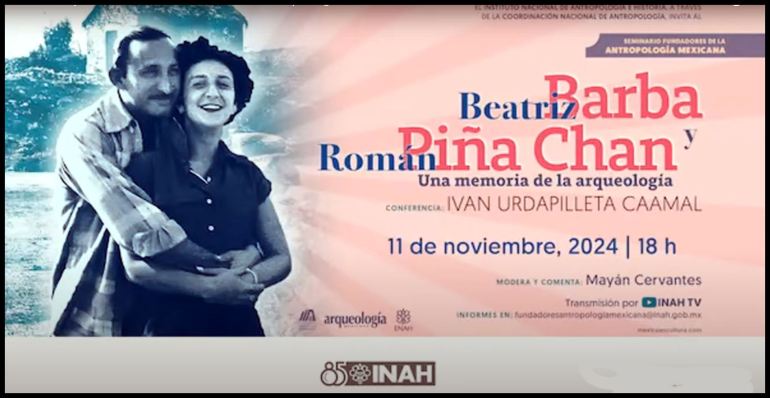
How different career opportunities are for Mexican archaeologists. In 2024, a very popular movie on the lifelong love affair between Roman and Beatriz was broadcast on Mexican TV,


Enjoy and appreciate your information. Wish I was younger so I cold learn more.
LikeLiked by 1 person