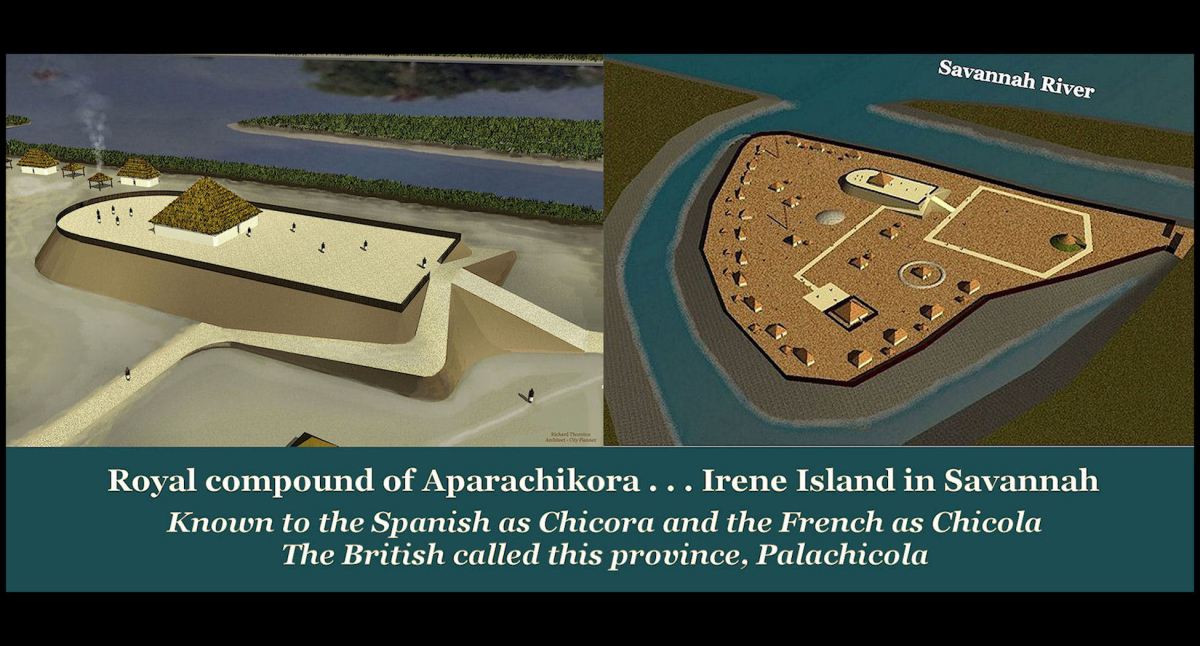
A canal and circular harbor . . . plus a surrounding village atop timber piles . . . was constructed there by “somebody” around 3545 BC. Radiocarbon dating proves that the location of Downtown Savannah has been almost continuously occupied since then.

Chicora was located in Savannah . . . not Pawleys Island near Georgetown, South Carolina! However, that was one of a series of names for this metropolis, whose earliest days are marked by the construction of a canal, harbor and village.
Its Panoan (Peruvian) name was Apalachikora*. . . which means “From Amazon Basin – People.” The Highland Creeks called themselves “Apalache” until around 1748, hence the name of the Appalachian Mountains.
*Correctly written, the word is Aparáshikora, but to most Europeans, other than Spaniards, the Southeastern Indigenous “R” was rolled so hard that it sounded like an “L.” Also, Europeans usually perceived the Indigenous “she” sound to be a “che.”
French Colonial Archives describe visit by the Jean Ribault Expedition in 1562, which include precise geographical, architectural and navigation details that exactly match Irene Island in the Savannah River, but bear no resemblance to Pawleys Island, which faces the ocean.
There is no public record of Native American mounds or a large Pre-Columbian town on Pawleys Island, South Carolina. When the Colony of South Carolina was founded in 1670, none of its indigenous peoples had ever heard of a large town there, which ruled the region.
In total contrast, Central Savannah abounds in Native American mounds, dating from about 3545 BC to the early 1600s AD. Chikilie, the High King of the Creek Confederacy told the assembled leader of Savannah on June 6, 1735 that the first capital of the Creek Confederacy was at Savannah and their first emperor was buried in an earthen tomb near Savannah. Indeed, the Indian King’s tomb was excavated by archaeologists and found to cover a royal burial dating to about 1200 BC or earlier.
Even more remarkable is a statement made by General James Edward Oglethorpe, founder of Savannah. He stated that the Indians around Savannah had a cultural memory of a friendly, red-haired French captain, who sailed his large ship up to Apalachikora about 170 years in the past!
The state-recognized Chicora Indians in South Carolina were given that name by academicians. They are composed of people with probable Native American descent, who had no knowledge of their tribal origin or language.
The Many Peoples of the South Atlantic Coast Series
by Richard L. Thornton, Architect & City Planner
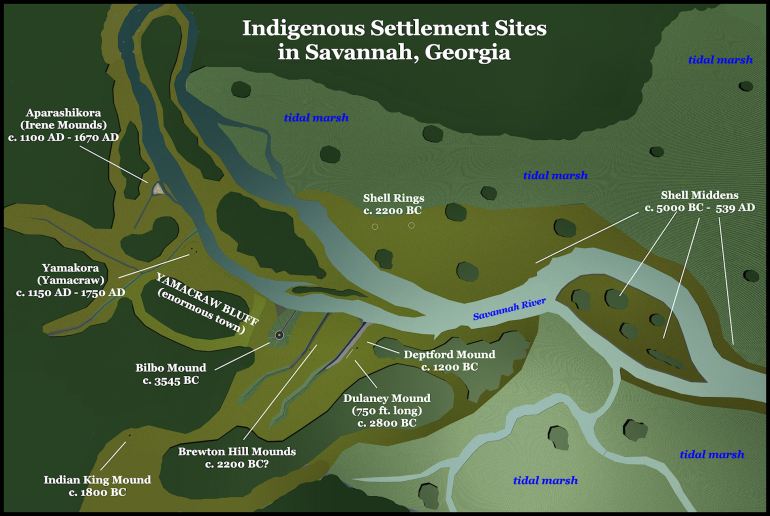
In the full, original version of the “Creek Migration Legend” that I discovered at Lambeth Palace in 2015, Chikili, the High King of the Creek Confederacy, stated that the new British colony of Savannah was located at the site of the first capital of the first Creek Confederacy. Its dense concentration of earthworks and shell structures certainly suggests in ancient times, it was probably the most important urban center in North America.

I created this simplistic computer image twelve years ago for an article in “The People of One Fire,” the forerunner of “The Americas Revealed.” At the time, the Bilbo Mound was thought to be an ancient burial mound within a natural pond that drained to the Savannah River. Archaeological investigations revealed that it was in fact a man-made harbor harbor and canal surrounded by a town or village on timber piles. A more accurate virtual reality image will be included in my forthcoming book on the South Atlantic Coast.
The profound significance of the Bilbo Mound
The Bilbo Mound was first excavated and radiocarbon dated by the famous archaeologist and geologist from Louisiana, William G. Haag, in 1957. Although Haag’s later work at Watson’s Brake and Poverty Point in Louisiana brought him national attention, Georgia archaeologists intentionally ignored then conveniently forgot his work in Savannah. What should have been made a National Historic Landmark 65 years ago was almost destroyed by non-descript industrial buildings.
Virtually everyone in Savannah were unaware of the Bilbo Site until I publicized it in my National Architecture column in the Examiner during 2015. SOME people in Savannah are now aware of the Bilbo site now, but it remains a neglected, swamp-like tract on the eastern edge of Downtown.
Keep in mind that the Bilbo Site is the oldest known man-made harbors in the WORLD and one of the oldest known timber platform communities.
- It is a thousand years older than the next oldest man-made harbor in Egypt.
- It is 500 years older that the earliest earthworks at Stonehenge and a thousand years older than the stone structures at Stonehenge.
- The oldest known timber pile platform village is located near Lin, Albania, on the shore of Lake Ohrid, and dates back to approximately 5800–5900 B.C. However, the huts on top of the platform appear to have been constructed from woven branches and animal skins.
- The Hallstatt region in Austria is home to the second oldest known evidence of timber structures on top of a platform like the one in Savannah. dating to approximately 3,400 years ago.
Why the Bilbo Site is ignored by Savannah’s tourism officials and most of Georgia’s archaeologists is beyond comprehension. Hopefully, my forthcoming book will make the folks living along the coasts of South Carolina, Georgia and Florida more appreciative of their ancient patrimony. Because Americans don’t seem to like reading books anymore, this book will mostly be full color architectural renderings and photographs . . . with concise text.
Maps that explain the Bilbo site
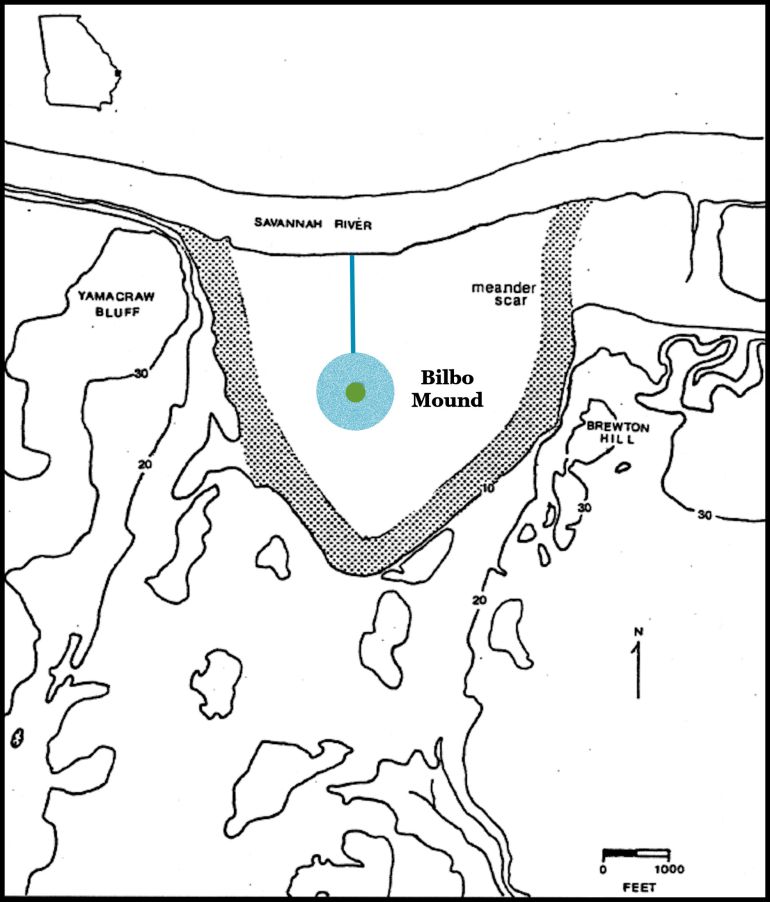
Schematic Site Plan

The original canal was excavated recently after an archaeological survey to create a major storm drainage canal. However, the new canal probably is fairly similar in width to the original canal constructed 5,500 years ago.
 The Americas Revealed
Thank you for highlighting once again, this massively important site or sites rather, around The Savannah River area or “Chicora.” My only question is this for clarity’s sake – is “Chicora” the town of the Bilbo people or is that a separate concept? I was under the impression that we call them “Bilbo” from the sword name notion but had no name for their town or village separate from that. I apologize if I’ve forgotten or missed something but thank you!
LikeLike
Apalachicora was the name of the elite town on Irene Island immediately before and during the Colonial Period. Yamakora (Yamacraw) was the name of the big town during that era,, where Downtown Savannah is located now. Note that the Irene Mound looked like the typical platform of a Greek temple. Don Yates found Bronze Age Greek DNA in the descendants of the Apalachete – such as myself. An earlier name for Savannah, when it was occupied by Austronesians was either Savainu or Wassaw.
The Bilbo harbor was constructed over 5,500 years ago. There is no telling who built it and what name they gave to their town.
LikeLike