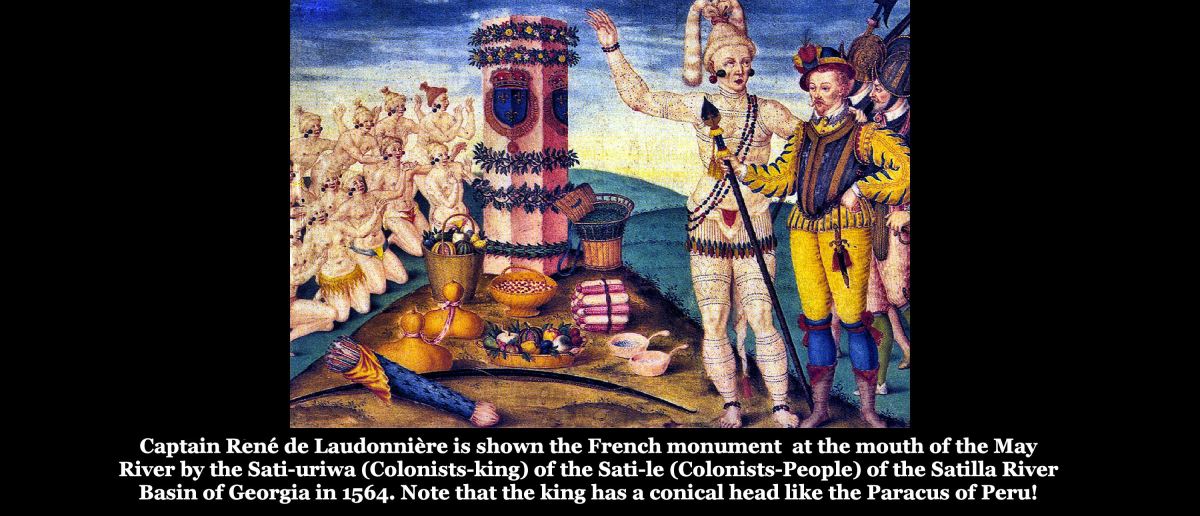
Since the 1880s, archaeologists and anthropologists in the Southeastern United States have defined Indigenous cultures by potsherds with English names. This has led them out into an orthodoxy, which is often, essentially mythology.
This mythology stated that once all of the Indigenous Americans had crossed the Bering Strain land bridge and chosen a place to live, they stayed at the same location until exterminated by European weapons and diseases. Well, the 5% who survived all became the federally-recognized tribes. No one else could possibly have real Native American ancestry,
Supposedly, all cultural changes were local phenomena, plus all Mesoamerican and South American cultivated plants in North America were transported by migrating birds . . . or Monarch butterflies, perhaps?
Anyone with an IQ over 65, who logically realized that immigrating peoples carried new genes, ideas and plant seeds with them were banished and shunned by anthropology professors . . . for fear that such heretical ideas would reach the tender ears of their students. That’s not a problem now because so few university students are majoring in anthropology.
The Many Peoples of the South Atlantic Coast Series
by Richard L. Thornton, Architect & City Planner
The mythical explanation of the painting above was created by Florida anthropology professors, but has been adopted by most anthropology professors at Southeastern Universities. It describes the scene as the King of the Satiuriwa Tribe at the majestic mouth of the St. Johns River in Jacksonville, Florida. Readers are told that although the Saturiuriwa Tribe was probably the most powerful and culturally advanced tribe on the South Atlantic Coast, it mysteriously disappeared between 1564, when the painting was made and 1566, when St. Augustine was founded.
As The Americas Revealed has told readers before, the St. Johns River did not have a mouth until a narrow channel was dug for fishing boats in the 1820s. Ocean-going ships could not enter the St. Johns River until 1860.
One does not have to be a rocket scientist to figure out that the Satille People lived along the two forks of the Satilla River until finally defeated in a long war with the Spanish Empire that began in 1565, when the Spanish attempted to build the first St. Augustine near the capital of the Satille on St. Andrews Sound in Georgia. The survivors ended up in the fertile bottomlands of Satilacoa Creek in Northwest Georgia. When their lands were given to the Cherokees in 1785, they moved southward and joined the Creek Confederacy.
Egghead kings all over the Southeast
My research is currently tracking across the Americas unique forms of architecture that originated in the mountains Taiwan 4500 years ago and Paracusa eggheads, who originated in southern Ukraine about 5,500 years ago. A fascinating fact I have uncovered is that the sons and daughters among the Paracusa elite in the Lower Southeast were literally purchased to become the nobility of tribes further north. This occurred at least as far north as Virginia, but maybe father. Powhattan was a Paracusa egghead, whose parents had been purchased from the Apalachete in Northeast Georgia.
What I am also finding that all of the emerging “kingdoms” that early French and Spanish explorers encountered on the South Atlantic Coast where ked by Paracusa nobility, who lived in either separate villages or in special large buildings. Their proto-kingdoms typically were composed by multiple ethnic groups.
So, what academicians have typically labeled “chiefdoms” were something else. They were multi-ethnic provinces, led by elite nobility, who were unusually tall and brainy. That is an entirely different understanding of the past in Eastern North America.
 The Americas Revealed
Last year I looked very closely at the Le Moyne/de Bry images of Rene de Laudonniere’s visit to the Timucua tribe in Florida. You use one of these images at the top of this article.
These images ended up being published with narrative captions on the bottom in Latin. I was able to find translations for many of them as part of the Jacksonville Public Library special collections.
https://jaxpubliclibrary.org/research/collections/le-moyne-de-bry-engravings-ansbacher-map-collection
https://cdm16025.contentdm.oclc.org/digital/collection/p16025coll9?utm_id=spec_coll_ansbacher_map_collection_catalog
Here’s some information from the translations. The chief we see in the image with the pillar at the top of the article was half a foot taller than the tallest Frenchman. And he was very proud of the fact that he had married his mother and had a number of sons and daughters with her. His father was still alive, but “lived with her no longer.” Father was still the leader of the tribe in war, as noted in other image captions.
When I read that I thought this was evidence of a shrinking bloodline. The elites are trying SO hard to preserve the Paracusa DNA that the son takes over as husband once his father is no longer fertile. It was accepted for him to procreate with his own mother rather than weaken the bloodline!
There are two complete images dedicated to hermaphrodites. Not transsexuals, but hermaphrodites who are born with the genitals of both sexes. Is this because of all the inbreeding? The text says they were very strong, which implies to me that they were also taller or larger people. Like the eggheads.
LikeLike
Very interesting Mary. I appreciate you going to that much time and work to find the captions. I have never even seen the captions attached to the images. By the way, those are not Timucuans. They a are Satile, a Georgia tribe, which owned the land where the real Fort Caroline was built on the Altamaha River. Their lands extended southward to Satilla River. About 15 years ago, Florida academicians began labeling the tribes in SE Georgia as “Timucuans” to cover up the fact that the fort in Jacksonville, is an inaccurate, 1/12th scale model, built in 1961.
LikeLike
Yes, you have written about the Satile. And many of the other images are about Fort Caroline and the surrounding area, and mention the May River. It evens mentions the abundant gold in the nearby mountains. That doesn’t sound like Florida…Of course they changed the name and relocated the tribe!
I have really enjoyed your research and biographical writings, Richard. I do a lot of research myself. I had been looking at the Le Moyne/de Bry images related to my interest in giants. I was happy to be able to apply some of the things I have learned from you and add another level of discernment to my examination of the images and captions.
LikeLike
The Timucua must have been a tribe that purchased the Paracusa blood as children, since they had such a short supply. Or maybe they were original Paracusa and had become irreparably diluted.
Also, I found a different version of the image you used at the top. It’s from a French website, so I am having trouble determining it’s provenance. And I can’t seem to post it in the comments I think it may have been an earlier version of De Moyne’s work. The search that brought it up was “images rene de Laudonniere”
It shows the tribe members clearly with eggheads, and their hair pulled up into a topknot. Then deBry gets the images edited into a much more cartoony version, dumbed down for the masses. The egghead and ponytails get turned into hats with plumes and animal tails. Like a guy getting a bad tattoo over the picture of his ex girlfriend.
LikeLiked by 1 person