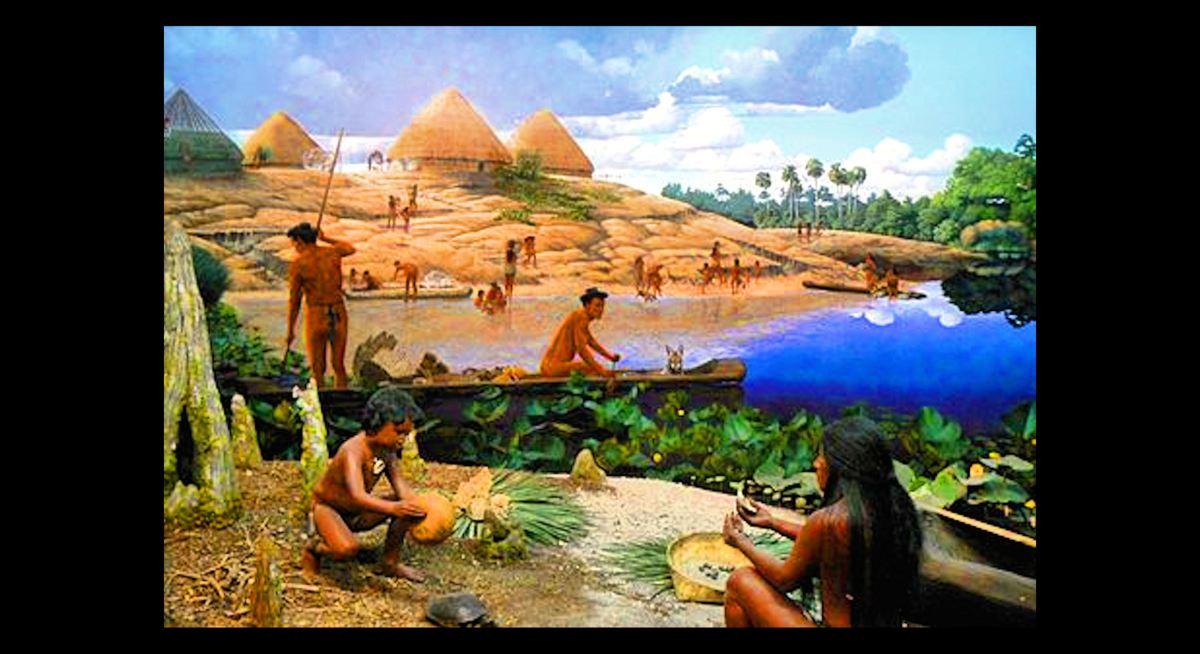
Or . . . everything that you wanted to know about the Timucuans, but knew that you would be wasting your time to ask a Florida academician or Google Search.
The Many Peoples of the South Atlantic Coast series
by Richard L. Thornton, Architect & City Planner
Timucua is the Spanish spelling of the hybrid word,
Tamakoa
Which means “Trade People or Tribe”
“Tama” is the Totonac, Itza Maya, Chontal Maya & Itsate Creek word for “Trade, Buy, Sell or Commerce”
“Koa” is the Middle Arawak suffix for “Tribe or people.” It is derived from the Carib suffix “kora,” which means the same.
The Timucua first began appearing on the northern Atlantic Coast of Florida around 1150 AD . . . driving northward a mound-building culture with some Mesoamerican traits. They have not lived in Florida for “thousands of years” as many Florida bloggers are now saying.
That would be impossible, because in 539 AD a massive comet struck off the coast of Cape Canaveral. Its shock wave and tsunami destroyed the barrier islands of Northeast Florida and created a tsunami debris ridge a few miles inland on the Georgia Coast which is up to 85 feet (26 m) tall today! That would have caused a total extinction of life in most of NE Florida and SE Georgia. This is why the Swift Creek Culture disappeared from SE Georgia instantaneously about that time.
In recent years, Florida academicians have been labeling all of SE Georgia, south of the Altamaha River, as being part of the greater Timucuan Empire. That is poppycock. As usual the Dixie anthropologists didn’t translate the Indigenous words.
There are no villages or tribes with Timucuan names north of the St. Marys River. The tribal-village names in Southeast Georgia are Panoan (Eastern Peru). Middle Arawak, Peruvian Arawak, Chontal Maya, Mexica (Nahua), Taino and Carib.
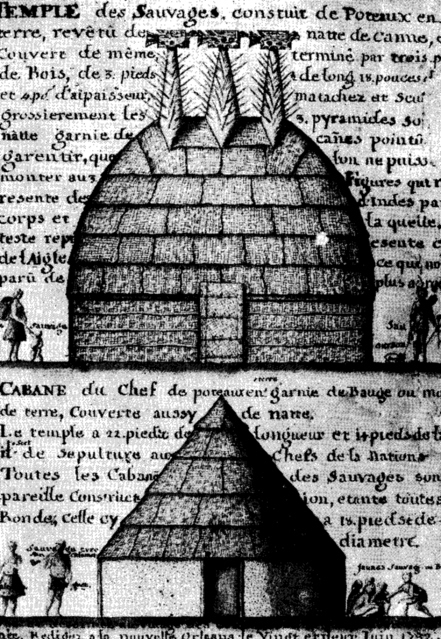
Below is an eyewitness drawing of two types of Timucuan houses.
Nowadays, the National Park Service website and a legion of Florida History websites are filled with drawings made by Fort Caroline’s resident artist, Jacques Le Moyne, which are labeled “drawings of the Timucua.” NONE of these drawing are of the Timucua. Le Moyne never went that far south and they were arch-enemies of the tribes in SE Georgia near the real Fort Caroline.
The drawings portray the Satile Tribe, which had villages between the Satilla and Altamaha Rivers in Georgia. They spoke the Panoan language from eastern Peru. Their name means, “Colonists.” Florida academicians call them the Satiuriwa, but that was the title of their king. The word means “Colonists-King” in Panoan.
Some Satlle moved to west-central Georgia to get away from the Spanish. Others moved to near Cartersville, GA. Both branches eventually joined the Creek Confederacy. ,

