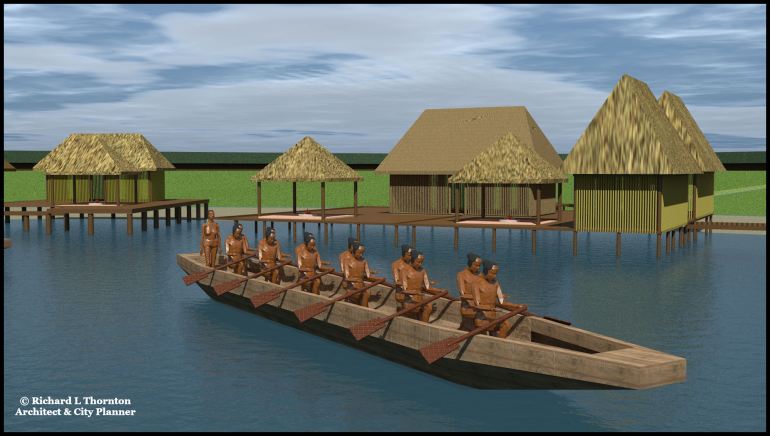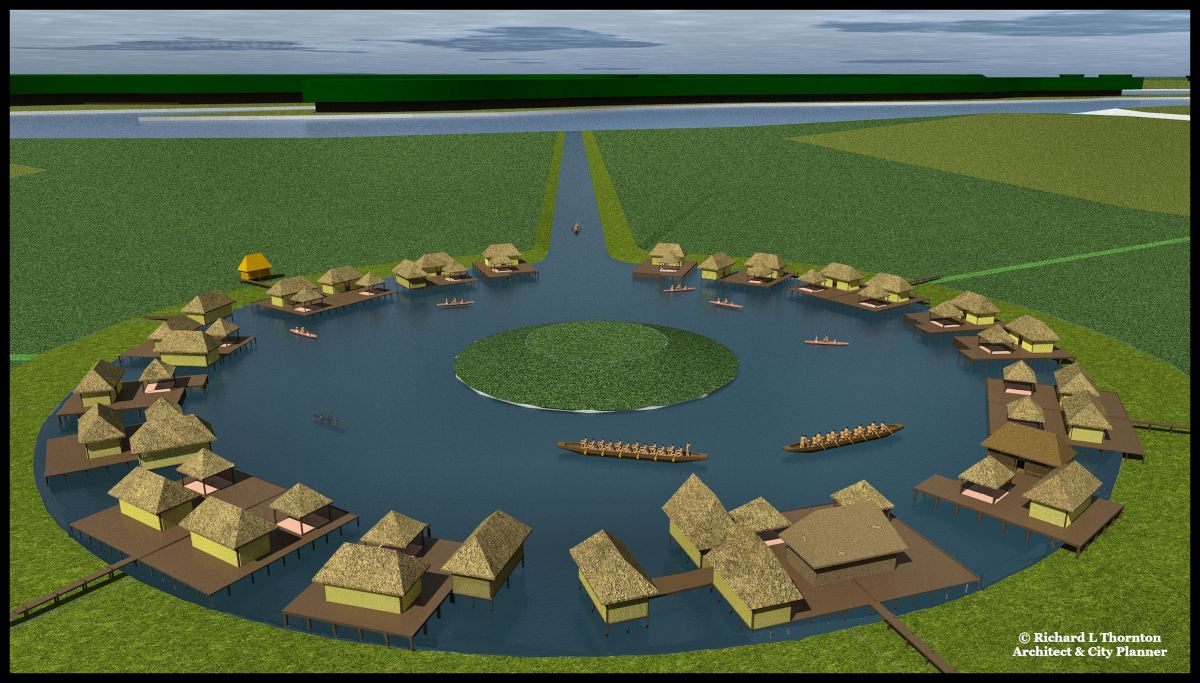
Savannah is the oldest, continually occupied urban site in the Americas . . . actually, in the world. Damascus is listed as the oldest city, but it was founded over 500 years later.
Why in the heck is this site not a National Historical Landmark or at least a State Historic Site?
Excerpt from The Sea Peoples of the South Atlantic Coast
by Richard L. Thornton, Architect and City Planner

Recent archaeological work changes everything
The last time that I wrote an article on the Bilbo Mound was during the Pandemic. Local archaeologists investigated sections of the mound and pond in advance of destruction of a portion of the ancient canal that connected the mound and harbor to the Savannah River. Their work received very little publicity in the Savannah Area and in professional journals. It is not clear, why other archaeologists did not seem particularly interested in their findings.
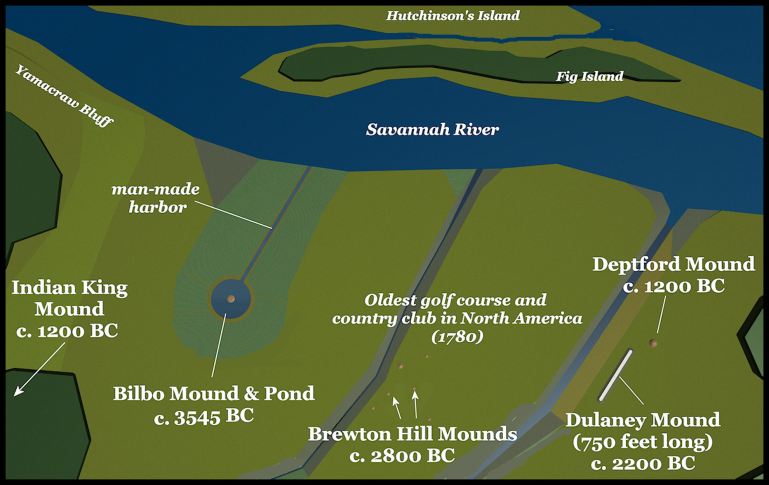
The Bilbo Mound has remained a mysterious legacy from the past for many decades. Why would “someone” excavate a canal and harbor almost 5,700 years ago at this location? Such a large scale project implies waterborne transportation, far more sophisticated than two passenger dug-out canoes. The discovery of a timber platform village merely broadens the scope of this mystery. Multiple styles of pottery suggests that the mound was used for burials long for many centuries after the platform village was abandoned. It is unlikely that the who’s and what’s of this site will be understood until a comprehensive archaeological investigation of the mound, pond, village site and environs occurs.
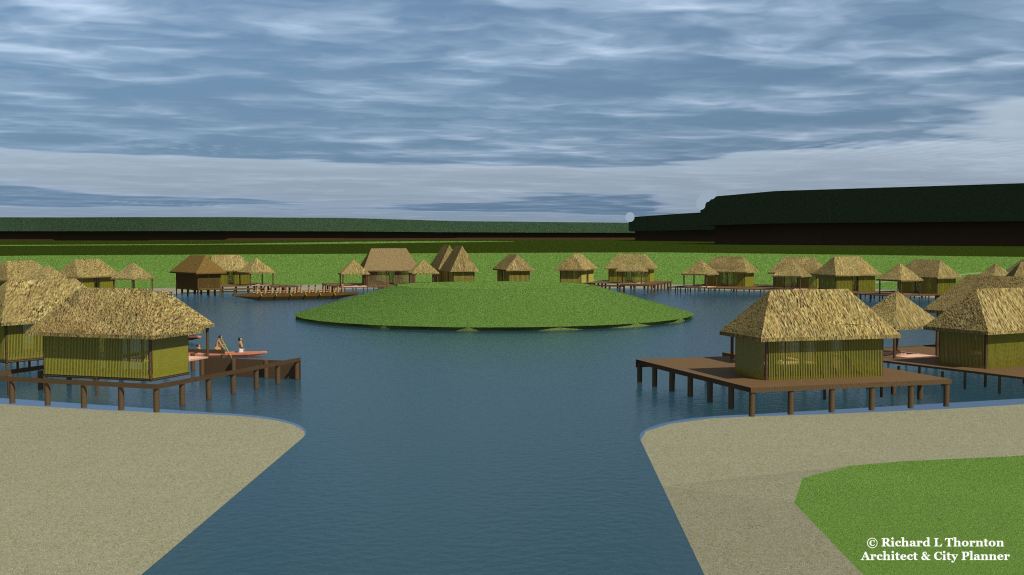
The latest archaeological work received very little publicity because the municipal government was very anxious to start work on a large storm drainage in the location of the ancient hand-dug canal. Savannah’s leaders apparently did not understand the significance of the remnants of an ancient wood platform village being found around the mound. What’s really odd is that in this exact same time period Central European Neolithic peoples were erecting platform villages in lakes and ponds.
To date, no human skeletal materials have been found in the detritus of the platform village, so it is impossible to state, who built it. The acidic soil and high water content of the burial mound almost completely consumed the original human remains.
Whatever the ethnicity of the original village, people continued to live there and nearby A cluster of burial mound, dating to at least 2,800 BC, were erected immediately south of the Bilbo village site on Brewton Hill. Scattered about Central Savannah are dozens of earthen mounds, earthworks, shell mounds and shell rings, built at various times between 3,500 BC and the 1600s AD. A few shell mounds are believed to be as much as 7000 years old.
Initial archeological discovery ignored by academicians
In 1957, geologist-archaeologist William G. Haag (aka William C. Hague) traveled from Louisiana to Savannah to analyze the soil bearing conditions of a proposed oil company terminal. An ancient shell mound had already been destroyed at that site, prior to his arrival.
After finishing the work for his client, he obtained permission to excavate the Bilbo Mound out of his own pocket. He dug all strata in the mound, even below the evidence of ceramics. He carefully removed charcoal and decomposed wood from several strata then upon returning home, he ran them through the radiocarbon dating process,
This was the first time in Georgia that the pottery styles had been assigned a precise time period via radiocarbon dating. It would be the early 1970s before Ocmulgee Mounds and Etowah Mounds would have the first firm radiocarbon dates. His accurate dates for the pottery styles contradicted the inaccurate speculations of Georgia’s archaeologists, so they ignored his report and made certain that few people as possible were aware of it – especially the students. I first learned about Haag’s work in Georgia, while visiting Poverty Point, Louisiana in February 1995 . . . but at the time had no clue that within a decade I would become heavily involved with Prehistoric architecture.
Haag passed away in the year 2000 . . . still viewed as a “non-personed” pariah by Georgia archaeologists, but highly respected in the Mississippi River Basin. The radiocarbon date for the Watson Brake archaeological site in northern Louisiana was not obtained until 2005. It was published in the American Antiquity journal (Vol. 70, No. 4, October 2005, pp. 631–668) by Joe W. Saunders, Rolfe D. Mandel, and colleagues. The published date is calibrated to 5470–4984 cal BP (approximately 3500–3350 BCE. It affirms that there were humans in North America building major public structures 5,500 years ago.
Much of my time these days involves the documentation with the precise tools of architecture profession, the HUNDREDS of ancient architecture sites in the Lower Southeast that were initially discovered by reputable, professional archaeologists, but whose peers or subsequent generations decided to conceal or conveniently “forget” because the site did not fit their orthodoxies. What I found in late 20th century archaeologists here was a pronounced tendency to “dumb down” Indigenous Americans . . . i.e. make them seem more primitive than they really were.
My efforts are particularly needed now, because there are so few people, studying archaeology as a career in Southeastern universities. Late 20th century archaeologists in Georgia tended to conceal archaeological sites from the public to the point, where profession forgot where early generations of archaeologists had discovered unusual or large manmade structures.