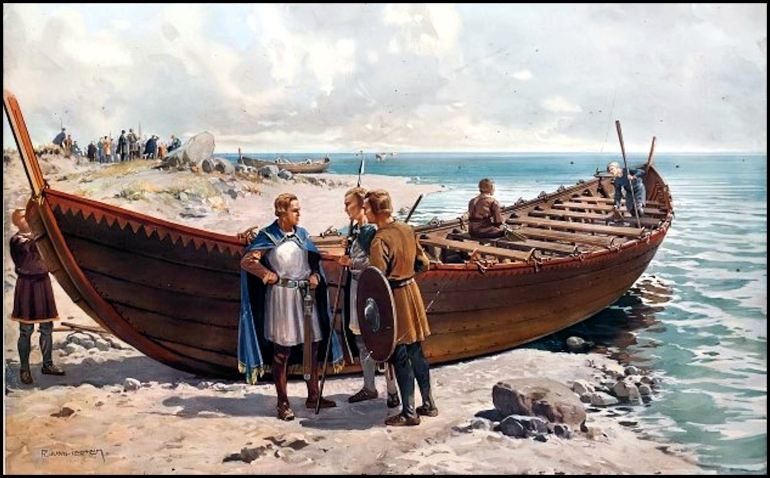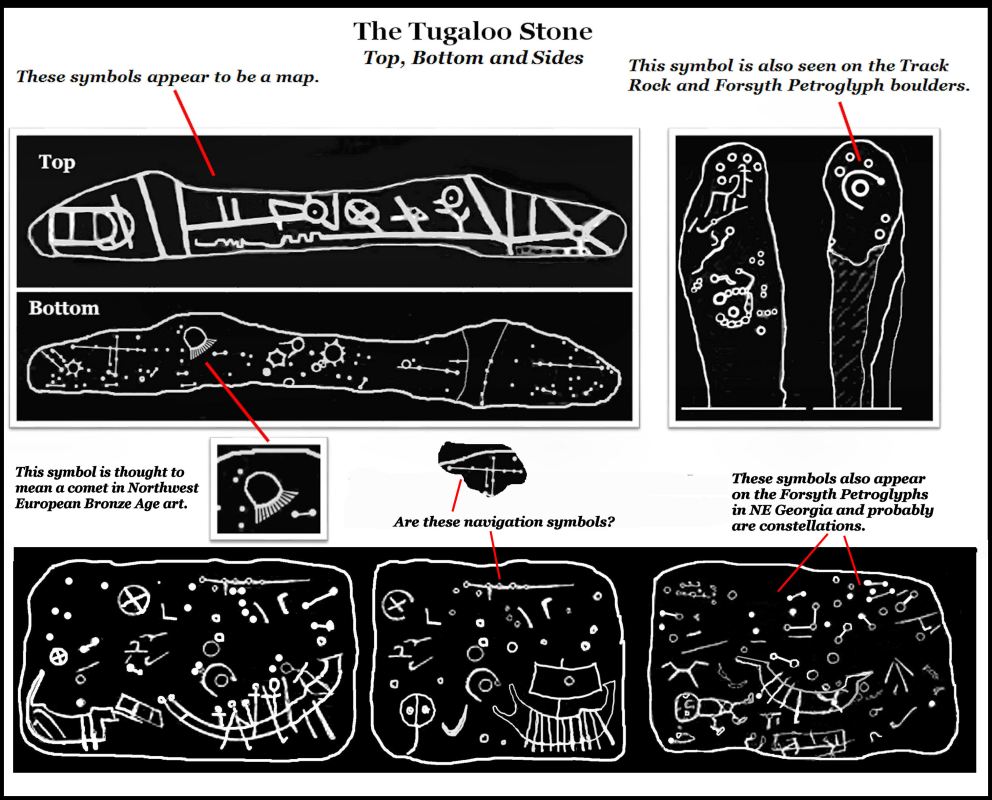
The Creek and Western Maya word for a king or leader of a town is mekko. The word, which in all languages actually means “great,” goes back to Bronze Age Scandinavia and was used there until the Christian Period.
Why did most of the Uchee tribes and some of the Creek Confederacy members have Irish or Scottish Gaelic names, when their original DNA was either Austronesian or Chontal Maya, in the case of the Creek tribes?
Why did the Windover Pond Bog bodies carry a combination of DNA markers that are labeled “Sami-Finnish-Northwest Siberian” in my family’s DNA tests?
Why are there are also pure Latin and Greek words in both the Aztec and Creek languages?
There were two distinct streams of Ancient Genes and Indo-European words flowing into Southern Mexico, the Upper Amazon Basin and what is now Georgia and South Carolina . . . Bronze Age Scandinavian and Bronze Age Greek. Dr. Donald Yates labels these mysterious components, the Odin Gene and the Helen (of Troy) Gene.
The answer is “I don’t know,” but these are definite facts, not theories. Nevertheless, they change everything that we were told in our history textbooks about the ancient past in the Americas.
by Richard L. Thornton, Architect & City Planner
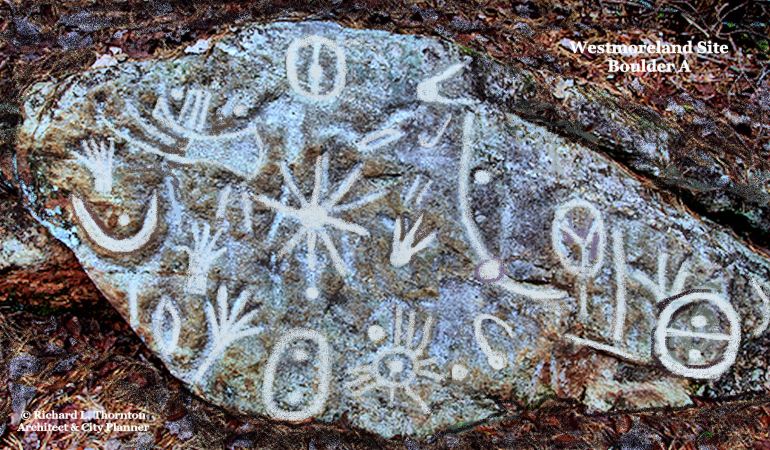
The Westmoreland Petroglyphic Boulder on the slope of Chimney Mountain, Georgia contains many symbols found on boulders and rock faces near Nyköping, Sweden, which have been firmly dated to around 2000 BC. They are the oldest petroglyphs in Scandinavia.
For most of my life, I have scoffed at the books by “pseudo-archaeologists,” which claimed that peoples from Europe or the Middle East founded the civilizations of the Americas. What the genetic research by Dr. Yates and my linguistic-architectural-petroglyphic research has found is that the mixing of small numbers of many peoples from peoples with various peoples from Asia, stimulated the rise of civilizations in the Americas.
It was a two=way street, though. The oldest earthen mounds, shell middens, stonehenges and metal tools were in the Americas! About 70% of the total vegetative food, consumed in the world are crops that were first cultivated in the Americas. Almost all commercial strawberries in the world are at least 1/2 descended from the strawberries domesticated by Creek farmers in the Georgia Piedmont. Most large peach varieties of the world are descended from a large, humid, temperate climate peach, which Creek farmers developed from a small, arid-tropical climate peach grown by Spanish missionaries on the Georgia Coast.
This revolutionary change in understanding came after I purchased a powerful HP AI computer in early 2025. Over the previous 20 years I had accumulated a long list of place names, tribal names and Native American political titles, which I could not explain with dictionaries for indigenous languages in the United States. The majority were along the South Atlantic Coast, but others were from the Southeast’s interior.
The AI computer completes increasingly complex tasks by learning successful search patterns from past assigned tasks. In other words, it essentially is able to program itself over time. The secret is to present the questions to the computer in a mathematical or statistical format.
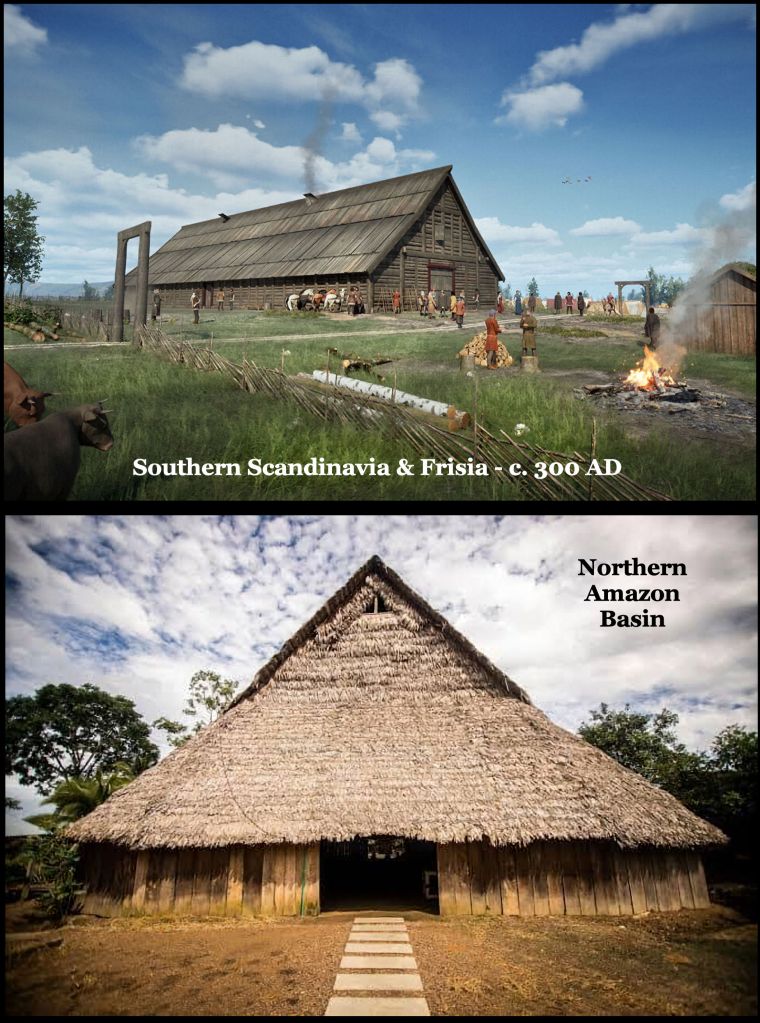
Giant apartment buildings in Scandinavia and the Amazon Basin, plus the Georgia and South Carolina Coastal Plain
During the Late Bronze Age and Iron Age in Southern Scandinavia, Frisia and eastern Scotland, most people lived in massive long-houses, which could hold the entire village, up to 500 people or more. During the Late Iron Age and Viking Age these evolved into “Halls” where the extended families of mekkos, jarls and kings lived, but were joined in communal feasts by all the karls (freemen).
When the French and Spanish first arrived in the region from approximately Midway, GA northward to Port Royal Sound, SC, they encountered megastructures virtually identical in size, form and function to those in Iron Age Scandinavia. They still exist to this day in the northern Amazon Basin.
The Coastal Plain inhabitants of Georgia and South Carolina quickly discovered that the long houses (malocas) were death traps when assaulted by Spanish soldiers. The projectiles of firearms easily penetrated the basket-like walls. Armored infantrymen could wipe out an entire village by tossing torches to the roofs. Also, the coastal population plummeted due to European diseases. By the time that British settlers arrived in the region in 1670, no such megastructures are mentioned.
A Georgia tribe with an Iron Age English name? Impossible!
The biggest challenge and most surprising result in my 20-year-long quixotic journey into extinct languages was the tribal name, Alecmanni. They were mentioned by several members of the Fort Caroline (French) Colony, including its commander, René Goulaine de Laudonnière. The tribe had become very wealthy, trading medicinal herbs all along the May River (Altamaha) northward to its headwaters near the Apalachen Mountains. Particularly valuable was the bark of the cinchona tree, from which quinine is made. Biologists have found feral cinchona trees growing along the Altamaha.
De Laudonnière stated that the word, Alecmanni meant “medicinal herb – people.” For years, I sought in vain for any indigenous language in North America or Mesoamerica that were similar to Alecmanni and meant “medicinal herb – people.” . . . NADA!
Once I learned how to operated the AI computer, I typed in this inquiry. Alek – manni = or similar to English words, Medicine herb – people.” In what language does Alek – manni is this true? In about three seconds, I received this message:
Manni was the Archaic Swedish and Archaic Northwest Germanic word for “noble people” or “noblemen.” In the Roman archives of their wars with the Germans, the Marcomanni (Forest-noblemen) and Allemanni (All noblemen) are mentioned. A single commoner was a man. The plural of man was originally manen, which was later shortened to men. However, the word for a noble was in the singualr mani and plural, manni. “I” was the suffix and prefix in Anglisk that meant “principal” or “
Only one language in the world, uses the word Alek with a similar meaning. Alec was originally the Muskogee Creek word for an herbal healer, but now means a medical doctor. Should I explore similar words in Germanic and Scandinavian languages, even though they are not in North America like Muskogee-Creek?
Note: Just like in Archaic Anglisk, “I” is used as a prefix and suffix to express a principal object. Thus, the word for town in Itza Maya, Tula, became the word for a capital town in “Itula” – Written today as Etowah. I have no explanation why this gramatical feature would be found in Archaic English, Itza Maya and Muskogee Creek.
YES
Aleka was the Anglisk word for an herbal healer before the Angles merged with the Saxons, Jutes and Frisians in Britain. Leka was the Archaic Anglisk and Archaic Swedish word for a medicinal herb. The “A” prefix was and is an enabler, which means “to make happen.” For example, the Archaic abedd, originally meant to sleep in the same bed.
The probable original tribal name was Aleckamanni, Over time, it was either shortened to Alekmanni or perhaps, the French misunderstood the pronunciation of the word.
No records could be found of an Anglisk fleet sailing to North America during the Iron Age and Roman Period, but there were many voyages to the island of Britain. There were many Frisian voyages to other parts of the Roman Empire and Africa, which remain anonymous. Perhaps that is the case for this mystery.