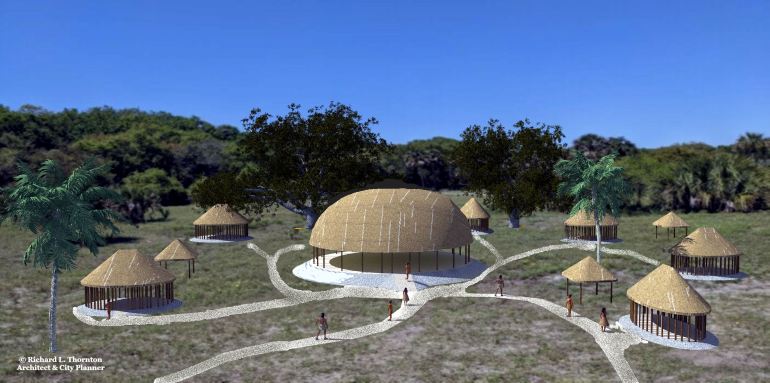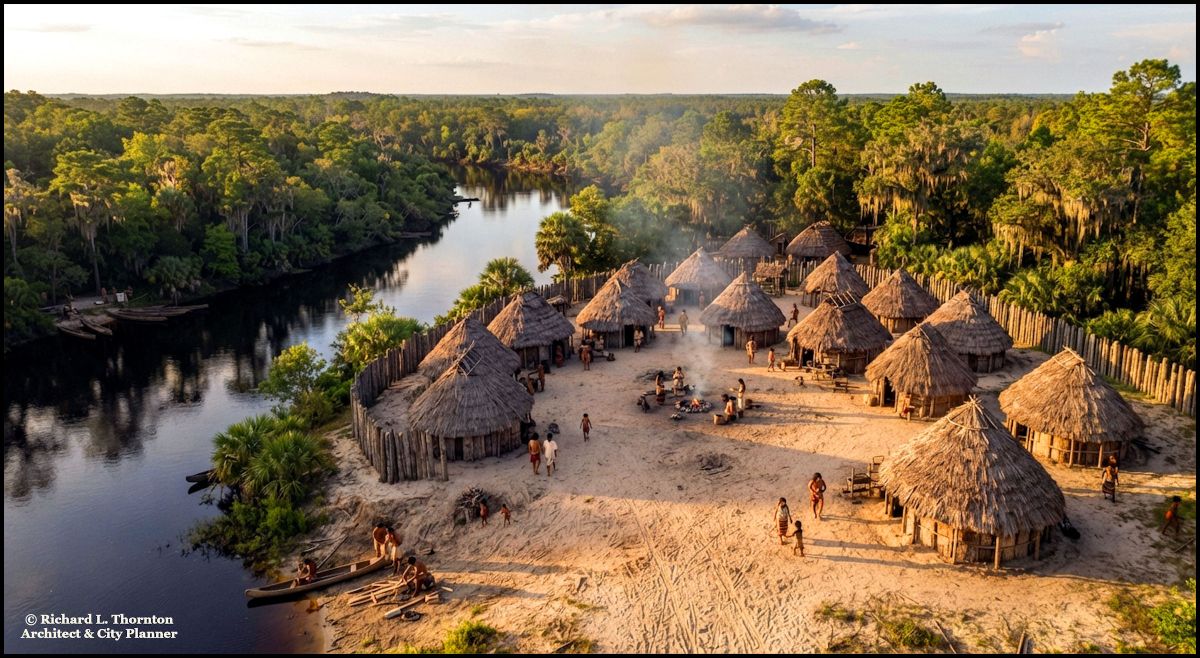
This is how the region looked around 1500 AD.
National Native American Heritage Month
(Above) The village of Marahica was on the north side of the St. Marys River and occupied by Peruvian Arawaks. It was visited by an exploration party from Fort Caroline in 1564 AD.
Rigorous linguistic and architectural analysis has determined that in 1500 AD, the majority of people in the Coastal Plains of South Carolina, Georgia and Florida originated from either South America or the Caribbean Basin. Most of the survivors of European diseases and Rickohocken slave raids assimilated into the Creek Confederacy or Seminole Confederacy.
The coastal plains of South Carolina and Georgia in Pre-Columbian times can best be described as “ethnic Brunswick stew!” The original names of the Georgia Barrier Islands had names in the Itza Maya, Chontal Maya, Samoan Polynesian, Shipibo Peru). Carib, Venezuelan Arawak and Peruvian Arawak languages.
Atolliteka (Aztec)
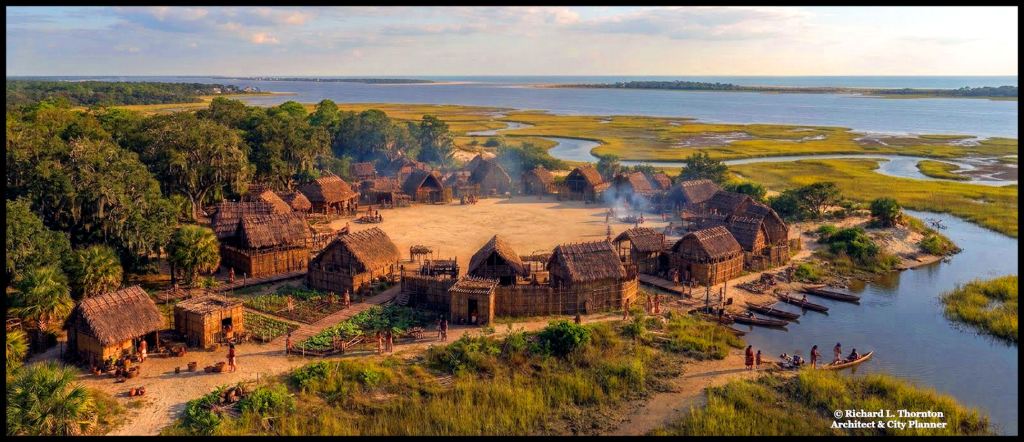
Arolliteka means “Corn gruel.” Atolli is essentially liquid corn grits with flavoring. The equivalent word in Muskogee-Creek is sofke. This village was located on the southern tip of Cumberland Island, GA and one of five communities around the mouth of the St. Marys River with Aztec names. Their names are easily translatable with a modern Aztec dictionary. The large capital town was at the location of present-day St. Marys, GA. Its name means “Large earthen pyramid surrounded by marshes.”
Choya (Panoan – Peru)
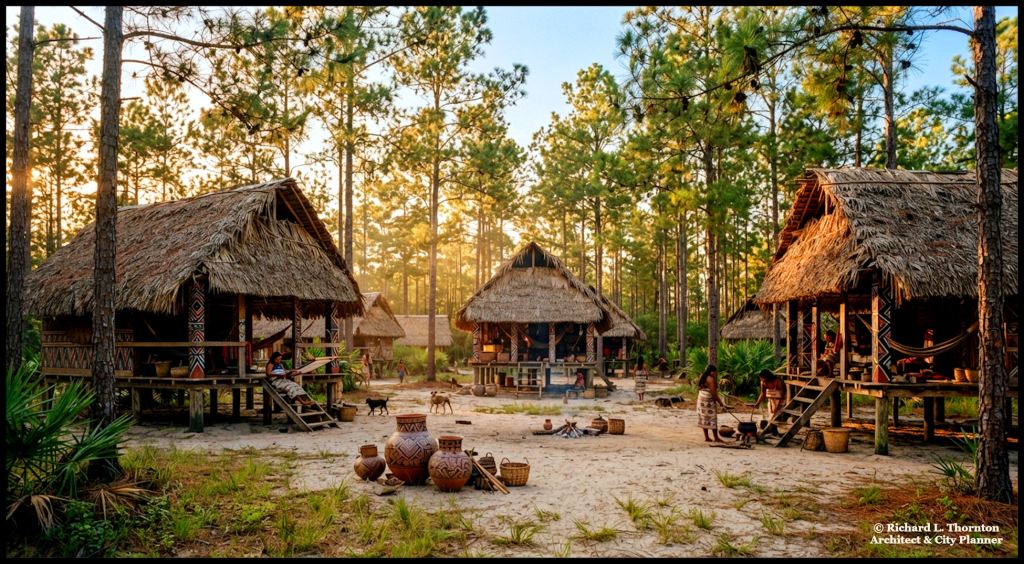
Choya is a Panoan word from Peru that means “carpenter ant”. Carpenter ants were parasites of the longleaf pines that were endemic in the region. The village was probably located on the northeastern edge of present-day Waycross, GA near the Satilla River. Note that these houses are almost identical to the houses that the Seminoles constructed in Florida during the late 1700s and 1800s.
Seminole Village i– mid-1700s.
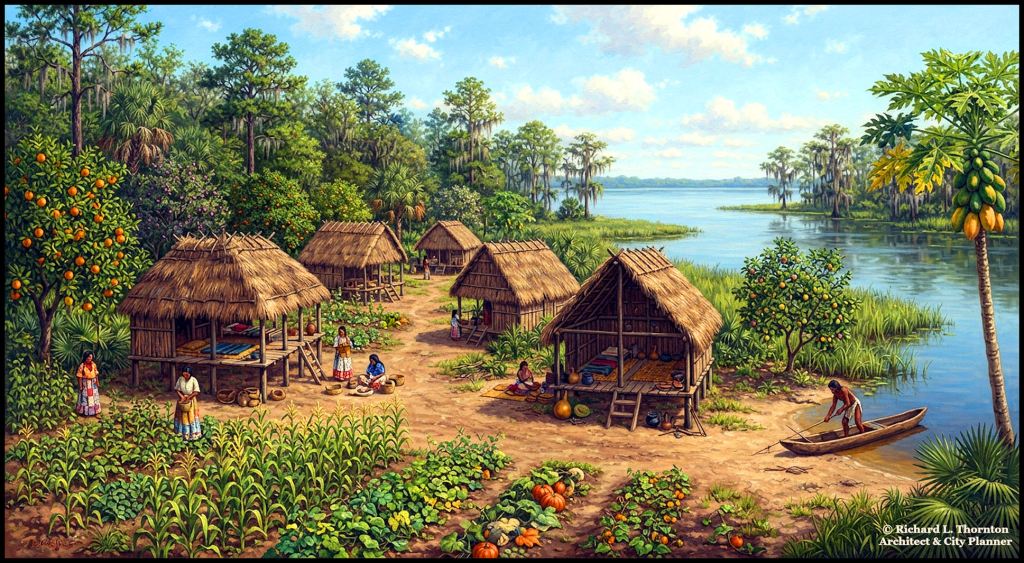
Seminole hamlet on Lake Apopka, Florida. Identical hamlets would have been seen around the Okefenokee Swamp and along the Southeast Georgia rivers.
Guadalquini (Jekyll Island) -Taino)
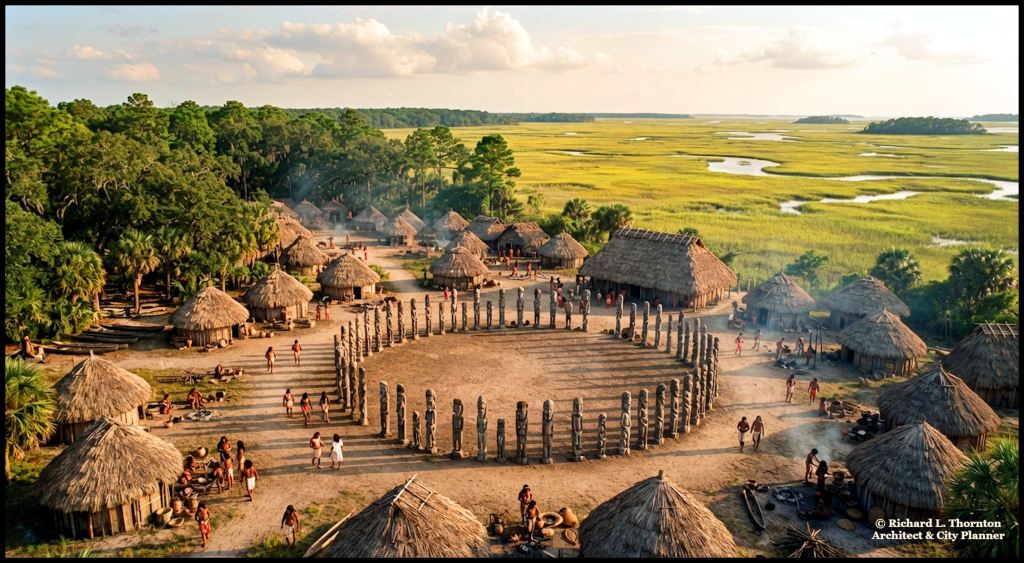
The word, Guadalquini, indicates that Jekyll Island was a regional ceremonial center for the Taino. Taino villages occupied a broad swath of Georgia from Jekyll Island to Southwest Metro Atlanta. They later became members of the Creek Confederacy.
Yama and Wahale (Chonal Maya – Tabasco)
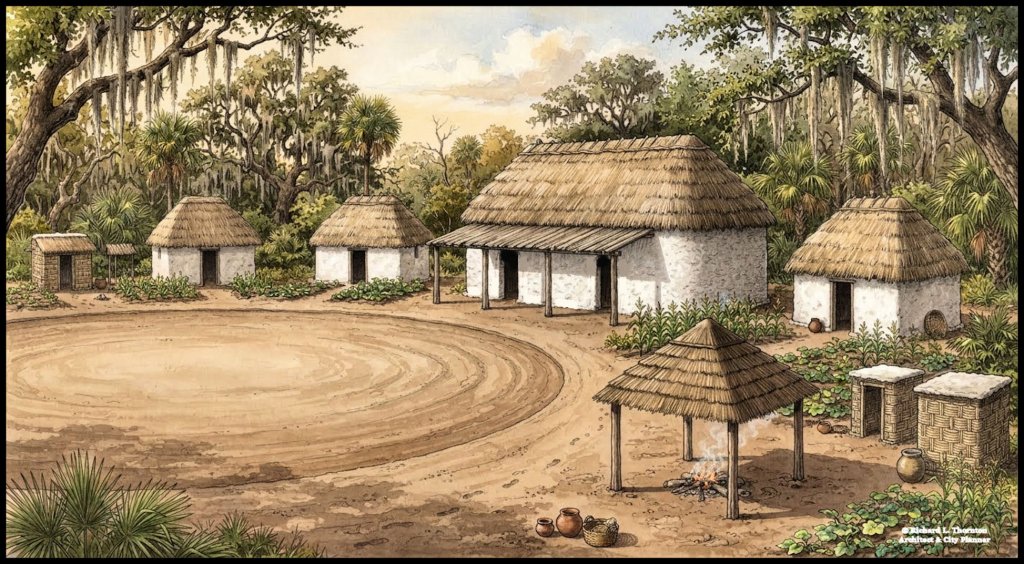
The Wahale (Guale in Spanish ~ Wally in South Carolina) were a branch of the Yamakora or Chontal Mayas. The word means “Southern Sea People.” The originated on the Gulf Coasts of southern Veracruz, Tabasco and Campeche states in Mexico. They were sent southward to what is now called St, Catherines Island, GA around 1500 AD by the king of Apalachikora (Irene Island on the Savannah River) to establish dominance over the Panoan villages on the island and nearby mainland. Around 1600., the Spanish established the administrative center for its mission system in Southeastern North America at Wahale.
Much larger towns with large ceremonial mounds were established at the mouths of the Santee (SC), Ashley(SC) . Savannah (GA), Altamaha(GA) . Ogeechee (GA), Turtle (GA), Satilla(GA) and St.Marys Rivers(GA). Their plans appear to have been similar to Proto-Creek towns within the interior of Georgia and South Carolina. The provincial capitals from the Altamaha River northward had Chontal Maya names. South of the Altamaha, they had Panoan and Aztec names.
Takatacuero (Venezuelan Carib)
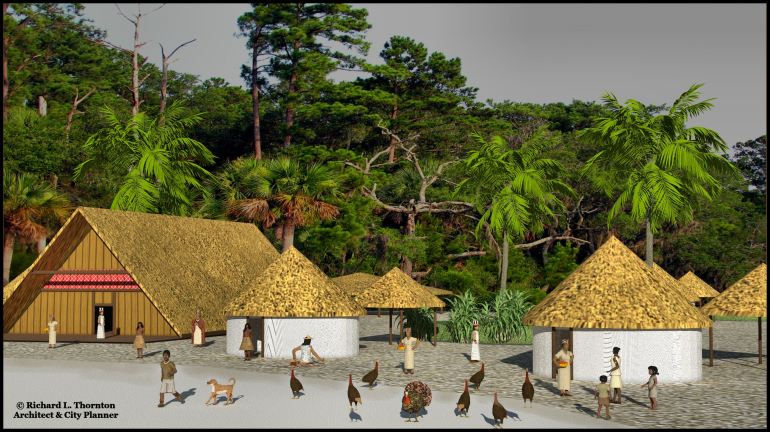
Takatacuero was located south of the Medway River in the vicinity of Midway, GA and Ossabaw Island. The name means “Toucan People.” The caney or communal building was an A-frame structure with a heavy timber frame and palmetto frond roofing. The smaller houses were called bohios and typically held a single family. Their walls were usually wattle and daub, but could be interwoven river cane stalks.
Wassaw Island (Samoan)