National Native American Heritage Month
by Richard L. Thornton, Architect & City Planner
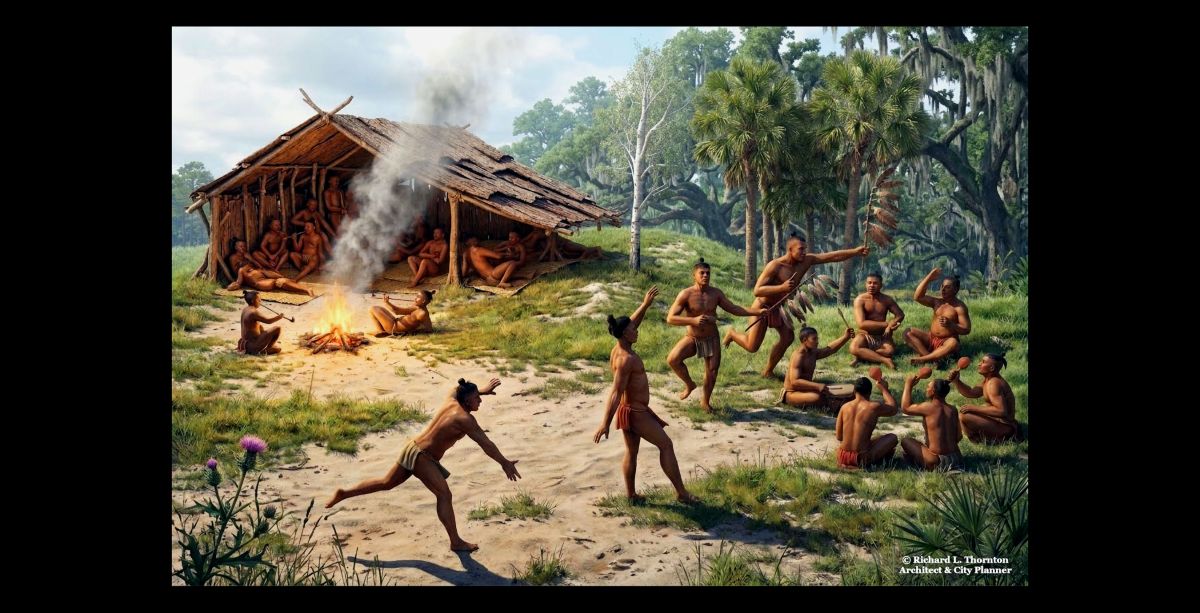
This computer-generated rendering is based on a water color sketch by German artist Philipp Georg Friedrich von Reck in 1734. He was an administrator of the Salzburger Colony, which befriended its Uchee neighbors. I thought readers would enjoy seeing what is possible with the new AI based architectural rendering programs. The secret to realistic portrayals of indigenous peoples, however, is doing thorough research on the subject, prior to creating the image.
When I attended Georgia Tech’s School of Architecture, everything was done by hand. My drafting was of acceptable quality, but I was mediocre at painting perspective renderings. I didn’t start getting A’s until I convinced professors to let me construct models of the buildings, rather than painting them. LOL Although I am a terrible artist, I was a skilled craftsman.
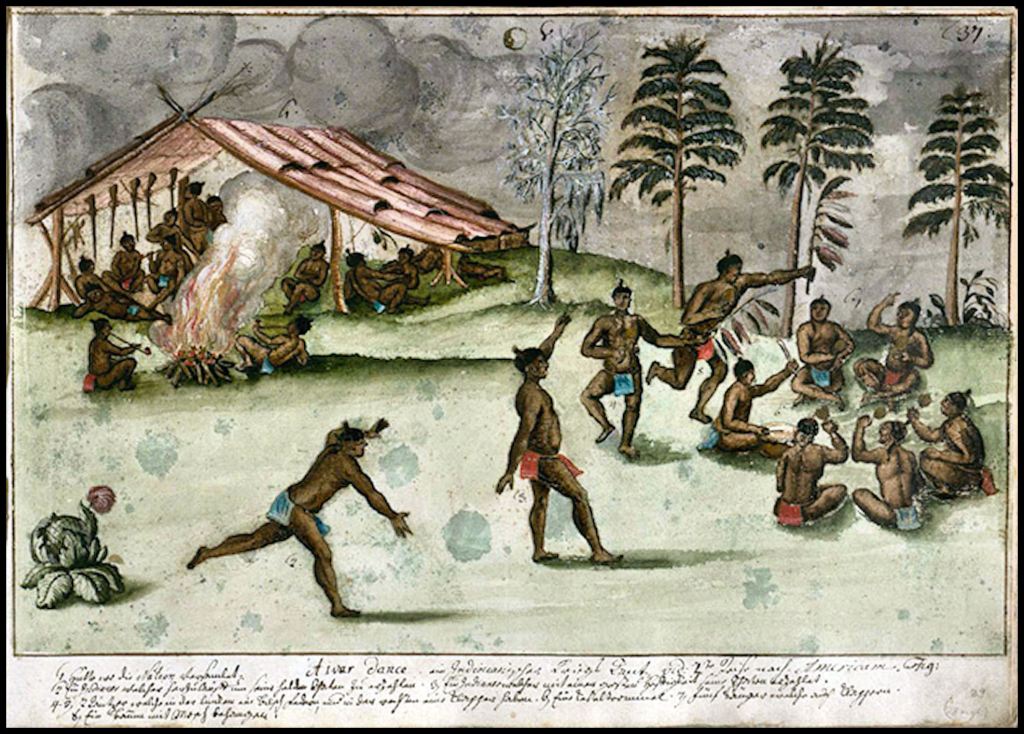
Original water color sketch by Von Reck – now at the Danish Royal Library in Copenhagen
This is hard for me to believe, but it has been 40 years since Microsoft invited me to participate in its creation of the Visio Computer Aided Design and Drafting program. I was given a free copy, when it was ready for market. That made an enormous difference in my life and professional practice. It was the end of spending long hours stooped over a drafting table.
My classmates, who had gotten A’s from fancy water color renderings and perfect ink line work, usually didn’t make the transition to computers. By the late 1990s, their skills were useless in a modern Architecture or Engineering office. They were forced to become reps for building materials manufacturers or work as artists in advertising firms.
Ironically, I am now essentially a Beta Tester of Microsoft’s Gemini . . . teaching the AI robots how to produce photorealistic imagery of the natural environments, where the buildings once existed or are to be built.
PS – My first desktop computer in 1984 cost the equivalent of $9,096 today and had 125 KB of memory storage in a cardboard floppy disk. I had to buy a new computer in 1987 to continue working with Microsoft as a beta-tester. This state-of-the-art Leading Edge brand computer had a whopping 30 MB of hard drive memory storage. Strangers in Shenandoah County, VA would stop by my office just to see this amazing contraption. It even played sounds! Initially, I had to drawing by typing in computer commands for each line or geometric figure. About a year later, Microsoft sent me (for free) a new mouse that it had designed, which was compatible with its Visio CADD software. My, my, my . . . the world has changed.

