Architecture of the North American frontier Series
Yes . . . Really! Although today classified today as a sub-tropical species that only grows in coastal plains near the Atlantic Ocean and Gulf of Mexico, they once covered the Shenandoah Valley. Yet . . . until the late 1990s, this Valley was blanketed in snow for much of the winter.
Also, until the mid-1800s, the mountain slopes of the Valley were dominated by Eastern Hemlock trees, which made excellent siding boards for houses, but normally only grow in regions of heavy rainfall. Shenandoah County. VA is the driest county, east of the Mississippi River. Both species are highly resistant to fungi, termites, Carpenter bees and Carpenter ants.
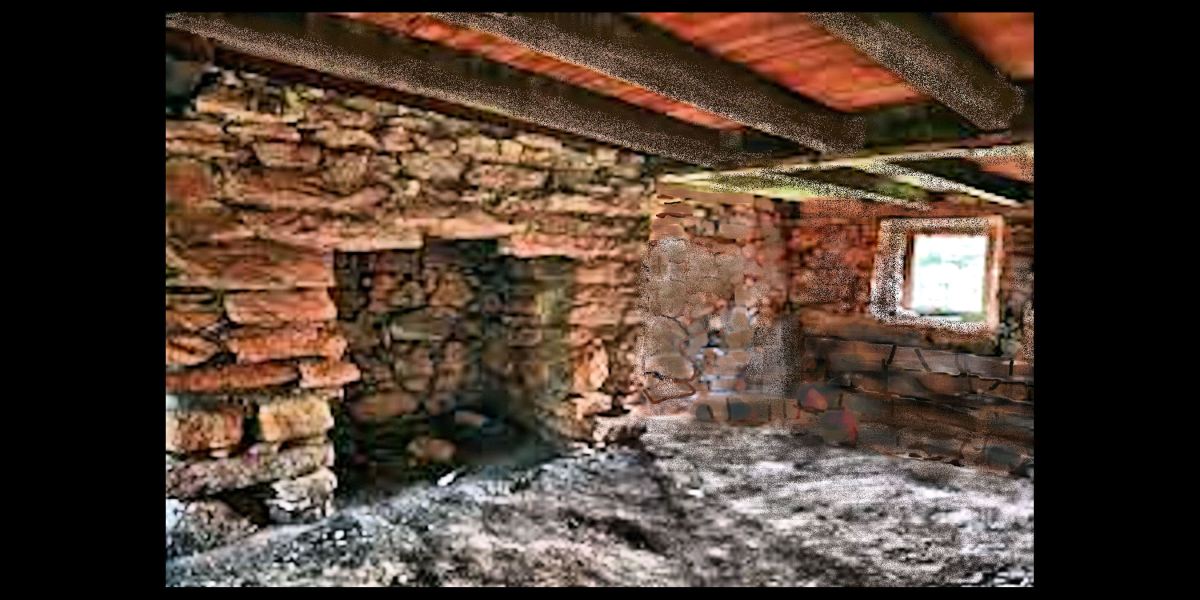
Above is a photo from autumn 1987, of the Southern Yellow Pine log floor joists supporting the Keeping Room of my house before it was restored. The logs, most still covered in bark, are in perfect condition. This room was the Winter Kitchen of the house, but in 1754, it was originally constructed by Col. George Washington as the first floor of a multi-floor log blockhouse for the Virginia Provincial Militia.
by Richard L. Thornton, Architect & City Planner

All of my log architecture historic preservation projects, after returning to Georgia, have been relatively large, “virgin” chestnut log houses, built in the early 1800s by mixed-blood Cherokee or Creek families. At every site, I was forced to recommend demolition of wood frame additions to the houses from the mid-to-late-1800s, because the wood had been ravaged by wood-devouring insects.
A Historic Preservation Architect from Atlanta challenged my statement in a recent article that the oldest generation of log houses on the American Colonial frontier were the most likely to survive until the 21st century. I stand by that statement . . . at least in the areas, where I have lived and practiced architecture . . . the Western North Carolina Mountains, the Virginia Mountains and the Georgia Mountains.
I sent her photos of the 240-year-old Southern Long Leaf Pine log joists in my Virginia farmhouse. She sent me back a link to a Wikipedia article on Southern Long Leaf pines, which stated that they are sub-tropical trees that only grow along the South Atlantic and Gulf Coasts. She added a note – “Before making any more rash, unprofessional statements in public media, perhaps you should drive down to Southeast Georgia to learn what a Long Leaf pine looks like.”

LOL – This is me in our yard in Waycross, Georgia next to the Okefenokee Swamp . . . at my sixth birthday party. The only trees, growing in our yard were Southern Long Leaf pines!
Personal experience aside, there are the statements made by eyewitness, Samuel Kercheval, in his fascinating 1833 book, A History of the Valley of Virginia. He wrote that between their extensive use in building construction and the masts of American ships, the seemingly infinite number of Long Leaf pines in the Valley were by then almost non-existent. For unknown reasons, new Long Leaf pines did not replace those harvested. Deciduous trees took their place.
Kercheval also stated that the Valley contained hundreds of earthen pyramids and burial mounds, when the first German, Dutch and Swish settlers arrived. The artifacts that these advanced Native Americans left behind . . . such as sophisticated painted pottery, statues, stone metates and stone-lined sarcophagi . . . suggested that they originated in Mexico.
I wish that I had known about Kercheval’s book while living in the Valley. I repeatedly encountered such artifacts on construction sites in the bottomlands of the Shenandoah River, but the archaeology professors at the University of Virginia would not look at them or even talk to me.
If you want to learn more about the Southern Long Leaf pines of the Shenandoah Valley and Northwest Virginia’s little known Native American history, below is the link to online chapters in The Shenandoah Chronicles.
 The Americas Revealed
Long leaf pine forests need fire, much like rain forests need rain.
LikeLiked by 1 person
I have also wondered about that. Perhaps the German farmers did not burn over the land like Native Americans did. On the other hand, Southern Long Leaf pines sprout everywhere in Waycross, GA, where I was born. No one burns over the land.
LikeLiked by 1 person
Yes, they do sprout and will grow and thrive unless they’re crowded out by other species and shrouded by leafy ground cover. My daddy was a small-scale tree farmer (in his spare time and on the weekends). We used to traipse around the woods carrying bags of longleaf saplings while he chopped down scrub oaks and cleared away underbrush to make room to plant. His capacity to ‘burn’ was limited but he understood the principle, and employed it whenever he could. While reading your article, I remembered this one published in Garden and Gun Magazine in early 2008 featuring an interview with a South Carolina landowner about efforts to bring back the longleaf pine. It’s an interesting and informative read. Unfortunately, (and all too typically), while decrying the demise of the ancient forests of the ‘Old South,’ and the exploitation and destruction brought by invading investors hoping to make quick bucks off of a desperate labor force, etc., the writer fails to venture back far enough to credit the Native American peoples who once populated these vast areas and well understood the ecology of the great forests that flourished for thousands of years. BUT it does explain how that process works including the natural benefits of fire, and the reasoning behind the more recent drive to restore what was lost to hard times, ignorance, and greed.
As always, thanks so much for expanding the story to bridge the information gap.
Hope you have a nice weekend.
https://gardenandgun.com/feature/the-longleaf-pine/
LikeLiked by 1 person
You have a grand weekend too! It is supposed to rain here, which is just fine with me. We have been in a drought!
LikeLiked by 1 person