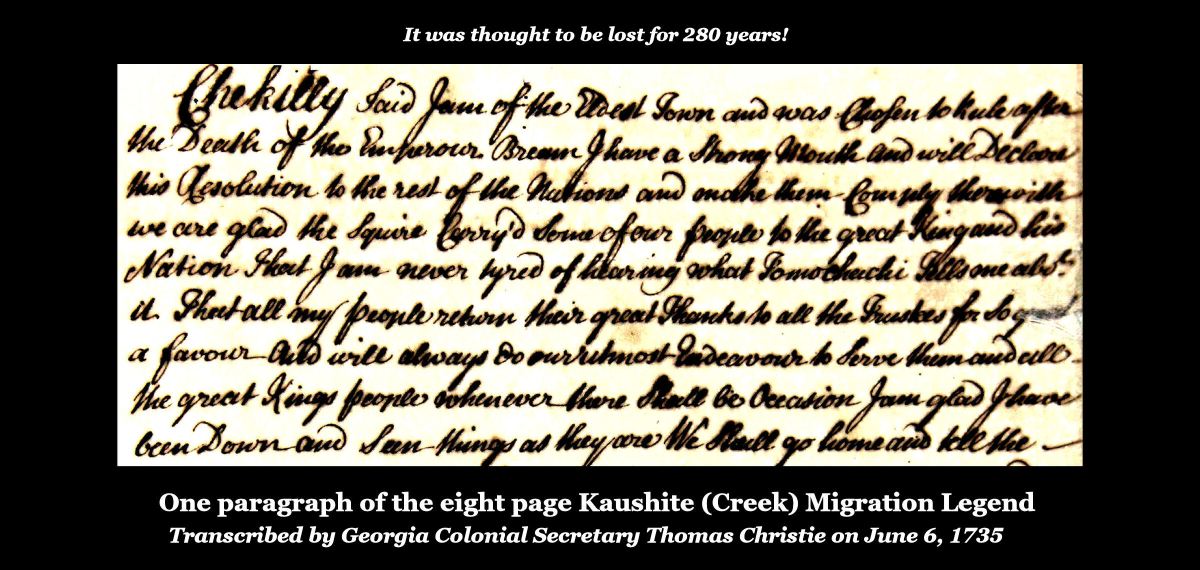
Muskogee-speaking tribes were not members of the original “People of One Fire” or Creek Confederacy.
The wooden chest sent by Georgia Colonial Secretary Thomas Christie to King George II on July 7, 1735 did not include any migration legends for Muskogee-speaking Creek tribes. The Migration Legend states that the original members of the Creek Confederacy were the Kaushete, Chickasaw, Alibaama (Alabama) and Apikate tribes.
The Peopling of Eastern North America Series
by Richard L, Thornton, Architect & City Planner
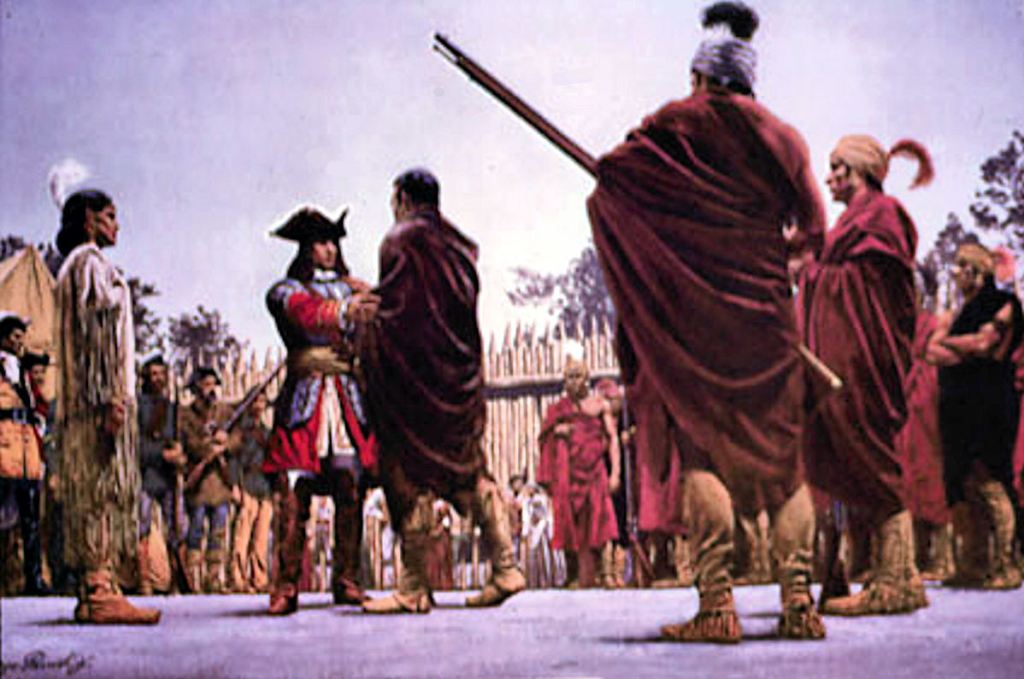
Painting of High King Chikili greeting Gen. James Edward Oglethorpe as Kvsaponekeska (Mary Musgrove) translates. They initially met in the capital town of Koweta, when it was located on the Ocmulgee River in present-day Macon, GA. The town site is now Amerson River Park. Kvsaponekeska means “Little Coosa Girl.” She was the daughter of a Kaushete miko (chief).
An email letter from Okmulgee, Oklahoma
Last week, I received an angry letter in response to my article on the Toltecs. The writer, a citizen of the Muscogee-Creek Nation in Oklahoma was quite upset by my comment that the extreme tall Upper Creek tribes were descendants of Toltec tribes in Mexico. He stated, “Both the Muskogee Migration Legend and our elders teach us that we originally lived on the Red River in Oklahoma then migrated eastward to Georgia then were forced back to Oklahoma on the Trail of Tears. We are NOT from Mexico and are not Toltecs or Mayas. Very frankly, we are tired of crazy white people like you, changing our history according to your delusional Librul agendas.“
I wrote back that he could read the transcript of the real Migration Legend for himself on the Access Genealogy website. He will not see the words “Muskogee” or “Red River” anywhere. In his opening statements to the leaders of Savannah, Chikili clearly stated that he was about to present on a painted bison calf skin, the migration legend of the Kaushete (Cusseta) People.
I added that in the real Migration Legend, the Kaushete lived on the slopes of an active volcano then migrated eastward along a river that flowed from the slopes of the volcano to the ocean. There is no active volcano in the Texas Panhandle, where the Red River begins. I did not know the man, who wrote me and have not received a response to my response.
Overview of the Kaushete Migration Legend
The Kaushete Migration Legend is unique among ancient migration legends in the world. It does not mention any personal names, deities, political titles, spirits, religious ceremonies. supernatural creatures or “magical” events. All of the animals mentioned were living in the Southeastern United, when it was first visited by European explorers. Some are extinct now, however. The main character in the story is consistently, “the People.”
The original form of the legend was actually the minutes of a speech give by High King Chikili before the leaders of Savannah, GA on June 6, 1735. Chikili probably spoke in a dialect of the Muskogee language, but we do know this for sure. Part of his speech consisted of him translating a bison calf skin on which were painted symbols in the Kaushete-Apalachete writing system. Mary Musgrove translated his words, which were then recorded in an early form of shorthand by Georgia’s Colonial Secretary, Thomas Christie. On the following day, Christie and Musgrove met to prepare the final form of the transcript for submission to King George II.
As soon as Christie arrived in Savannah in early 1733, he began interviewing Creek and Uchee leaders, concerning their religious traditions, architecture, political structure and migration legends. These documents, plus the Kaushete Migration Legend and the Painted Bison Calfskin were placed in a stout wooden chest then shipped to London on July 7, 1735.
After reading Christie’s reports, King George II instructed William Wake, Archbishop of Canterbury to prepare a translation of the Creek writing system then create a Bible in the Creek language, printed in the Roman-English alphabet. A portion of the Migration Legend was printed in the American Gazetteer newspaper. That portion was then translated into German for a book on the Americas. In 1884, Albert Samuel Gatschet, a Swiss-German ethnologist translated the German translation of a portion of the legend back into English then published it in 1884.
Despite five expeditions by American academicians in search of the original documents, they were never found and presumed lost for 280 years. With the essential assistance of Prince (now King) Charles III, I was able to located the chest of documents at Lambeth Palace in London. Prince Charles paid for one of the world’s leading archival photographers to make digital copies of the original manuscript. The Muscogee-Creek Nation was one of three institutions, who were to receive copies of the original legend.
Unfortunately, the MCN Donations Review Committee refused these extraordinary archival documents with similar language to what was sent to me this week. They stated – verbatim: (1) They had never heard of Mary Musgrove. (2) Her translation was all wrong. (3) They were tired of white people like this Musgrove woman, trying to change Creek history.

Orizaba Volcano – edo. de Veracruz, Mexico ~ 5,636 m (18,491 ft)
Orizaba is the tallest mountain in Mexico and the third highest in North America.
Chronology of the Migration Legend
- For eons, the People lived in caves near the tallest mountain in the land, which was a volcano, standing alone from other mountains. A river flowed off the eastern slope of the volcano then flowed eastward to the ocean. The river’s waters were stained by the minerals of the Orizaba Volcano to be like blood mixed with water. Therefore, the People called it the Bloody River. The river is now called the Rio Yamapo/Jamapo or Rio Sangriento (Bloody River).
- The People came out of their caves and then were taught how to grow corn by their neighbors living in the coastal plain.
- Invaders came to their land. Many children died. The People began migrating along the Bloody River until they came to the sea. Here they stayed for awhile, but the damp land (swamps) caused their children to die.
- The People then began migrating northward on the Great White Path, which paralleled the ocean.
- Eventually, the People came to the Great River, where they stayed for awhile. The land was fertile, but the air was very damp and foggy. They did not like this place either.
- The People then decided to migrate generally eastward. Each night they would plant a stick. Each morning they would travel in the direction of the stick’s shadow.
- They eventually came to another river, where they decided to establish a town on an island. (Tennessee River Valley) They became friends with the Chickasaw, Alibaama and Apeke the formed the People of One Fire to protect each other from enemies. The members chose the fire that came from the Great Volcano to the south as their Sacred Fire. Here, they stayed many years until a drought came to this land.
- One band of the Kaushete decided to march up the Tallassee River (Little Tennessee River to live off the wild plants, fish and animals of this region. They heard of great towns to the south that were receiving enough rain to grow crops, so the People decided to migrate southward.
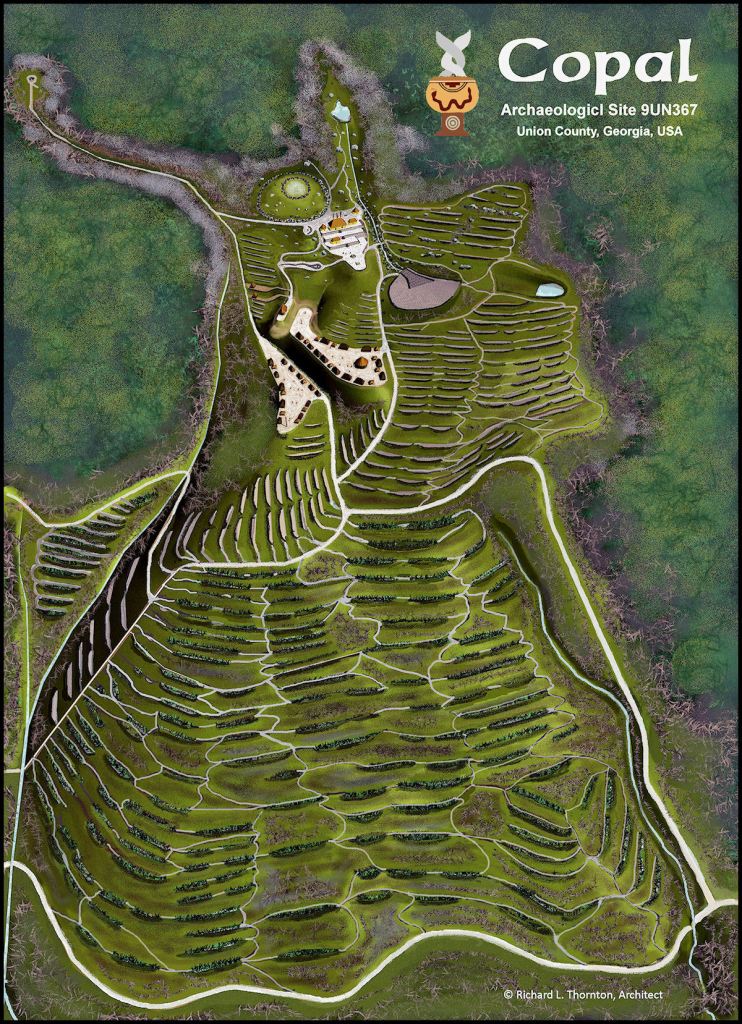
- They came to a great city on the side of a mountain. Nearby they heard drums beating on top of the highest mountain, called Notelet. They fired a white arrow into the city to tell them they were friendly. The residents of this town had flattened foreheads. The People asked for food, but the only response from the flattened-forehead people was a red arrow.
- Therefore, the People destroyed this town and killed everyone, except one white dog. As they marched away from the destroyed town the saw a large army of flattened forehead people pursuing them.
The People came into the valley in the Lower Mountains (Nacoochee Valley of Northeast Georgia). Its people, called the Apalache, were wealthy and so gave our People food. They told our People that we must quit our bloody ways and bury out hatchets, if we wish to stay among the Apalache. That we did.
The Toltecs of southern Veracruz
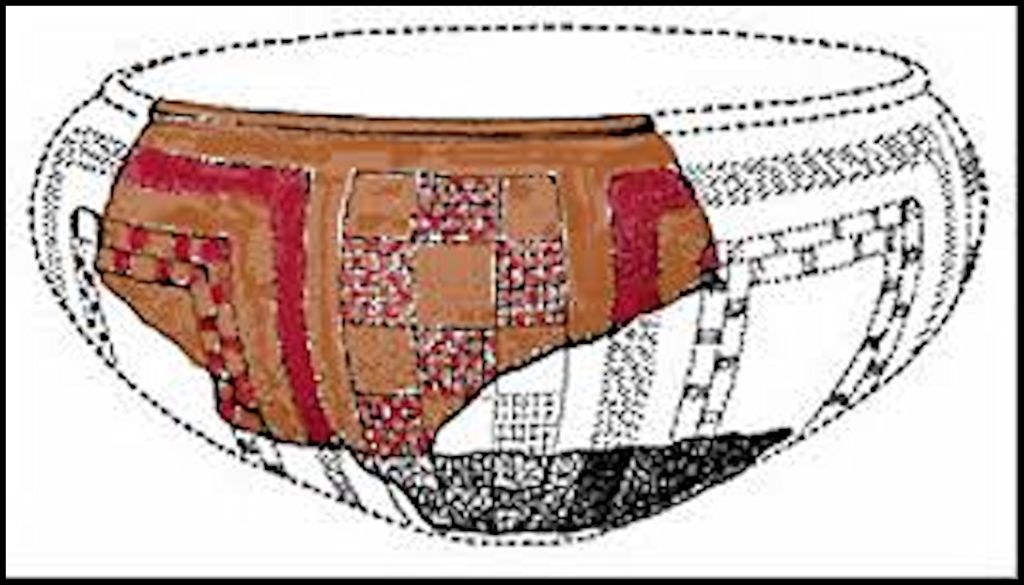
Sample of the Red On Buff pottery found on Hiwassee Island, Tennessee
Life is stranger than fiction: In late August of 1970, I was headed back to Mexico City from southern Veracruz State. I had to stop in Cordoba, Veracruz, which had a magnificent view of the Orizaba Volcano. I only had to be there for a few hours in order to catch the First Class express bus to Mexico City, so I visited the Cordoba History Museum. Its indigenous pottery was very different than what I had seen elsewhere in Mexico. Many of the examples were made from white clay or were buff colored with red and black checkerboard patterns on them.
The museum exhibits stated that in earlier times, the region had been occupied by very tall Toltec tribes, whose men were very tall. Over time, bands of these peoples had migrated to other parts of the Americas. It was believed that they had almost been exterminated by raids from the Aztecs and Totonacs. These two kingdoms sacrificed the children of other peoples to their rain goddesses then ate their bodies. I wrote in my journal that two of the Toltec tribes were named the Tausquite and the Tequiste. Tausquite was said to mean “Warrior People.” Kaushete may have been another tribe’s name that I just didn’t write down.

The town on Hiwassee Island, Tennessee was name Taske or Tasqui. It was visited by both Hernando de Soto and Juan Pardo in the mid-1500s.
Forty-eight years later, I was looking at a French map from the late 1600s. It was made by French Royal Marines and traders, who had explored the Tennessee River Basin. The Natives living on Hiwassee Island were named the Tausquite, while those on Bussell Island, upstream on the Tennessee River were named the Coushete . . . has to be the same as Kaushete. On the Little Tennessee River were two towns named Tausquite. That region is now the Tusquitee Section of the Nantahala National Forest. Tuskegee is the Muskogee-Creek version of their name.
As some of you may know, the very tall Native People in south Florida, which the Spanish called the Calusa, called themselves the Tequiste, anglicized to Tekesta.
The Kaushete Migration Legend is REAL history.

Future destroyer of fake Creek history!
Gringos are not born with a full head of black hair!
 The Americas Revealed
I would appreciate some maps of the places you mention. Your blog jumps all over the place. It’s hard to visualize the names and places, since they all change with language and cultural tradition. And this frigging ElectroGadget keeps inserting punctuation at random . . .
LikeLiked by 1 person
Real simple – go to Google Maps – enter search words Cordoba, Veracruz . . . Orizaba Volcano . . . Hiwassee Island, Tennessee . . . Tusquitee, North Carolina or Little Tennessee River.
LikeLike
Absolutely spellbinding! Thanks so much, Richard, for sharing this fascinating history!Bill BridgesSent from my iPhone
LikeLiked by 2 people
I simply love this post Richard and thanks for the description of the pottery.You must spend hours researching your subject and you know how to answer anyone who disagrees with you. Well done. Have a good week.
LikeLiked by 1 person
Your detractors need to remember, Even the tribes you mention intermarried after the formation of the people of one fire; why is it so hard to believe that maybe there are two parts of their family tree (Those who hold to a strictly red river origin)?
Some that came from the west and some that came north from the Yucatan area?
Goodness, migration is the history of the world!
LikeLiked by 1 person