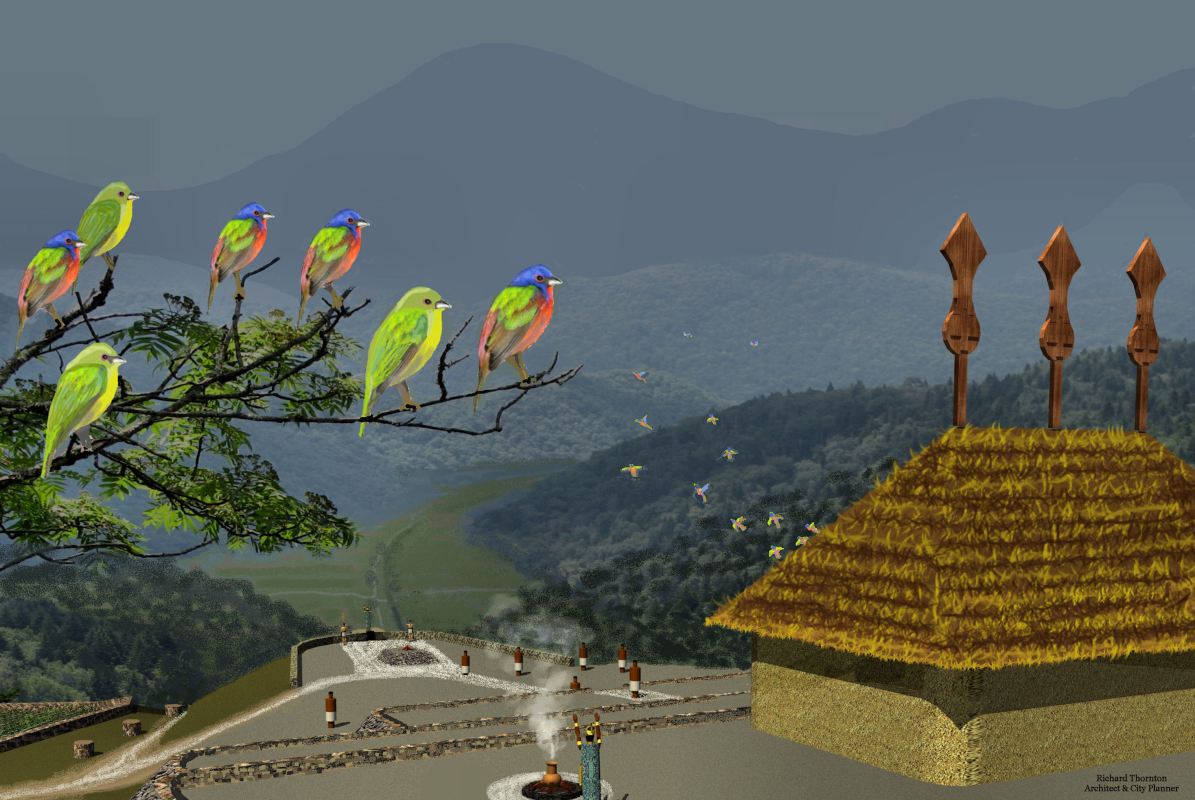
The Summer Solstice of 2026
A tradition going back over 3,000 years to the first civilization in Mexico.
We know from British explorer, Richard Brigstock, that Seventeenth century Creeks believed that the Sun Goddess, Amana, was invisible, lived at Teotihuacan and created the universe. The Painted Buntings (birds) and Monarch butterflies that spent each winter in central Mexico, were her messengers. Creek Sun Goddess temples on mountaintops maintained large flocks of Painted Buntings during the warm months.
We know from Georgia’s first Colonial Secretary, Thomas Christie, that the Green Corn Festival was NOT the same celebration as the Creek New Year . . . as taught by most history and anthropology textbooks. The New Year’s Celebration was always during the 5-6 Leap Days, leading up to the Solstice. The celebration of the Green Corn Festival varied by latitude and altitude. Each Creek province celebrated feasts of the earliest “corn on the cob”, barbecue, hush puppies and Brunswick stew on a different date.
In 1734, Christie traveled throughout the Creek Confederacy to meet with local leaders and historians. The first Green Corn festivals were on the Georgia coast and islands in mid-May. The last Green Corn Festivals were held on the northern side of the Blue Ridge Mountains in Georgia extreme SW North Carolina and SE Tennessee in early August. His report on Creek history and cultural traditions to King George II accompanied the “Creek Migration Legend” when it was shipped on July 7, 1735.
by Richard L. Thornton, Architect & City Planner
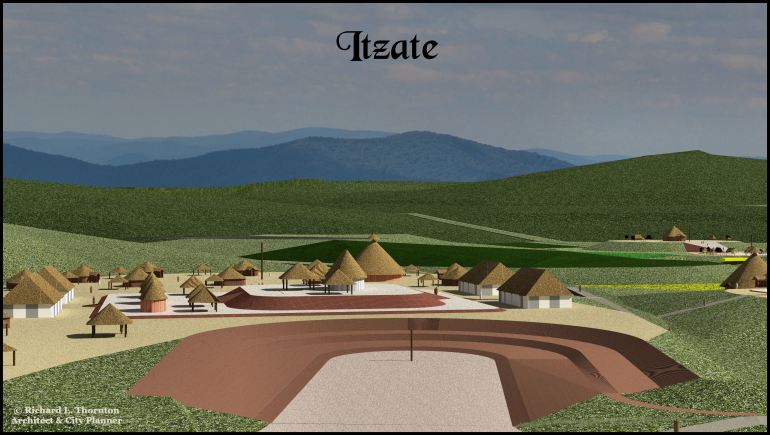
The evolving architecture of ancestral Creek towns
Where have the years gone? Two decades ago I was in the midst of a five-year study of Creek Architectural History for the Muscogee-Creek Nation in Oklahoma. They had asked me to read as many archaeological reports as possible for ancestral Creek town sites in Georgia, South Carolina, Tennessee, Alabama and Florida. Tribal leaders were particularly interested in the size, geometry and orientation of principal earthen pyramids. Were Creek towns really planned to be oriented to the cosmos? The short answer was a big “YES.” The long answer, though, was that the orientations and geometries of public architecture varied radically over time.
The first big discovery was that all the metropolis on the Ocmulgee River in Georgia, built between around 900 AD and 1150 AD was oriented to a triangular grid, whose hypotenuse was the azimuth of the Winter Solstice Sunset. This triangular grid extended into western North Carolina and much of South Carolina. I was able to find towns with large mounds that had been overlooked by the current generation of archaeologists in a region spanning from western North Carolina to Middle Georgia by looking for nodes in the grid.
What was true for Ocmulgee was not true for other towns in other time periods. Temples could be oriented to the south, the east, the west, the equinoxes, Winter Solstice sunset, the Winter Solstice sunrise or the Summer Solstice. Temples could be rectangular, square, round or oval. The primary independent variable in this pantheon of architectural traditions seemed to be the time period. All primary temples in any given time period tended to have the same geometry.
There was no evidence of architecture gradually evolving over time. There were sudden changes that accompanied the founding or reestablishment of towns. This strongly suggested ethnic changes. There was a hitch, though. The architecture and town plans changed starkly, but pottery styles tended to evolve. Unlike almost all the tribes in North America, Creek towns produced multiple, distinctly different, pottery styles at the same time.
For example, archaeologist Arthur Kelly discovered the earliest Swift Creek pottery at the Mandeville town site on the Lower Chattahoochee River, dating from around 100 AD. Initially, it was in an extremely sophisticated form, but only represented about 1% of the pottery. Within a century, most, but not all the pottery at Mandeville was Swift Creek. Meanwhile, Swift Creek style pottery was spreading to other towns throughout the Creek Motherland.

Adam Cartwright had lots of questions
Beloved actor, musician, singer and fellow Native (American) of Waycross, Georgia . . . Pernell Roberts . . . asked me many questions via email during the first decade of the 21st century. His and my families were both members of Trinity Methodist Church in Waycross. Most questions I couldn’t answer, because the official archaeology and history books had no answers.
Most of Pernell’s questions were focused on the Pre-Columbian and Colonial Native American history of the Georgia Coast and Okefenokee Swamp region. Outside Savannah the information from archaeologists is rather sketchy and primarily consists of pottery style inventories. They never bothered to translate the meanings of the Native American words! It has taken me twenty years to answer Pernell’s questions.
In addition to being the person, who first suggested that I publish my research online . . . and was my first subscriber . . . I now know that it was Pernell, who recommended to the Oklahoma Centennial Commission that I be the Architect for the Trail of Tears Memorial in Tulsa. My new book on the South Atlantic Coast is dedicated to his memory.


I didn’t know that Pernell Roberts was Native. Good to know that. I had the biggest crush on him as a kid.
LikeLiked by 2 people
Yes, Pernell’s cousins, nieces and nephews, who were my general age, plus me really stood out in Waycross, since most of the white kids, for unknown reasons, had red or blond hair. I have a photo of my six-year birthday party, My mother and I had black hair. Everybody else in the photo are blonds.
A lot of young ladies around the world had a crush on Pernell. Vivi, my French soulmate, had a live size poster of Pernell attached to the wall over her bedwhen she was a teenager! As you will learn in my forthcoming book, she later confessed that on the first night we met, she imagined that she was with Pernell. LOL Both Pernell and I were Eastern Creeks, so we did have similar features.
LikeLiked by 1 person
Hi Richard. We are continuing our search for many astroarcheolgy sites here in Union County Georgia. What we have cataloged so far are 5 to 10 verified alignments of major land features that back your statement. We also have the in ground artifacts which place these findings in Situ. We currently are finding hard evidence of ancient rock art and even statues and portraits of ancient people. Once we gained knowledge of these objects and processes it has opened a new perspective to archaeological discoveries in the southeast. More to come. Charlie
Get Outlook for iOShttps://aka.ms/o0ukef ________________________________
LikeLiked by 1 person
I have made friends with a Mexican archaeologist (PhD) from the northern Yucatán Peninsula, who was trained in Mexico as I was to be on the lookout for alignments with the cosmos and natural environment. She has a green card and is head of a foundation that is providing lessons in Maya history and culture to Latin American and Gringo students. Unfortunately, She lives in South Metro Atlanta, but the people in Union County might be work out to compensate her for time spent with your group on site from time to time. Your group needs a professional archaeologist to validate your observations. Otherwise, academicians outside Georgia will not take you seriously . . . despite the fact that archaeology is barely running on fumes inside Georgia. Most of my professional work now is outside the United States, so I don’t give a flip what they think.
LikeLike