
Dr. Frederick Rich found pollen from both Northern and Southern tree species in the bog around the superheated crater, but the quarried stone temple remains a mystery.
Most references state that Nodoroc is a Creek Indian word, meaning “Gateway to Hell.” There is no evidence that the Creek (Muscogee) language ever had a single, established word for “Hell” in the way English does. There is no documented single Muscogee Creek word that is a direct, one‑to‑one equivalent of the English noun “gateway” in the sense of a literal passageway or entrance. The closest word is “itapa”-which means a passage through a provincial boundary.
The word, Nodoroc can be translated directly from a Late Medieval Duets (Netherlands) dictionary. The word would have meant “Swamp Smoke” to 17th century Dutch colonists in North America. This suggests the early presence of Dutch or Frisian colonists in the Southeastern United States.
Also, the stones were dressed with iron or steel tools. Therefore, the temple could have not been built by the Creek Indians or their ancestors, as stated by most references. Pre-Columbian Creeks made extensive use of copper and natural brass tools and weapons, but never iron or steel.
by Richard L. Thornton, Architect & City Planner
The Stone Temple and Sacrificial Altar
Gov. George Gilmer, the 19th century Georgia governor, who forced the Cherokees out of Georgia, had the temple measured and drawn before the stones were disassembled and transported to his plantation near Lexington, GA. The sacrificial altar was used a step for carriages and automobiles, but the other stones (of extraordinary historical value) remain in a stack overgrown by weeds and vines. One is on display in a museum (See below.)
All stones in the temple had ancient patina on them from being exposed to the elements for many centuries. The interior stones were quarried quartzite, roughly dressed to create diagonal joints. The exterior stones were fully dressed metamorphized sedimentary rock (similar to travertine) blocks from deposits 70 miles (114 km) away,
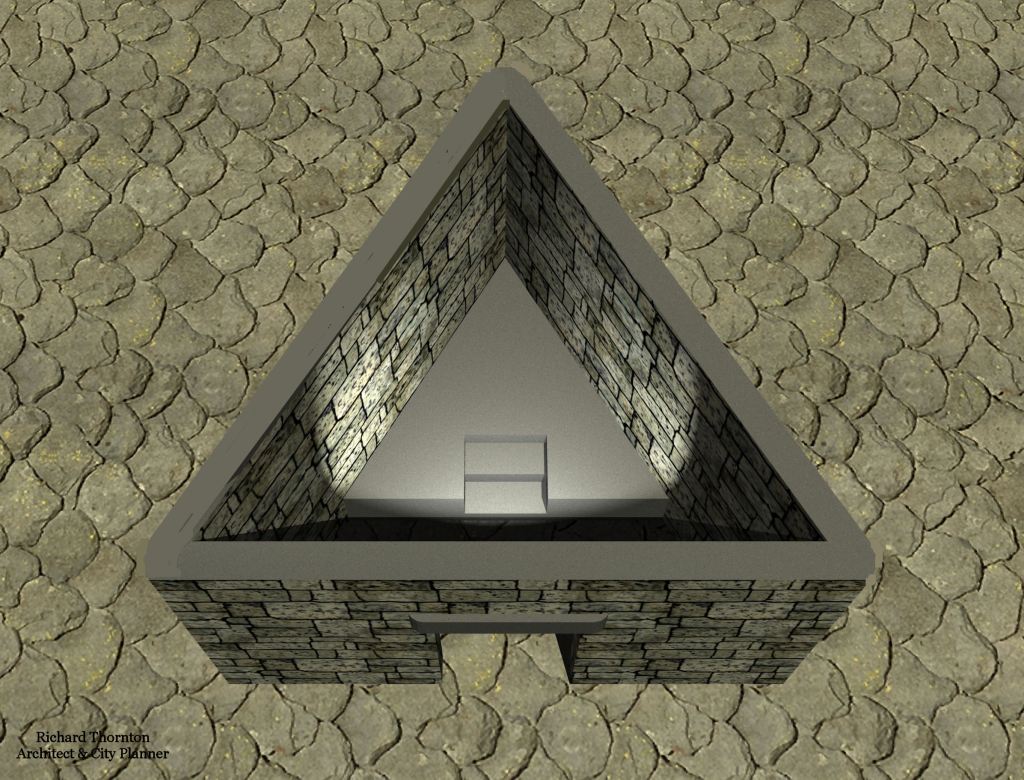
View from above, with pyramidal roof removed
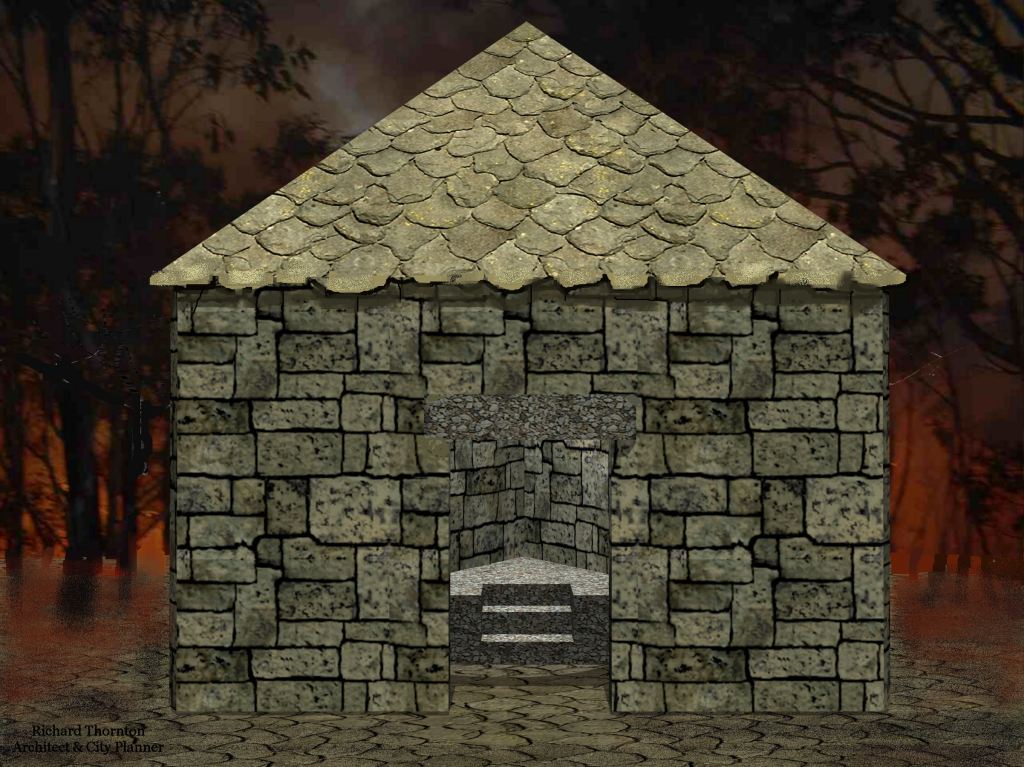
Side facing the mud volcano
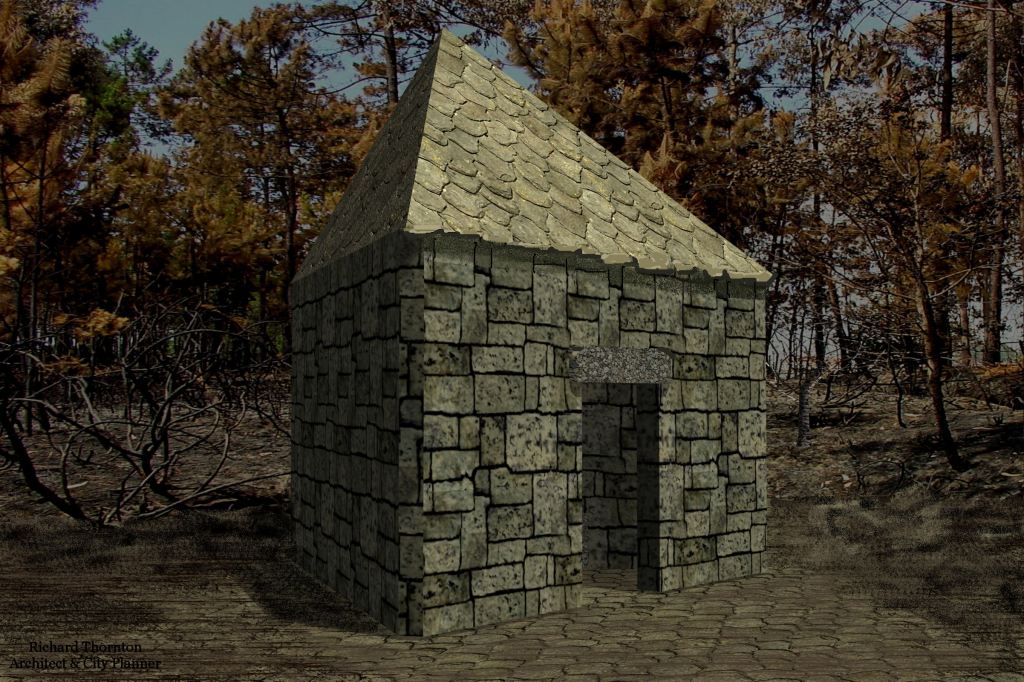
The only other triangular temples or shrines in ancient times are found in Mainland Greece.
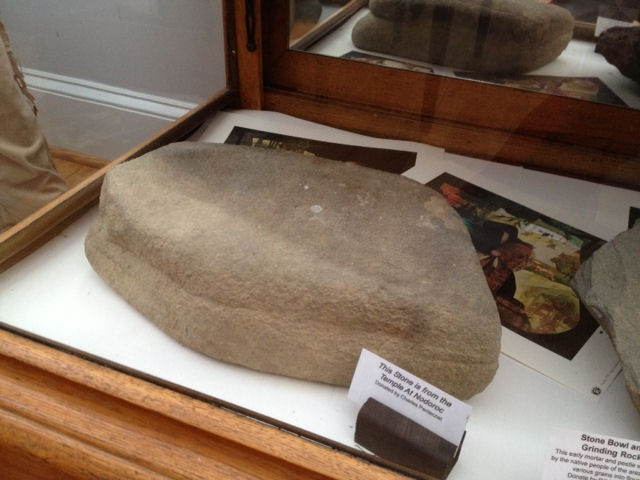
Stone from Nodoroc Temple interior on display at the Jackson County, GA Historical Museum
The Nodoroc Geological Site
The city of Winder in Barrow County, GA is the location of the infamous Nodoroc. Barrow is in the northeastern portion of the Atlanta Metropolitan Area.
The Nodoroc today is primarily an area of bluish, quick-mud, about 250 feet in diameter. It can quickly swallow a human or animal. The Nodoroc is an extremely dangerous place to visit because the cremated peat behaves like quick sand. It still claims deer, coyotes, wild dogs or feral hogs from time to time.
Prior to the mid-1800s, however, it was a burning mud volcano that covered several acres. The center of the site belched flames and black smoke that could be seen for many miles. The flames and smoke presumably came from burning methane, but this is not known for certain. The lethal heat associated with the Nodoroc suggests that perhaps, it was more akin to a true volcano in that the highest temperatures were deep within the crater. However, it is NOT a conventional gas volcano* in the sense of Chimney Mountain (active) and Dicks Knob Mountain (dormant) in Northeast Georgia.
^During the time of the dinosaurs, northern Georgia contained many massive volcanoes. This is why minerals such as gold, copper, greenstone, sapphires, rubies and even some diamonds can be found there. However, about 50 years ago, two geology professors at Georgia Tech found evidence that small volcanoes had erupted much more recently. The Creeks had moved their capital from the Nacoochee Valley back to Ocmulgee Mounds in 1700 after a massive gas volcano explosion had melted all the snow and flooded the valley. Archaeologist Robert Wauchope found layers of volcanic sand from 5 to 15 feet deep in the valley that separated the Late Lamar Culture (Creek) occupation of the valley from 18th century European artifacts. Indeed, throughout the top soil of my mountain crest property, I have found young, black lava bombs, pumice bombs and pockets of volcanic sand.
Back in the 1800s the mud in the Nodoroc was so acidic and heat so intense that it could dissolve animal flesh in one day, bones in a few days. The vegetation around the mud volcanic was stunted and yellowed. The Creek Indians have a tradition that the bodies of executed criminals, traitors and war captives were disposed there. The most heinous of murderers were executed by being thrown into the volcano. One documented case involved a mother, who killed and ate her three children.
After the massive earthquakes along the New Madrid Fault in 1813 and 1814, the Nodoroc mud volcano began to steadily diminish in size. Then one day, in the mid-19th century it exploded with a mighty roar of flames and searing hot mud and left a mile diameter ring of destruction. Afterward, the flames died. This sounds like a smaller scale event similar to the 1700 AD explosion, north of Helen, GA.
Today, Nodoroc Volcano is marked by a bog with stunted trees growing in it near the Winder Airport. There is no detectable heat coming from its crater, Is this fearful place extinct? Only time will tell.
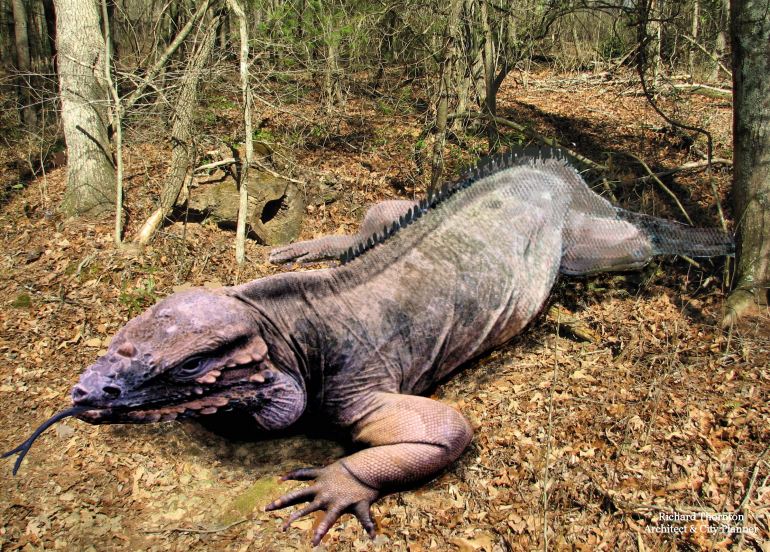
The wog became rare in Georgia after the Wood Bison were wiped out by a British cattle disease. They went completely extinct after Nodoroc ceased to belch flames.
In Creek Indian folklore, the Nodoroc was inhabited by a monster named the Wog. The Wog primarily ate the dead flesh of animals that had wandered into the inescapable Nodoroc, but when hungry would forage for young livestock animals or even cats and dogs. Frontiersmen stated that the wog had long, jet black hair, except that the tip of its tail was silver. It was the size of a horse, but its front legs were longer than its rear legs. The wog had a long forked tongue. Early settlers claimed that they had seen the forked tongue of the wog probing through the cracks of their log chinking at night. That experience made several frontier families quickly leave the region.

