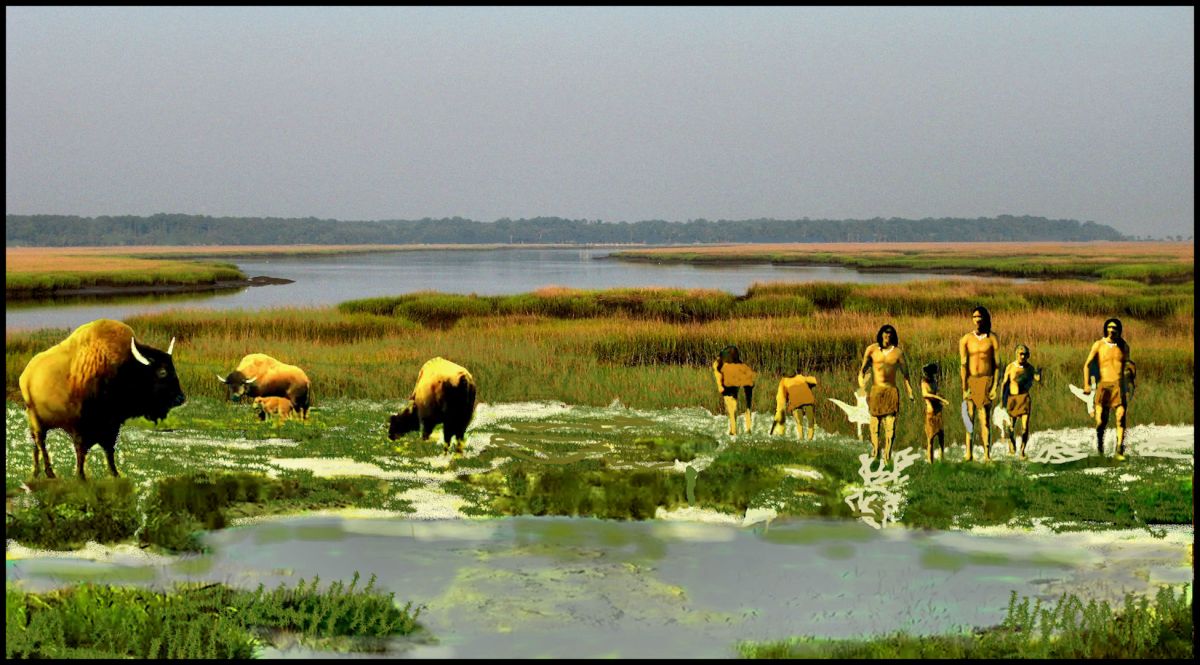
Southeastern Virginia on the Nottaway River
The Americas Revealed continues its series on the Peopling of Southeastern North America. The illustration above is from my forthcoming book, Indigenous Architecture of the South Atlantic Coast. It portrays a band of humans arriving on the South Atlantic Coast during the last Ice Age.
Archaeologist Dennis Stanford of the Smithsonian Institute worked on this site during the last two years that I was in Virginia, but I never got to talk to him about it. However, while I was in the office of his former boss, NPS Director Roger Kennedy, Roger told me that many university archaeology professors refused to work at Cactus Hill out of fear that their “Pro Clovis First” department heads would fire them immediately or else refuse to renew their teaching contracts at the end of the academic year! Yes, the Byzantine environment of archaeology in the United States was that bad.
by Richard L. Thornton, Architect and City Planner
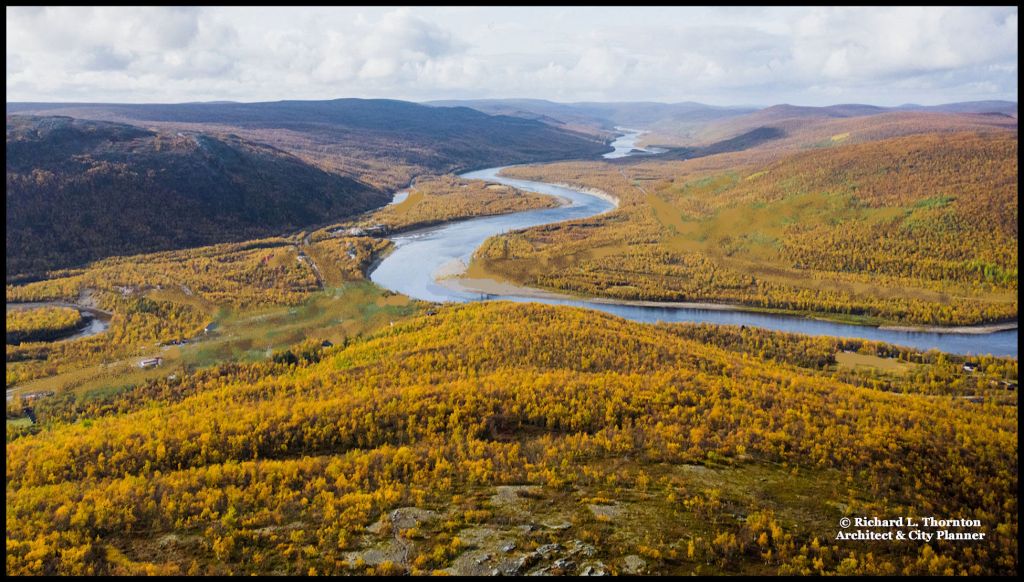
This is a Twin Motions virtual reality image of Southeastern Virginia around 15,000 BP. Readers will soon be seeing many more of these highly realistic AI images based on Twin Motions technology.
My have things changed in the past 30 years. My friend, archaeologist William M. Gardner, was the founder of Thunderbird Archaeological Associates, a cultural resource management firm based in Woodstock, Virginia, that specialized in archaeological surveys, excavations, and cultural resource consulting. He was nationally known as a paleontologist, (very early Native American sites) but helped me on Colonial Era Farm sites, when we suspected that a specific site had been originally occupied by Indigenous peoples or one of many farm outbuildings burned by Union cavalry during the Civil War. National Park Service archaeologists had found the sites of 12 agricultural structures on my farm.
Throughout the 1980s, Bill and his team unearthed permanent village sites along the Shenandoah River that dated from 10,000 to 12,000 years ago, and contained up to 1000 residents. The oldest village initially fashioned Clovis-style stone points for hunting mega-fauna then evolved to fabricate smaller points for hunting smaller game.
Bill’s first announcement of large villages making Clovis Points produced widespread and angry objections from throughout the archaeological profession. The orthodoxy was that small, extended-family bands first crossed the Bering Land Bridge around 13,000 years BP then gradually spread to reach Virginia around 10,000 years BP. Obviously, humans were living in permanent village of 500-1000 people in 12,000 BP, they must have arrived much earlier.
Bill told me that many archaeologists around the nation still refused to speak or communicate with him because of the discoveries on the Shenandoah River. In that era, to make public statements that conflicted with orthodoxies was a crime punishable by eternal banishment.

