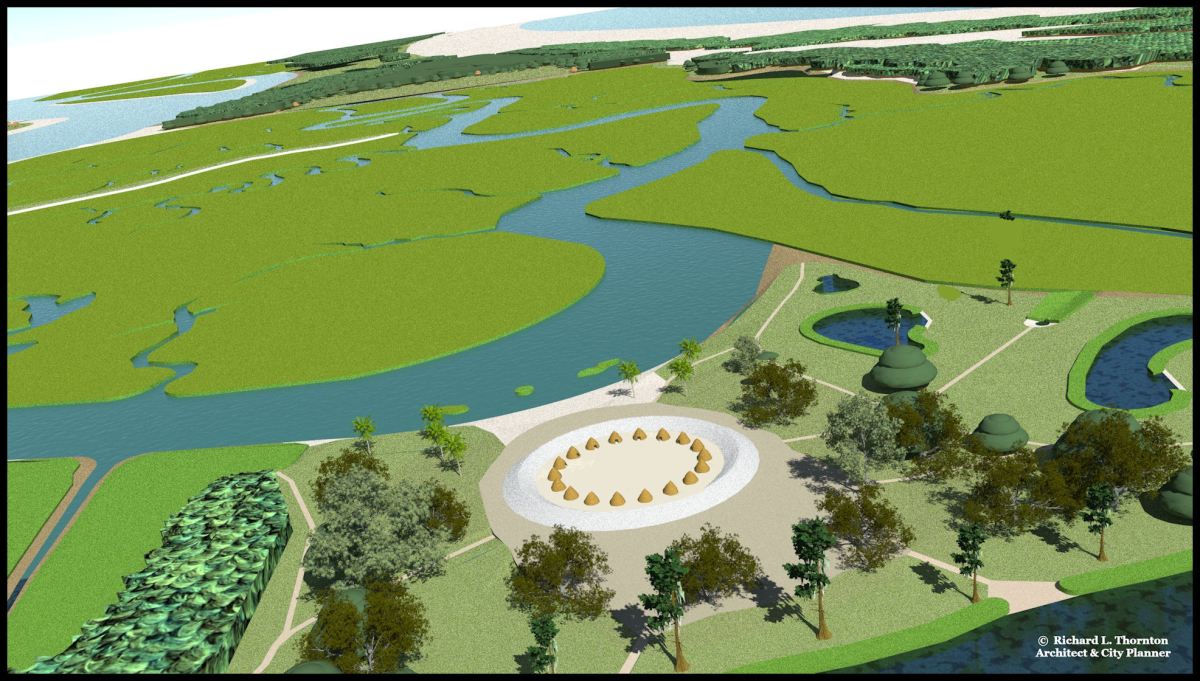
Ossabaw Island was listed on the National Register of Historic Places in 1996
The ancient structure is only a few years younger than the oldest known shell ring in the world . . . located in Japan
A team from the Muskogee-Creek Nation in Oklahoma worked at the shell ring with professors from the Laboratory of Archaeology at the University of Georgia.
by Richard L. Thornton, Architect & City Planner
What are shell rings?
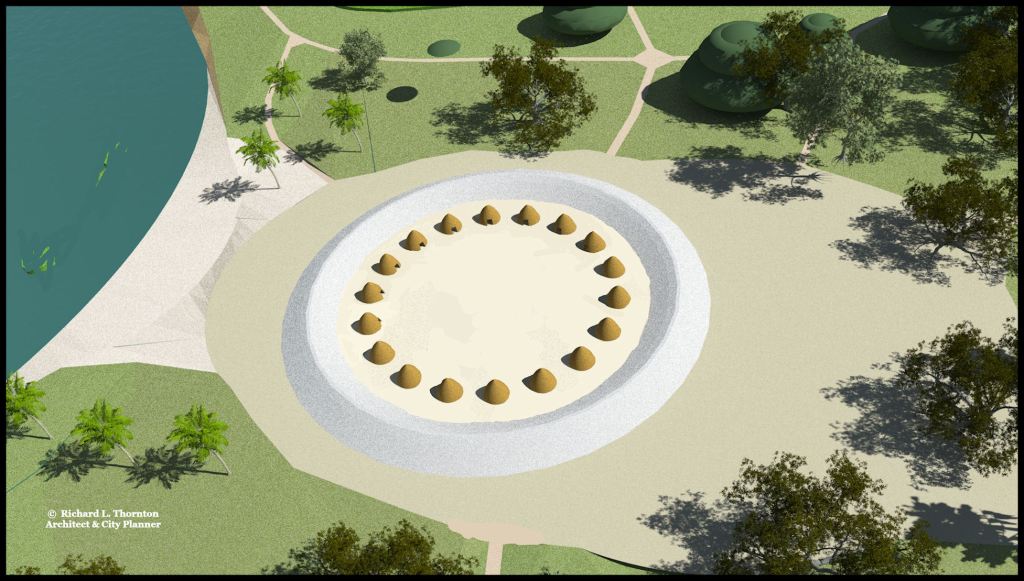
Shell rings are massive, ancient circular, oval or crescent-shaped mounds made primarily of discarded shells. They usually also carry the detritus of daily life by their builders. The contents included mollusk shells, fish bones, shrimp and crab shells, animal bones, ashes, decomposed wood and sandy soil, Constructed accretionally by unidentified populations thousands of years ago, they are among the earliest evidence of large-scale, permanent coastal settlements in North America.
They are most commonly found along the South Atlantic coast of the United States . . . specifically the coastal marsh sides barrier islands in South Carolina, Georgia, and Florida. The earliest structures are found in the region from the mouth of the Altamaha River in Georgia to Port Royal Sound, SC. Similar structures have also been documented in Japan, Colombia and Peru.
For decades, experts debated whether they were simply accidental “trash heaps” (middens) or intentionally designed. It was also originally assumed that the houses were on top of the rings to elevate them from hurricane tidal surges. Archaeological investigations have found evidence that the houses were inside the rings. The shell rings functioned as levees to protect occupants from tidal surges. Recent LiDAR and excavation data show they were highly sophisticated, structured villages. The hollow centers served as central community plazas used for religious ceremonies, seasonal feasting, or political assemblies.
Description of this shell ring
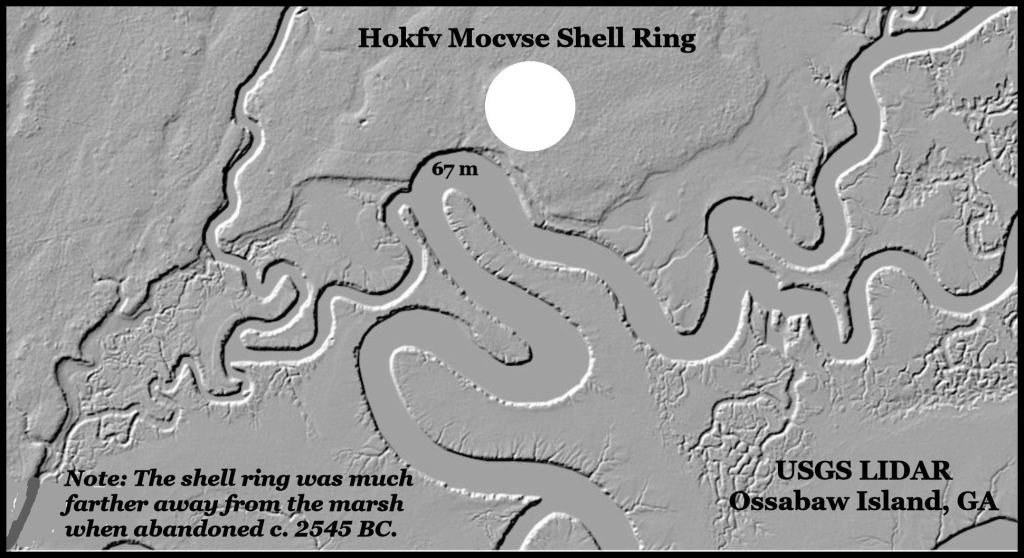
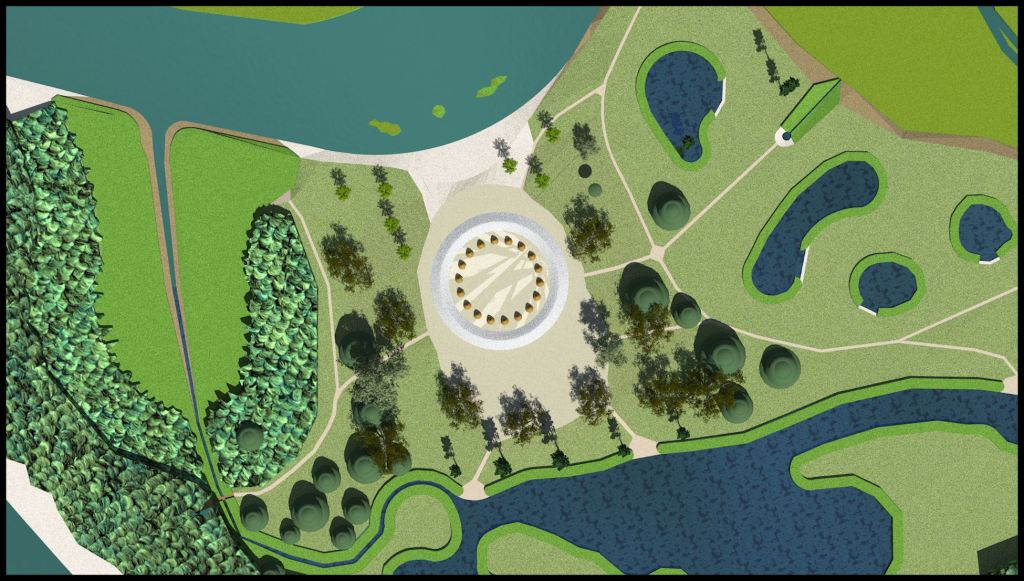
The “Hokfv Mocvse” Shell Ring on Ossabaw Island, GA is approximately 92 meters (300 feet) in diameters. It is believed to have had a peak height of about 3 to 3.7 meters (10 to 12 feet).
The village site was occupied between 5090 and 4535 cal BP (around 5,500 years ago) The oldest shell rings in Japan date from about 5,500 BP. It probably began as a ring of large tree trunks, located approximately, where the shell is now. No ceramics were found in the site. Georgia contains the oldest pottery north of the Amazon Basin. This fact means that the site was abandoned before 2,500 BC.
Most shell rings in South Carolina and Georgia date back to the Late Archaic Period (between 3,000 and 5,000 years ago), making them contemporary with Stonehenge and the Egyptian pyramids. Shell rings in Florida tend to be younger.
In Japanese archaeology, village-encircling circular or horseshoe-shaped shell middens are known as Kanjō Kaizuka (環状貝塚) or Bateikei Kaizuka (馬蹄形貝塚). They functioned almost identically to the Late Archaic shell rings found across Georgia and South Carolina. They are about 5,000 to 6,000 years old (dating back to approximately 4000–3000 BC).
Linguistic considerations
Hokfv Mokose are Muskogee-Creek words that mean “Shell Necklace-New.” Archaeological reports and online references incorrectly translate “Hokfv” as meaning a mollusk shell. That word is folvhpe-hvrpe. However, Muskogee was never spoken in that part of Georgia.
In the Creek language spoken around the mouth of the Savannah River, the shell ring’s name would be Chanchal-Mochawse. Georgia Creeks were in contact with French speakers in the 1560s and English colonists in the early 1600s, so used English phonetics, when spelling their native words with the English alphabet. A”C” in Muskogee is roughly an English “ch” sound. So, the correct Anglicized spelling of the Muskogee name is Hoklaw Mochoshee.
Ossabaw Island was actually last occupied by a Panoan People from Peru. The island’s Native American name was Asepo, a Panoan word from Eastern Peru, which means “Yaupon Holly – Place of.” Part of my Native American DNA is Panona. The rest is from Southern Mexico. The Native people, living on the mainland west of Ossabaw Island spoke a Carib dialect from South America.
Now you know!

