They helped conceal contemporary accounts of Pre-Columbian voyages to North America!
These were some of the many words created, when the more broadly educated English-speakers of the 1700s tried to read books, printed in the 1500s and 1600s or handwritten earlier. . . yes, really.
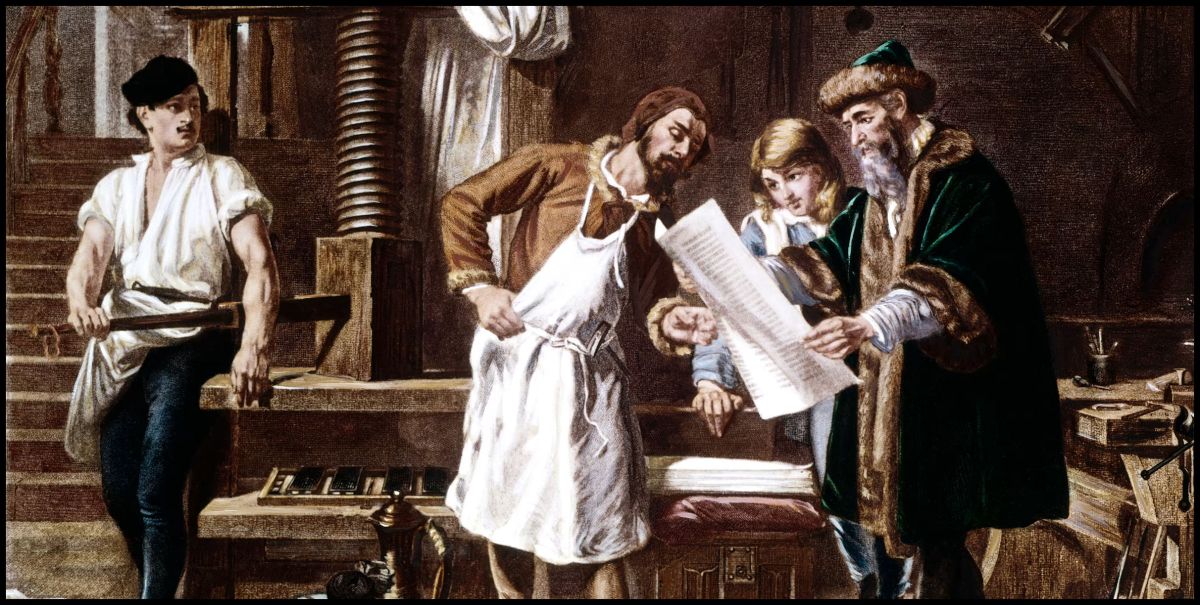
Many of the current differences between the English, Frisian and Scandinavian languages occurred in the 1500s because of the Guttenberg Printing Press.
by Richard L. Thornton, Architect & City Planner
In recent weeks, I have been trying to translate an early medieval journal from Allhelgonaklostret, a Benedictine monastery founded around 1072 by Bishop Ricwald during the reign of King Sweyn Estridsson. It seems to be describing fleets of colonists going to the Atlantic Coast of North America from Ireland, Iceland, Norway, Frisia and Angeland . . . the part of Denmark, where the Anglisk (English) originally lived. Until annexed by Sweden in 1658, Lund was the capital of the Danish province of Skåne and is now the location of one of Europe’s top universities.
The texts mostly in Latin, with some Medieval Swedish texts. I had two years of Latin in high school and worked near Lund, immediately after graduating from Georgia Tech. There is always an online Archaic Swedish dictionary and Google Translate, if I don’t understand a word. HOWEVER, I am finding it extremely difficult to read the manuscripts produced by monasteries in Scandinavia, Frisia and the British Isles during the Early Medieval Period. Their alphabet was different than used today. The words most closely resembles Old Norse, spoken in Iceland! People living in southern Scotland, northern England and East Anglia during the Early Middle Ages, could have carried on conversations with Scandinavians. They also used very similar alphabets.
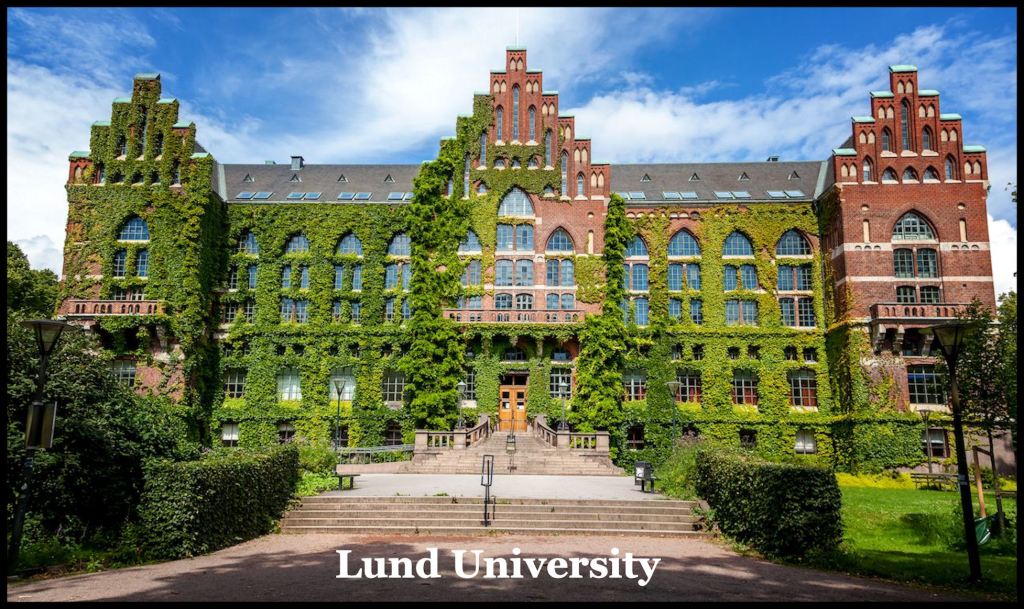
The library at Lund University contains extraordinary archives on the Bronze Age, Viking Age and Medieval history of what is now Skåne County, the southern tip of Sweden.
Personal Note – June 17, 1972 – Exactly two weeks after I graduated from Georgia Tech and started a job in Landskrona, Sweden, I first met Swedish singer, Agneta Fältskog, in Lund. At that time, she planned to move to the USA in order to sing on Broadway. She asked if we could sit together at a restaurant table, so she could practice her English. She was really a sweet, likable lady. However, I thought to myself, “What chance does this naive, but pretty, Swedish farm girl have to make it in the major leagues of New York City, even if she has the voice of an angel?”
- A little over three years later, on November 15, 1975, ABBA performed at Rockefeller Center in New York City on “Saturday Night Live” – I dropped my ice tea glass in shock and broke it, when I recognized her face.
- On the 50th anniversary of that evening that began in Lund, Agneta posted a private video on YouTube for me, filmed on the farm, where she grew up.
- June 17, 1972, was also the night in which the infamous Watergate Burglary occurred!
Europeans in the Southeast before Columbus
Here is the reason that I would be involved in such nerdy activities. In 2025 and 2026, while working on the translations of “Native American place names” on the South Atlantic Coast, I found both tribal and place names that were definitely European words. They were in Irish Gaelic, Scottish Gaelic, Archaic Swedish, Anglisk (Archaic English before mixing with Saxon) and Basque dictionaries. In the USA, such things were considered heresy and would not be taken seriously. I looked for work by European scholars and American geneticists that would back up my dictionaries.
The first author of a Georgia History book, William Bacon Stevens, cited two Danish scholars as finding strong evidence that Europeans had settled in Georgia and South Carolina, prior to the voyages of Columbus. Karl Kristian Rafn (1795 – 1864) was a Danish historian, translator and antiquarian. His scholarship to a large extent focused on translation of Old Norse literature and related Northern European ancient history. He was also noted for his early advocacy of the recognition of Norse colonization of North America. Rafn’s lifelong research was launched by the research of Bishop Friedrich Münter (1761–1830) of Zealand in Denmark, who was probably the first scholar to identify Icelandic sagas that seemed to describe many voyages to North America.
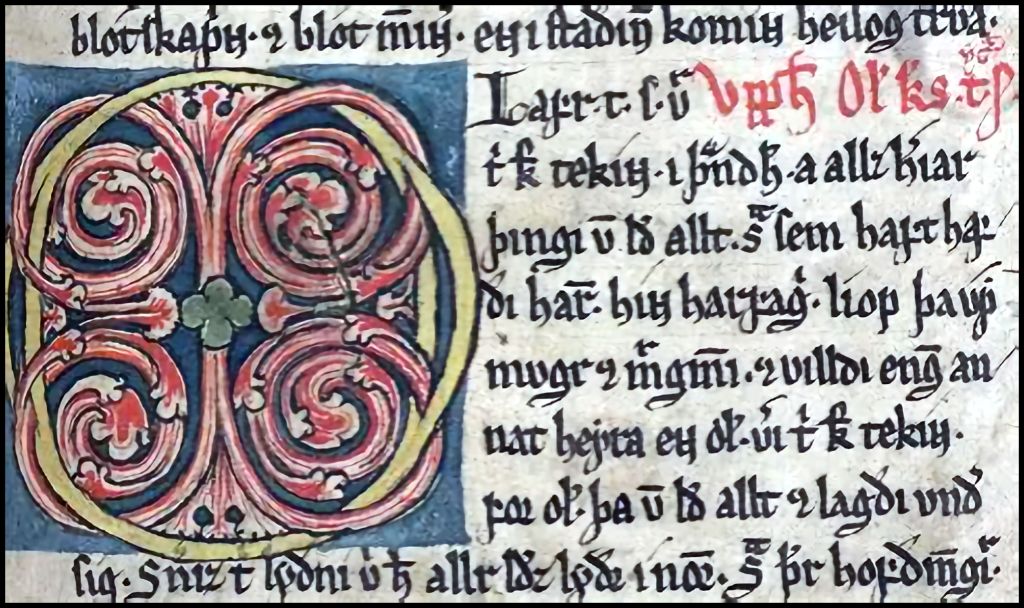
The Medieval Script used by Anglo-Saxons. Scandinavians and Lowland Scots
A mysterious alphabet
I didn’t have a single sentence translated until I realized that even the alphabetic letters recognizable today portrayed different sounds then than now. There were several symbols that left me totally clueless. Eventually, I found websites that explained the meanings of the Early Medieval letters. They were derived from the old Runic alphabet, used by Scandinavians, Frisians, Angles and Saxons. The strange symbol that looks like an f, originally meant the S at the beginning of a sentence or double S’s that were pronounced like “sh.” That usage did not cease in the United States until after American Revolution, when American scholars began simplifying the King’s English spellings and pronunciations.
The most astonishing discovery was that the languages of Northern Europe had been changed radically by the Guttenberg Printing Press, which was invented in 1440 in Mainz, Germany on the Rhine River. For several decades, most of the presses and types were manufactured in Mainz and exported to other regions. The Rhineland-Palatinate region used an alphabet, similar to those in Western Europe and the Americas today.
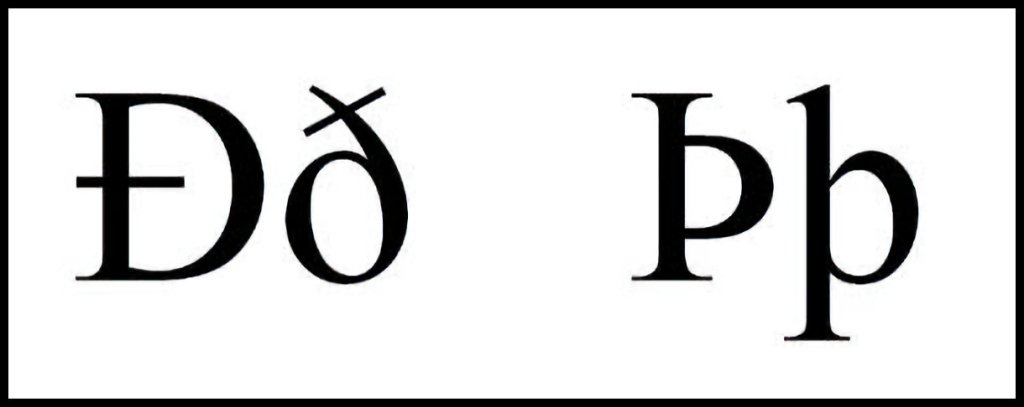
A Northern European D with a bar on it meant a “TH” or “soft D” sound at the beginning of the word. The letter “thorn” on the right meant a “th” sound at the front or end of the word. These letters soon disappeared upon the widespread use of printing presses in Scandinavia and England.
Until the late 1400s, the literacy rate in England and Scandinavia was well below 20%. Since French and Latin were the languages of the elite, English evolved as an unwritten language. Frisian, Danish, Swedish and Norwegian were also evolving away from each other, but at least the nobility spoke the same language as the commoners.
The situation with English was made more complex because people living in southern Scotland, northern England, the Midlands and East /Anglia spoke many more Scandinavian words, whereas Saxon was closer to what was spoken in northwestern Germany at the time. The original Anglisk language was close to Archaic Swedish, so descendants of the Angles, Jutes and Norse immigrants use what would be spelled “Yi” today for the pronoun “I,” while Saxon regions said, “Ich” – which is used in Germany today.
Keep in mind that there was no standardized spellings for the vernacular languages in Northern Europe until the late 1600s or even 1700s in some nations. When a wannabe printer received a press from Germany, it did not include types for several of the symbols used in Northern European Medieval scripts. Individual printers used other letters to symbolize the missing ones.
Over time, printers in England, Scotland, the Netherlands, Frisia and Scandinavia gradually came to agreement as to what letter would be substituted. Then as more and more people became literate, later generations forgot that the alternate letter symbolized a different sound. The end result was that words that were originally the same sound in all of these countries acquired different pronunciations.
During Medieval times, the letter “Y” meant a long U sound like “you” in England, southern Scotland and Scandinavia. However, early 16th century English printers eventually adopted the letter Y to be the substitute. However, by the 1700s Y had been changed to mean its current sound, which was formerly written as “eo” with the two letters touching each other.
How to pronounce Modern English properly
Apparently, the majority of Scandinavian printers decided to use a “d” to symbolize the letter “thorn.” Thus, the pronouns that began with a “th” sound, were pronounced by the late 1600s as having a “d” in the front instead of the original “th” sound. Thus, “thou” became “dou” and ultimately “du.”
The Late Medieval personal pronouns in most of England were:
Yi – thou – he/she – we – thee – thier
Thus, these words became I – you – he/she/it – we – ye – yer . . . but English speakers in the 1700s did not realize that you was really thou and ye was really thee.
Now you know!


My own work. Please share if you can. One of the reasons Chaco Canyon is a sacred place.
[image: Chaco Canyon & Polynesian Triangle Online Copy.png]
LikeLiked by 1 person
All I received were those words above. Sorry
LikeLike
I tried to fix it from my present site, and couldn’t. My old site collapsed today. So I am now working on a wordpress site for Sacred America at sacredamerica.org. Not yet up, but coming.
LikeLike