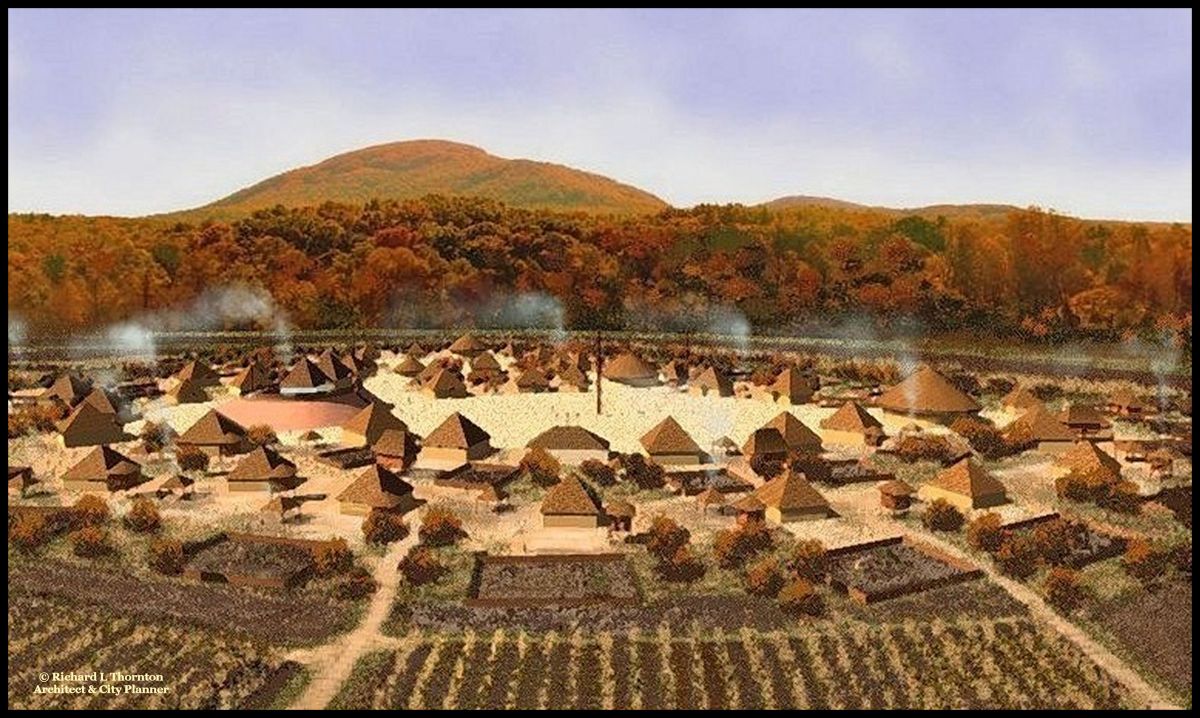
This architectural rendering, honoring the original Creek heritage of Western North Carolina, was placed on a prominent location on the first section Little Tennessee River Greenway.
The Coweta Creeks constructed this style of mound at several locations around Georgia. However, the Franklin, NC Area contains their mother town, Cowee, plus several subordinate villages named Coweta. Most Cowetas moved farther south during the period of extreme droughts and long winters in the late 1500s.
Community leaders chose an architectural rendering that I originally created in 2007 to illustrate the former Native American town near the center of Franklin. The art was a Christmas gift to the leaders of the Muscogee-Creek Nation in Oklahoma.
The first section of the Little Tennessee River Greenway is a five-mile long hiking and biking trail that parallels the river. It features fishing piers, playgrounds, picnic shelters, exercise stations and a butterfly garden.
The rendering was created from a computer model of the village of Nokose, which once stood around the famous Nacoochee Mound. It is a famous Georgia landmark, which announces the entrance to Alpine Helen, Georgia. Early Georgia maps show the mountain overlooking this Creek village to also be named Nocose. The name was changed to “Yonah” in the 1830s by gold miners from North Carolina. Yonah is a Cherokee word that now means “grizzly bear.:
There is a connection with the Franklin, NC area, however. Nokose means “bear’ in several Creek languages and in Chickasaw. The village around the mound in Franklin was called Nikase, which means “bear cub.” The name was later altered by Cherokee speakers to “Niquasee” or “Nikwasee.”
The last occupants of the Native American town, where Downtown Franklin is now located were ethnically Wataree People, but this band elected to join the Cherokee Alliance. The Cherokees called them Wautagi. Their chief befriended explorer William Bartram in 1776. He told Bartram that the village site in present-day Franklin had been occupied by many peoples., but were part of the territory, ruled by the Apalachete in the Nacoochee Valley. Each ethnic group had altered the mound to their architectural traditions. In 2018, I confirmed that statement by analyzing the Nikwasee Mound with various infrared spectrums It HAD been different shapes in the past. (See below.)
The chief also warned Bartram that there was a Cherokee war party headed to Nikwasee to kill him. In his journal, Bartram noted that he immediately raced southward five miles to the safety of the Tallulah River, which was the northern boundary of the Creek Confederacy at that time. Thus, we have an eyewitness account that the mound was never utilized by ethnic Cherokees. Its last users were allied with the Cherokees, but also on good terms with the Creek, Uchee, Chickasaw and Sokee towns, located immediately to the south of present-day Franklin.
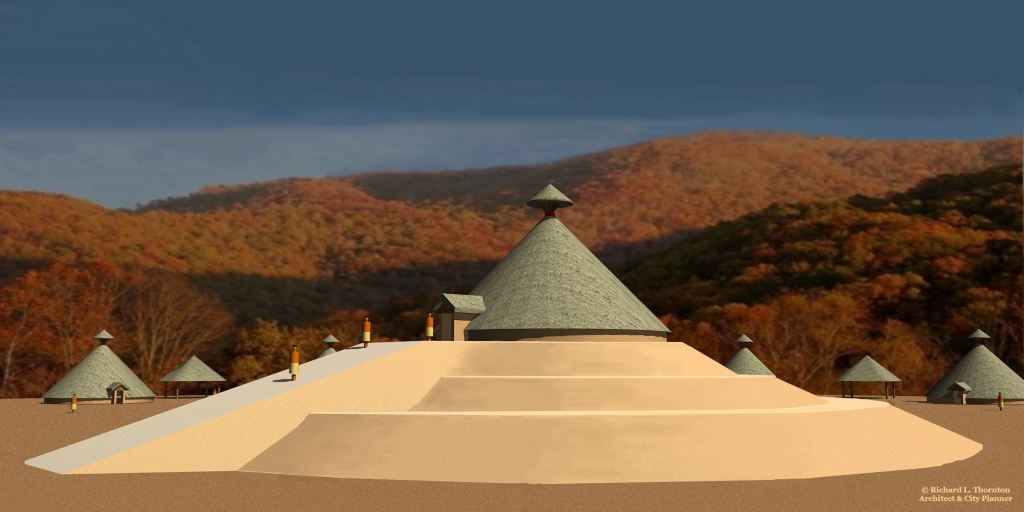
The Nikwasi Mound in Franklin probably began as a simple burial mound about 3-4,000 years ago. An Austronesian tribe, called the Wassaw, then expanded it into this form . . . perhaps 1,800 years ago?
What about the copyright?
A resident of Franklin and several tourists from Georgia have recognized that the sign in Franklin was my work. Of course, the artist who furnished the rendering above, told the leaders of Franklin that it portrayed the “Cherokee” village in Franklin and didn’t tell them that it was a copyrighted creative product of a well known Creek Architect in Georgia. LOL I can tell from the proportions of the architectural rendering, utilized in Franklin that it was lifted from a YouTube video. In 2016, I altered the original drawing to fit a YouTube HD format.
In the past, I have caught members of the Cherokee Qualla Arts and Crafts Guild photo-shopping out my name and replacing with their own, then selling the prints of my work as “authentic Cherokee art of Cherokee towns.” They were turned into pumpkins. The young women were soon too fat to fit into their cars. In this situation, I will let it ride. The sign is proof that Franklin, NC is part of the “Greater Atlanta Prosperity Sphere.” That’s certainly preferable to the “Cherokee Casino Poverty Sphere” which characterizes much of Western North Carolina nowadays.


Hi Richard,
Hope all is well. Thanks for all you do and have done in this regard.
This is much appreciated and the dogma and small “c”s have been exposed
long ago. You will be remembered Sir, and in a good way. Younger
Ph.D.s are not so piled high and deep. Cool that LIDAR is so useful and
all over…this is a huge help. Looking forward to more…
Best wishes,
Bill
LikeLiked by 1 person