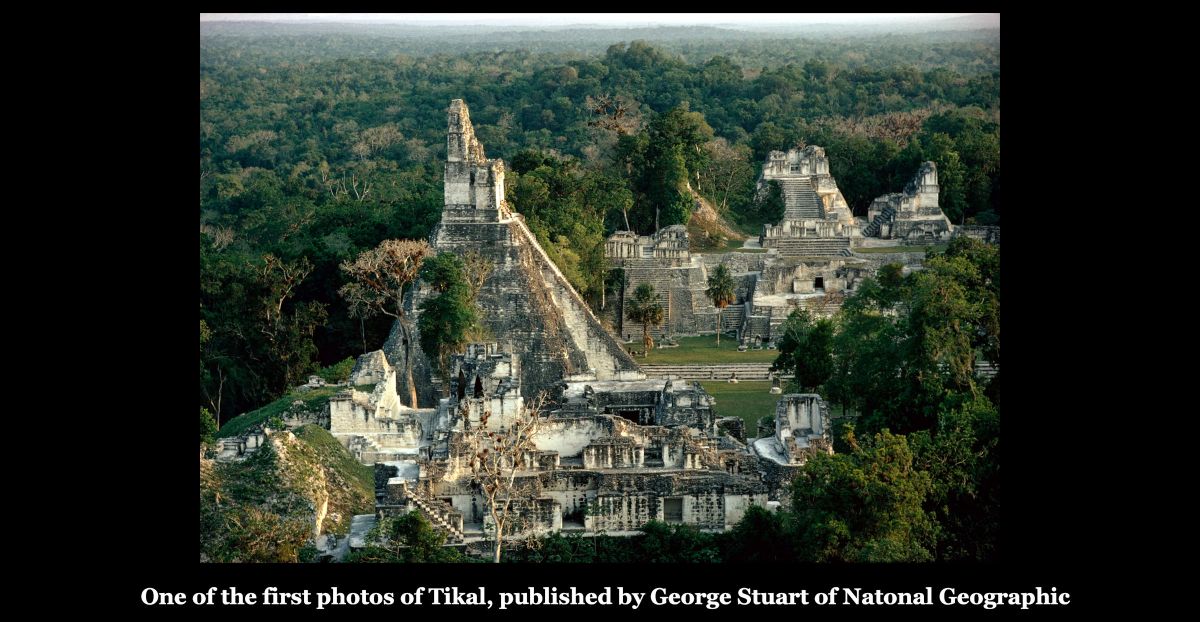
Along with many other peoples from many places
A NEW SERIES IN “THE AMERICAS REVEALED”
by Richard L. Thornton, Architect and City Planner
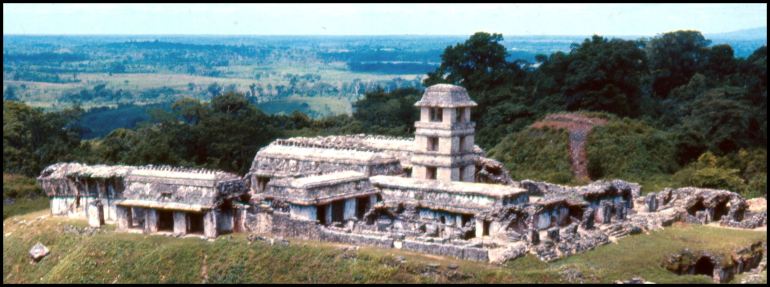
David Schele, Linda Schele and I first met George Stuart at the lower right of this photo.
Did you get the gist of the previous article on George and Gene Stuart? Even though it is an early draft of the first chapter in my new book and will take a few minutes to read, you really should read it. It is the basis of many articles that will be published in The Americas Revealed during the coming months.
Here is the lesson learned. The relationship that I had with George and Gene Stuart for a decade was a metaphor for what was going on in their profession at the time. The cracking of the Maya writing system was one of the greatest scientific achievements of the 20th century, yet at the same time, the branch of archaeology in the United States that was associated with Indigenous American cultures was becoming increasingly isolated from other professions, hostile to the acquisition of new knowledge and absolutely vicious in their attacks on those, who questioned their orthodoxies.
In 2003, the President of the Georgia Council of Professional Archaeologists arrogantly stated to the annual conference of the Society For Georgia Archaeology:
“We know everything there is to know about the Southeastern Indians. It is time to move onto other things.”
I was an acquaintance-friend of George Stuart for a decade. My grandmother’s Creek pottery and baskets, my grandfather’s wood carvings and my Mesoamerican & Creek artifacts were on prominent display in the Living Room of our house in the Reems Creek Valley of North Carolina. During his multiple visits to our home, including the interview for his book on the first visit, George never commented on the Native American display nor mentioned that he was an archaeologist. This was the man, whom I idolized in high school, but did not realize that he was in my home!
The previous article listed all the things that Gene Stuart did to jump-start both our goat cheese sales and my architecture practice. She became a good friend, not just an acquaintance, but she never mentioned to me that she was also an archaeologist, had lived for several years next to Etowah Mounds and had spent many summers in Guatemala or Mexico.
I did not realize who they were until they had downed several glasses of wine, while feasting on my barbecue in the front yard of the North Carolina house. Only then did I realize that I had met George in Palenque and that Linda Schele had become an internationally acclaimed anthropologist!
While living in Virginia, I never discussed Mesoamerican architecture with either George or Gene . . . until our last dinner together with Vivi at my side at the Occidental Restaurant . . . and that was after they both had consumed several cocktails. They started talking about their experiences and discoveries in Guatemala . . . then were shocked when both of us understood everything they described.
After Vivi graduated with honors from the Sorbonne in Ancient European History, she spent many months in southern Mexico getting to know her Tamulte Maya relatives and exploring Mesoamerican cities. She stayed for over two weeks at the Palenque Inn and knew both Moises and Alfonso Morelos, well. She could even speak Tamulte Maya, almost fluently. That floored George and Gene. Like me, they only knew some individual Maya words and phrases.
You see, like many Gringo anthropologists . . . in their minds Indigenous Americans were simple, somewhat childlike people, lacking formal eductions, but with sophisticated concepts of the cosmos. Also, like many Gringo archaeologists.George and Gene could not quite “deal” with Native Americans who had degrees from upper-tier universities, who wore coats and ties (or Parisian fashions in Vivi’s case) and spoke several languages. That is why they always visualized me as a goatherd.
The anthropology-archaeology professions have also intentionally isolated themselves from other kindred professions . . . thinking themselves intellectually superior to geologists, architects, engineers and geneticists . . . when in fact, our educational and professional requirements are far more rigorous. For example, when I wrote an article in the National Examiner about the Kenimer Earthen Pyramid , , , being identical to the earthen pyramids for the Sun God, built by the Itza and Kekchi Mayas of the Highlands.
Almost immediately, the Senior Archaeology professor at the University of Georgia wrote a comment to the article, stating, “Now run along children and play. Stop talking about things, you know nothing about. ” The truth was that he did not know diddly squat about the subject.
Soon thereafter in 2012, an anthropology professor at another university, who despite being lily-white, specialized in the cultures of Northeast Africa, wrote an editorial in the Journal of the American Institute of Archaeology. Among many pejoratives, he stated, “Richard Thornton is nothing, but an ignorant peon.* He has never been in Mexico and wouldn’t know a Maya, if he saw one. Anything he says should be ignored. In a few months, he will be long forgotten.”
*I wonder how many anthropology professors in the United States have enjoyed several lunches in the private office of the Curator of the Museo Nacional de Anthropologia de Mexico like this ignorant peon? In my case, he was half-Maya.
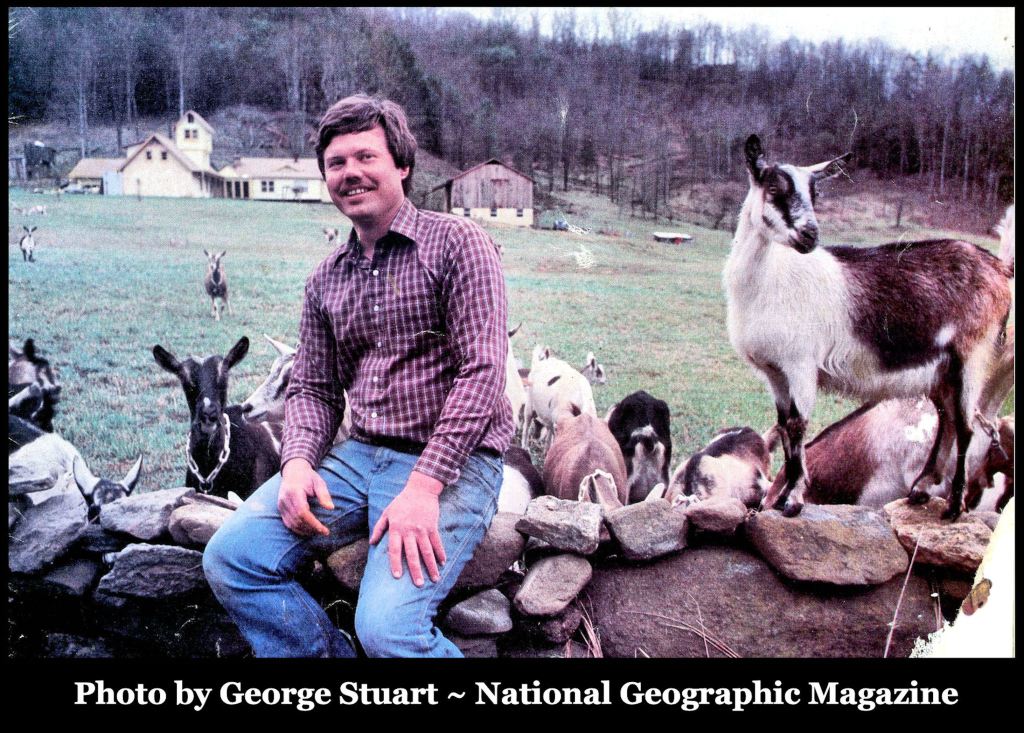
After the University of Minnesota found absolute proof in early October of 2012 that the attapulgite, used to make Maya Blue stucco in Palenque, was mined in Georgia, I drove up to Barnardsville, NC to visit George Stuart’s vacation-retirement home. It was near the dense forest of the “Coleman Boundary.” When I telephoned him to ask for a visit, he initially had forgotten my name. I had to jog his memory of the several visits to our goat farm on the other side of the mountain and the article that he wrote on our goat cheese operation for National Geo.
After I arrived at the house, it was obvious that George had also forgotten that I had lived in the Shenandoah Valley for seven years and had been in Mexico several times. Those memories came back somewhat. I told him about the Georgia-Maya Blue connection. He seemed surprised that I knew what Maya Blue was, but then added that he had seen nothing about that in the news or professional journals. I told him that it would be announced on TV on the evening of December 21st – The beginning of the Maya New Year. He was still very dubious.
The new Mrs. Stuart invited me to stay for lunch. She and George were hospitable, but it was clear, they perceived me as a welcomed stranger and that George had even forgotten me visiting his home in Washington, DC several times. I gave him my address, phone number and email address, but never heard back from him. Thus, I don’t even know if he watched the premier of “America Unearthed. “
As typical of his profession, archaeological journals have never discussed the very real fact of Georgia minerals being used on an industrial scale in Palenque. They figure that if they don’t discuss something, it will go away. That worked before the onset of the internet, when university anthropology departments had control of the flow of knowledge . . . but no more.
The objective of this series is to provide a comprehensive account that describes the accumulative understanding of the cultural connections between North America and the remainder of the Americas. Yes, we will be discussing Chaco Canyon, too!
In keeping with the standards of professional architectural practice . . . our series will be organized chronologically and begin with what several Southeastern Native Peoples told about their origins to early European explorers and later, General James Edward Oglethorpe, founder of the Province of Georgia.
In this series, I also want to create a written record of people, who worked on this effort behind the scenes, but never received public recognition. For example, it was Dr. Deborah Clifton, a Creek-Choctaw anthropologist at LSU-Lafayette, who first realized that the original name of the Florida-Alabama Gulf Coast was Am Ixchel . . . “Place of the Maya Goddess, Ixchel.”
Until next time . . .


Astute as ever, Richard. Thanks!
LikeLiked by 1 person
Thank you!
LikeLiked by 1 person
Looking forward to your new series, Richard… Especially discussions about Chaco Canyon!
LikeLiked by 1 person