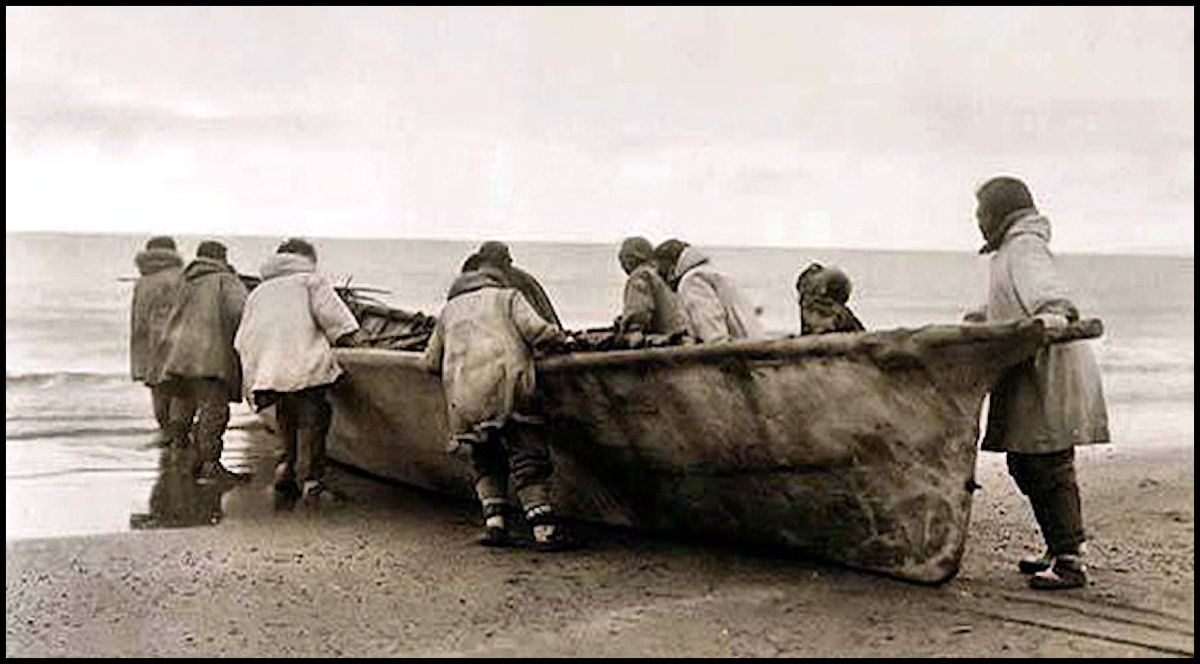
The Inuit are a non-AmerIndian people from Siberia. Chronologically, the Inuit are out of order in this series, but their well-documented migration from Siberia to Greenland refutes all arguments against the probability that at least some Pre-Columbian peoples arrived in North America by means other than walking across the Beringia Land Bridge.
In 1970, the nationally acclaimed archaeologist, Lewis Larson (of Etowah Mounds fame) was the only anthropology professor at Georgia Tech. As far as the peopling of the Americas goes, there was only one correct answer on his exams. The Clovis People crossed a land bridge across the Bering Strait about 10-12,000 years ago and then populated all of the Americas.
Larson stated that no Europeans or Polynesians visited the Americas before Columbus. I seemed to be the only student, who knew that Larson’s even more famous colleague, Arthur Kelly, had been forcibly retired from the University of Georgia in December 1969 for showing the Atlanta Journal-Constitution writer, John S. Pennington, numerous Mesoamerican style artifacts unearthed along the Chattahoochee River, As a precaution, Larson taught Tech students that no evidence had been found of Mesoamericans living in Georgia.
Thirty-five years later, my first DNA test stated that all of my American Indian DNA was Southern Mesoamerican, plus I had substantial Austronesian, Polynesian and Sami DNA. So, how did that happen?
by Richard L. Thornton, Architect & City Planner
Note: My greatly accelerated capacity to assemble fascinating information is due to my new HP AI computer, which literally talks to the AI in the internet search engines. To obtain sources for this intel, merely type the sentence in your search engine set on AI.
Keep in mind that . . .
The maximum distance required for water travel via island hopping, between Siberia and Alaska is 2.4 miles or 3.86 kilometers.
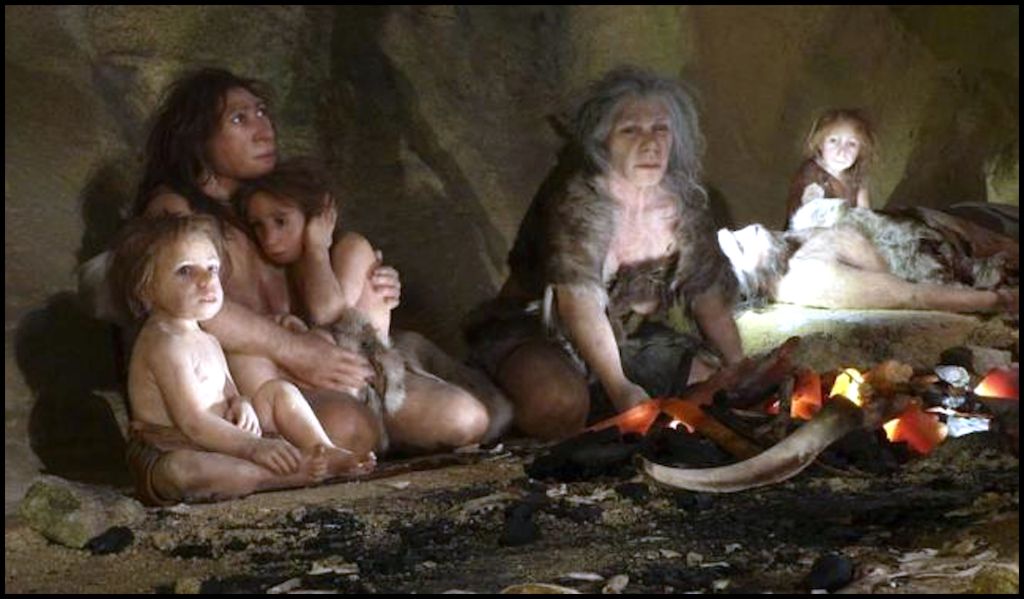
Home erectus was definitely able to traverse distances across water of 19 miles or 30.5 km, possibly as far as 50 miles.
The ancestors of Homo luzonensis, probably a diminutive variation of Homo Erectus, reached the Philippine island of Luzon by at least 709,000 years ago, requiring a minimum water crossing of 2.5 to 9 miles (4 to 15 kilometers) if they took an island-hopping route, or up to 31 miles (50 kilometers) of open ocean if traveling directly from the continental shelf.
Denisovans traversed the longest maritime distances among archaic humans, crossing deep-water sea straits spanning up to 60 miles (100 kilometers) to reach islands beyond the Wallace Line in Indonesian Islands. While both Neanderthals and Denisovans are traditionally thought of as land-dwellers, genetic and archaeological evidence confirms that both species successfully navigated open water to settle various islands.
During the initial peopling of Sahul (the combined Pleistocene landmass of Australia, New Guinea, and Tasmania) approximately 50,000 to 65,000 years ago, the longest single distance over water traversed by early homo sapien humans was between 80 and 100 kilometers (approximately 50 to 62 miles).
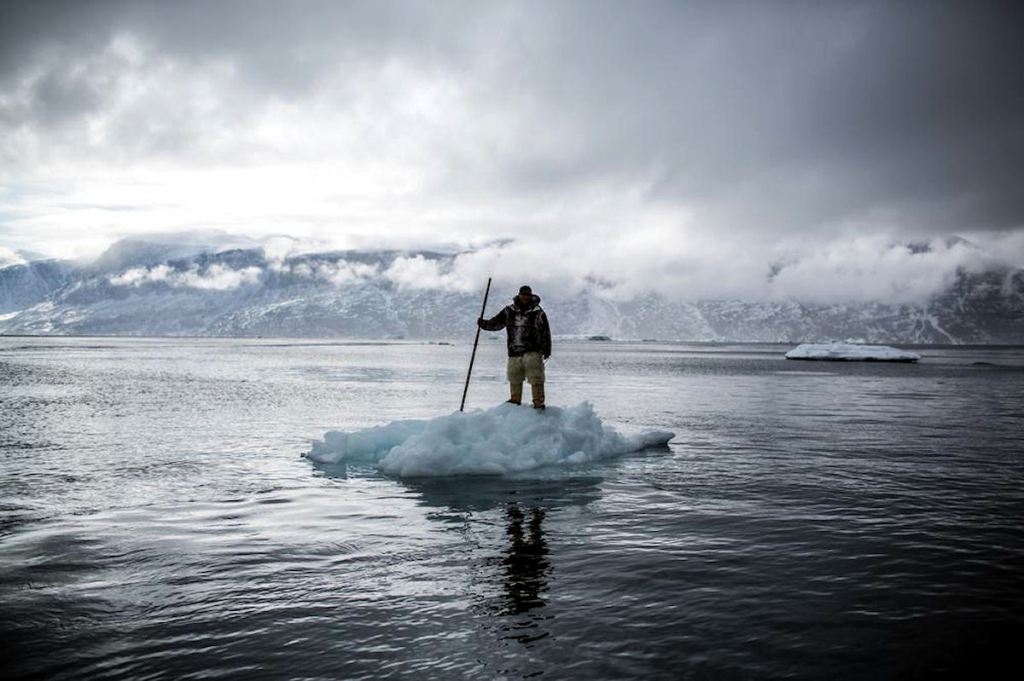
Inuit Migrations
The oldest known wooden dog sleds were discovered on Zhokhov Island in the Eastern Russian Arctic near North America and date back roughly 8,250 to 8,500 years.
Wave 1: The Paleo-Inuits (c. 3000 BCE): The earliest distinct Arctic migrants crossed from the Chukotka region of Siberia into western Alaska roughly 5,000 years ago. They brought specialized micro-stone tool technologies (the Arctic Small Tool tradition) and early hunting dogs.
Wave 2: The Return to Siberia (c. 200 BCE – 800 CE): Ancestors of the Inuit and Yup’ik later crossed back over the Bering Strait into Siberia, where they lived along the Asian coast for over a thousand years. During this “Old Bering Sea” period, they highly developed their open-ocean whaling techniques, iron-point harpoons, and large skin boats (umiaks and kayaks).
Wave 3: The Neo-Inuit / Thule Migration (c. 1000 CE): Around 1,000 years ago, these marine-hunting experts crossed the Bering Strait again, moving eastward back into Alaska. Armed with superior whale-hunting gear and fast dog sleds, this “Thule” culture rapidly expanded past Alaska, across Canada, and ultimately into Greenland, replacing earlier populations to become the direct ancestors of modern Inuit.
The ancestors of modern Inuit (the Thule people) migrated from Alaska to Greenland in roughly 100 to 150 years, traveling primarily along the coastal waters and on sea ice rather than walk through inland tundra regions, farther to the south. They obtained food for the journey by fishing and hunting members of the seal family.
There was nothing that prevented peoples from NW Siberia, northern Eurasia and northern Scandinavia from reaching North America by the same means. Indeed, the Windover Pond People of Florida had the same DNA markers and burial customs as the Proto-Sami of northern Scandinavia and Karelia. //We will talk about them in more detail in a later article.


Richard, I tried to write a “comment” but since I don’t have any social accounts, I’ll try to rewrite it.
Consider the putative ancient dates for Monte Verde, Meadowcroft, Topper, etc and it leads me to think of much earlier arrivals for early peoples. Currently orthodoxy has moved to first peoples coming from Siberia during the worst possible time, i.e. the LGM 20,000 years ago. However, 40,000 years ago the polar region was much like today — ice free in summer, no glaciers, and much coastal exposure. It would have been “easy” for people to migrate via both the Bering Strait and via island-hopping from Europe. This is consistent with the above sites’ early dates, with genetics and with languages. It is also the topic of my presentation to AAPS this October. AND I look forward to hearing your presentation! Glad you are making a second effort to participate.
Karl & Katherine Hoenke
3049 Golden Rain Road #8 Walnut Creek, CA 94595
8262 North Heights Rd Kelseyville, CA 95451
Karl 925-202-3147 Katherine 925-548-7755 ________________________________
LikeLiked by 1 person