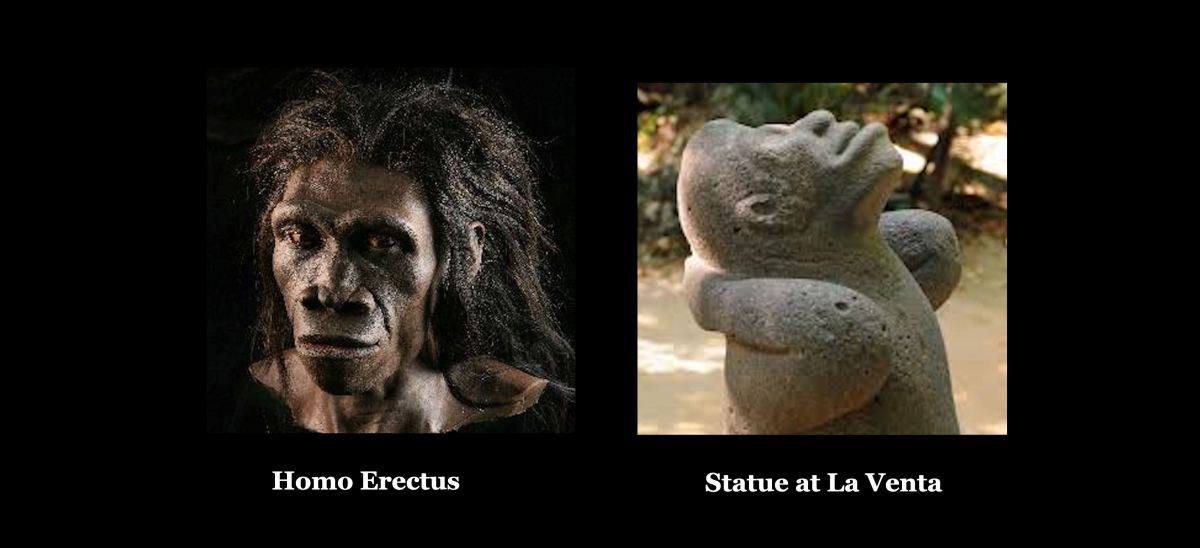
There is controversial evidence that hominids were in the Americas long before the last Ice Age and continued to live in some regions until around 2,500 years ago.
In late August 1970, I was stunned to come upon the statue of a Home Erectus in the coastal jungles near the ruins of the great city of La Venta in Tabasco State, Mexico. * That experience has been a riddle that has puzzled me in the decades since then.
*Since I was an official guest of the Dep. Relaciones Culturales, Dr. Román Piña Chan was able to issue me an official INAH photo ID, which made it legal for me to explore sections of INAH archaeological zones, not open to the general public.
Homo erectus was an extinct species of archaic human from the Pleistocene Epoch, spanning nearly 2 million years. It was the first human species to evolve a humanlike body and gait, to leave Africa and colonize Asia and Europe, plus to wield stone weapons and to cook food with fire.
Homo erectus is believed to have gone extinct in Southeast Asia around 117,000–108,000 years ago, based on the most recent fossil evidence from Ngandong, Java. That makes them the last known Homo Erectus population, but there may be younger fossils elsewhere.
At the bottom of this article is an outstanding new video, which explains many fascinating discoveries about Homo Erectus, which are generally unknown to the public. The biggest surprise for me was that the Homo Erectus bands, who left Africa to settle in Europe, Middle East and Asia were constantly evolving thereafter. Their brain size and physique changed over time from being ape-like to being on the threshold of modern humans.
by Richard L. Thornton, Architect & City Planner
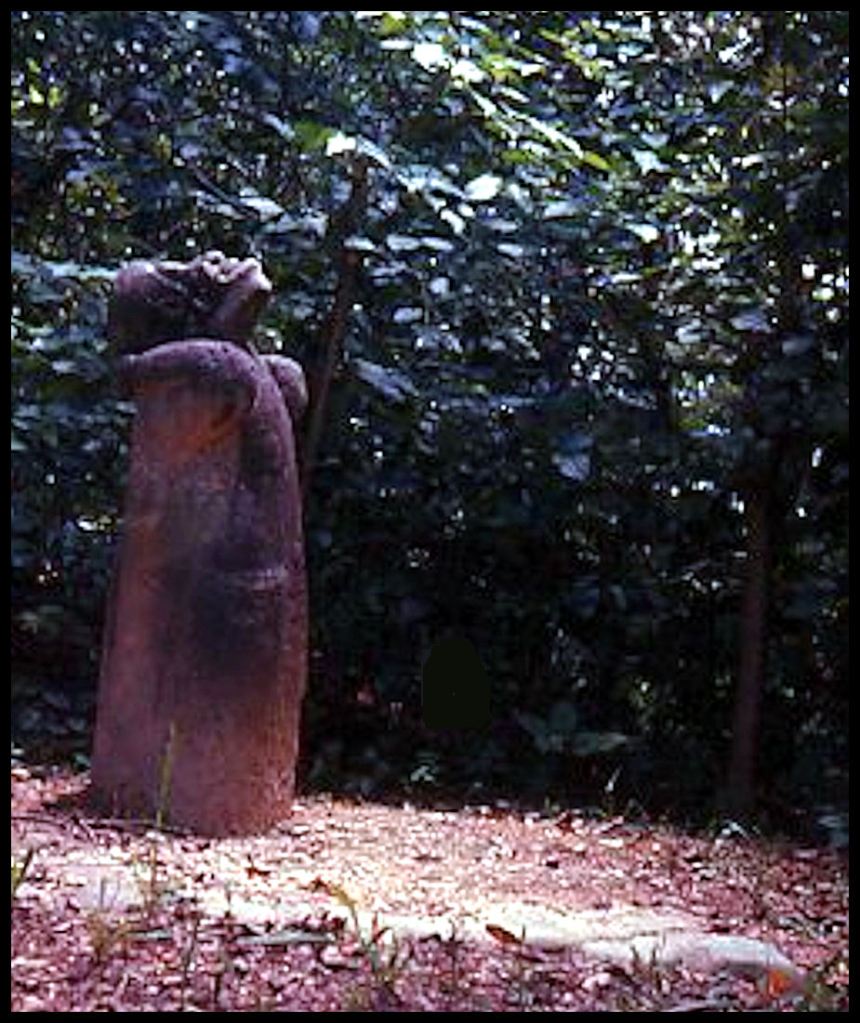
When I first came upon this statue in the jungle, I thought it portrayed a chimpanzee. Closer examination revealed that it was primitive hominid, with his hands tied behind his neck. Since i was on the fellowship in Mexico, this statue has been moved to the safety of a museum in Villahermosa, Tabasco.
Ancient butchered bones
Butchered bones are key because cut marks, cleave marks, percussion blows, and tool wear patterns indicate human processing of animal remains. . Such evidence directly supports human presence and behavior, unlike isolated animal remains that could be natural or carnivore-caused. These discoveries suggest that humans may have entered the Americas tens of thousands of years earlier than previously thought, possibly via multiple routes, and that early populations engaged in hunting, processing, and possibly tool-making.
1. Bluefish Caves, Yukon, Canada – c. 24,000 years ago
Archaeologists uncovered mammoth, horse, bison, caribou, and other animal bones with distinctive cut marks made by stone tools. Fifteen samples showed confident human modification, and others had probable cultural marks. These finds, dating to 24,000 years ago, predate Clovis by at least 10,000 years, suggesting earlier human occupation in North America
2. Cerutti Mastodon Site, San Diego County, California – c. 130,700 years ago
Excavations revealed broken mastodon bones alongside cobbles with use-wear and impact marks, interpreted as hammer-stones and anvils. If the bones were intentionally broken by hominids, this would be the oldest known evidence of human activity in the Americas, far earlier than any other site.
3. Rio Puerco Canyon, New Mexico – c. 37,000 years ago
A team from the University of Texas documented a refuse pile of mammoth mother and calf bones, some with blunt force trauma, plus possible bone knives, fire evidence, and stone cobbles. This is the oldest widely accepted butchery evidence in the Americas, challenging the 16,000+ year Pre-Clovis faction timeline.
4. Pre-Clovis and Clovis artifacts on ocean floor near Sapelo Island, Georgia
During the first half of the 1990s, two underwater archaeologists, employed by the Georgia Department of Natural Resources facility on Sapelo Island, GA discovered a series of camp sites and tool-making sites on the ocean floor The sophistication of the tools varied starkly between campsites. Some were Pre-Clovis, Clovis or Early Post-Clovis. Others seem to belong to much earlier times and were similar to the Homo Erectus, Neanderthal or Early Cro-Magnon tools of Western Europe.
In 1995, I attended a meeting of the Northwest Georgia Archaeological Society at the Etowah Mounds Museum, where the two archaeologists presented their discoveries. The range of artifacts, at least to me, looked very similar to those from a 1.2 million year occupation of the Atapuerca Cave System the Sierra de Atapuerca, Burgos province, Northern Spain. It is the key cave complex, where Homo erectus–related artifacts and fossils have been discovered in continuum with artifacts of later hominids. I saw them in an exhibit in the Museo Nacional de Antropologia in Madrid, Spain.
Never heard of this amazing discovery? The Lords of Seth in Georgia Archaeology were outraged that Pre-Clovis First proponents had given a public presentation in a state-owned building. The two archaeologists were soon thereafter fired on the grounds that the Director of the Georgia Department of Natural Resources did not give them permission to speak in public. All of these priceless artifacts quickly disappeared. State officials and prominent Georgia archaeologists refused to even discuss the discoveries.
It makes one wonder how many other archaeological discoveries have been concealed in North America by people with political power and a hidden agenda.
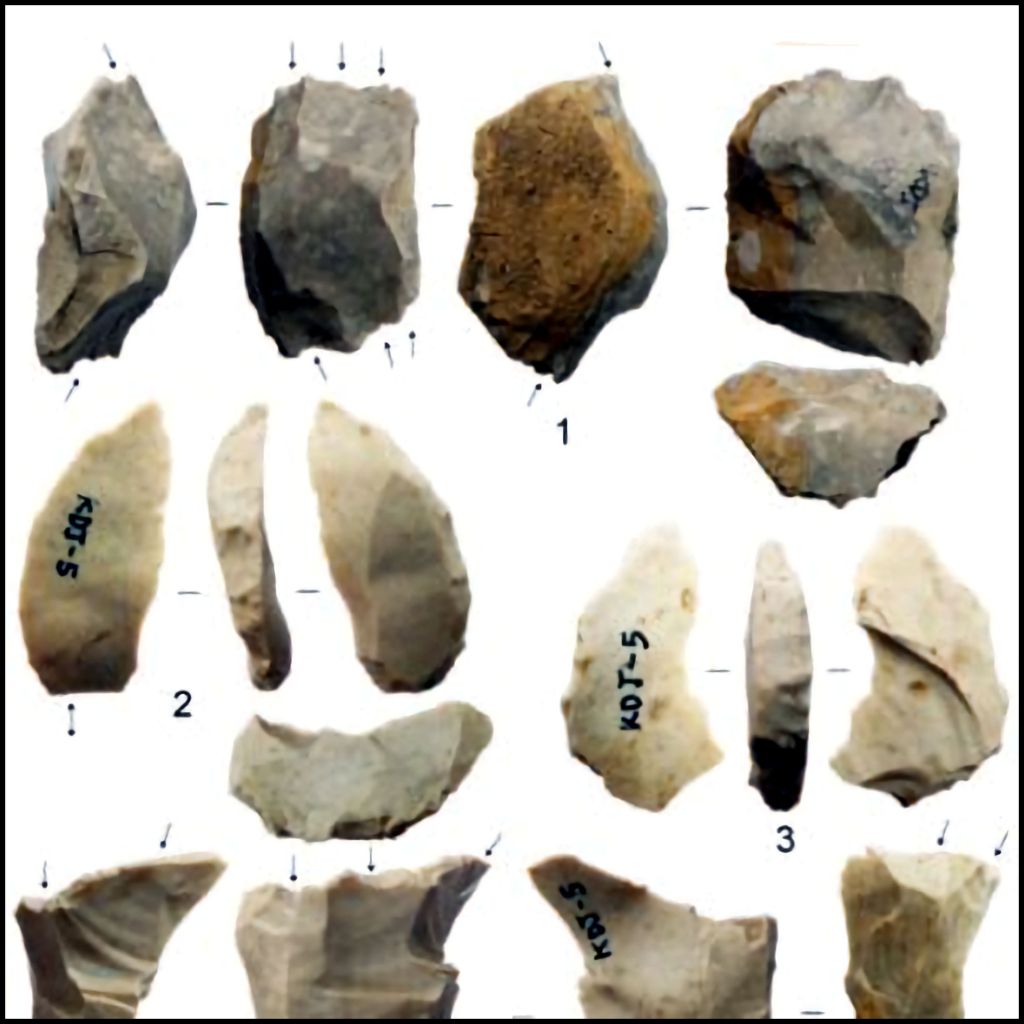
Typical tools made by early Homo Erectus. Stones like these were found at the -50,000 year level at the Topper, South Carolina sites on the Savannah River.
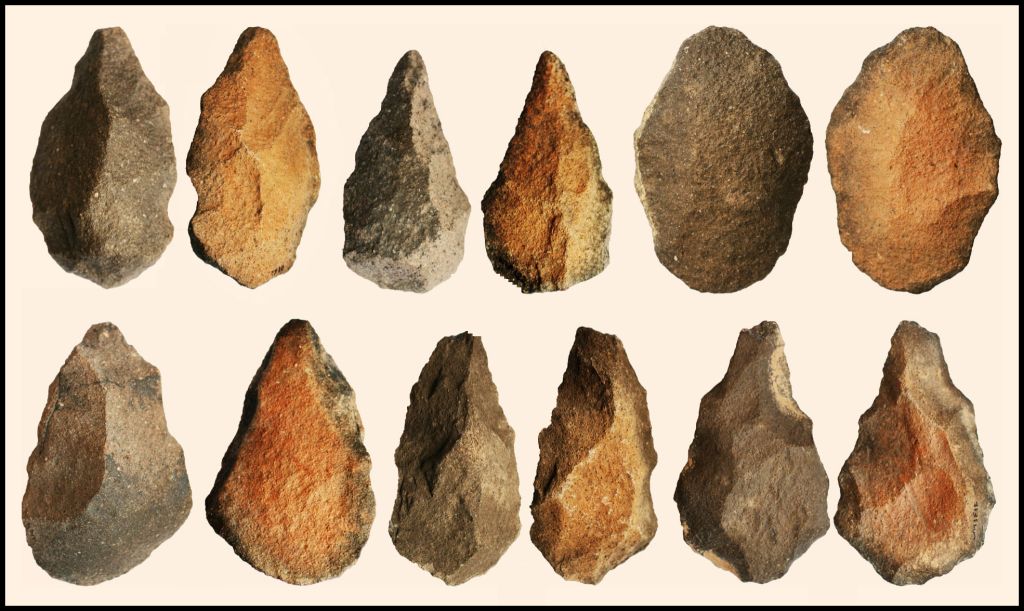
Typical tools made by Middle to alte Homo Erectus. Tools like these are difficult to date and assign cultural affinity.

